Search
00
GBAF Logo
trophy
Top StoriesInterviewsBusinessFinanceBankingTechnologyInvestingTradingVideosAwardsMagazinesHeadlinesTrends

Subscribe to our newsletter

Get the latest news and updates from our team.

Global Banking & Finance Review®

Global Banking & Finance Review® - Subscribe to our newsletter

Company

    GBAF Logo
    • About Us
    • Profile
    • Privacy & Cookie Policy
    • Terms of Use
    • Contact Us
    • Advertising
    • Submit Post
    • Latest News
    • Research Reports
    • Press Release
    • Awards▾
      • About the Awards
      • Awards TimeTable
      • Submit Nominations
      • Testimonials
      • Media Room
      • Award Winners
      • FAQ
    • Magazines▾
      • Global Banking & Finance Review Magazine Issue 79
      • Global Banking & Finance Review Magazine Issue 78
      • Global Banking & Finance Review Magazine Issue 77
      • Global Banking & Finance Review Magazine Issue 76
      • Global Banking & Finance Review Magazine Issue 75
      • Global Banking & Finance Review Magazine Issue 73
      • Global Banking & Finance Review Magazine Issue 71
      • Global Banking & Finance Review Magazine Issue 70
      • Global Banking & Finance Review Magazine Issue 69
      • Global Banking & Finance Review Magazine Issue 66
    Top StoriesInterviewsBusinessFinanceBankingTechnologyInvestingTradingVideosAwardsMagazinesHeadlinesTrends

    Global Banking & Finance Review® is a leading financial portal and online magazine offering News, Analysis, Opinion, Reviews, Interviews & Videos from the world of Banking, Finance, Business, Trading, Technology, Investing, Brokerage, Foreign Exchange, Tax & Legal, Islamic Finance, Asset & Wealth Management.
    Copyright © 2010-2026 GBAF Publications Ltd - All Rights Reserved. | Sitemap | Tags | Developed By eCorpIT

    Editorial & Advertiser disclosure

    Global Banking & Finance Review® is an online platform offering news, analysis, and opinion on the latest trends, developments, and innovations in the banking and finance industry worldwide. The platform covers a diverse range of topics, including banking, insurance, investment, wealth management, fintech, and regulatory issues. The website publishes news, press releases, opinion and advertorials on various financial organizations, products and services which are commissioned from various Companies, Organizations, PR agencies, Bloggers etc. These commissioned articles are commercial in nature. This is not to be considered as financial advice and should be considered only for information purposes. It does not reflect the views or opinion of our website and is not to be considered an endorsement or a recommendation. We cannot guarantee the accuracy or applicability of any information provided with respect to your individual or personal circumstances. Please seek Professional advice from a qualified professional before making any financial decisions. We link to various third-party websites, affiliate sales networks, and to our advertising partners websites. When you view or click on certain links available on our articles, our partners may compensate us for displaying the content to you or make a purchase or fill a form. This will not incur any additional charges to you. To make things simpler for you to identity or distinguish advertised or sponsored articles or links, you may consider all articles or links hosted on our site as a commercial article placement. We will not be responsible for any loss you may suffer as a result of any omission or inaccuracy on the website.

    Home > Business > China, France denounce U.S. nuclear sub pact with Britain, Australia
    Business

    China, France denounce U.S. nuclear sub pact with Britain, Australia

    Published by maria gbaf

    Posted on September 17, 2021

    9 min read

    Last updated: January 20, 2026

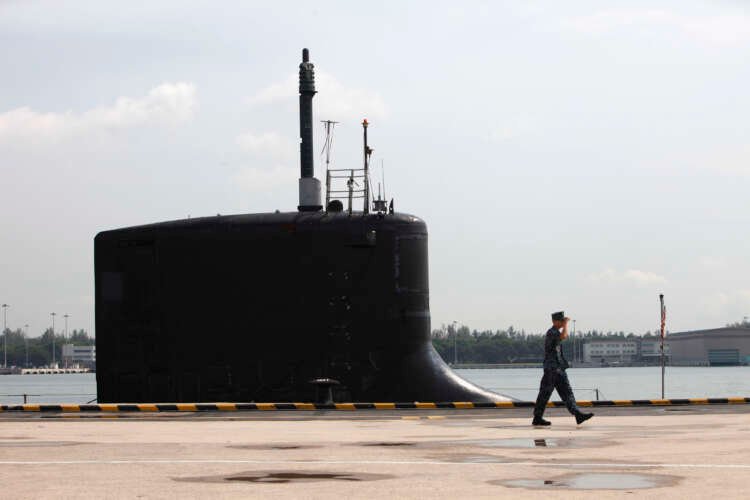
    This image depicts the geopolitical tensions arising from the AUKUS agreement, highlighting China's and France's concerns over U.S. and UK nuclear submarine technology transfers to Australia, amidst a backdrop of rising military competition in the Indo-Pacific region.
    Nuclear submarines and military alliance discussion related to AUKUS - Global Banking & Finance Review
    Why waste money on news and opinion when you can access them for free?

    Take advantage of our newsletter subscription and stay informed on the go!

    Subscribe

    By Trevor Hunnicutt, Nandita Bose, David Brunnstrom and Colin Packham

    WASHINGTON/CANBERRA (Reuters) -China on Thursday denounced a new Indo-Pacific security alliance between the United States, Britain and Australia, saying such partnerships should not target third countries and warning of an intensified arms race in the region.

    Under the arrangement, dubbed AUKUS, the United States and Britain will provide Australia with the technology and capability to deploy nuclear-powered submarines.

    France, which loses its own submarine deal with Australia, called the plans brutal and unpredictable.

    The United States and its allies are looking for ways to push back against China’s growing power and influence, particularly its military buildup, pressure on Taiwan and deployments in the contested South China Sea.

    U.S. President Joe Biden, British Prime Minister Boris Johnson and Australian Prime Minister Scott Morrison did not mention China by name in the joint announcement and senior Biden administration officials, who briefed reporters ahead of time, said the partnership was not aimed at countering Beijing.

    But Chinese Foreign Ministry spokesman Zhao Lijian said the three countries were “severely damaging regional peace and stability, intensifying an arms race, and damaging international nuclear non-proliferation efforts”.

    “China always believes that any regional mechanism should conform to the trend of peace and development of the times and help enhance mutual trust and cooperation… It should not target any third party or undermine its interests,” he told a regular briefing in Beijing.

    Johnson said the pact was not meant to be adversarial and said it would reduce the costs of Britain’s next generation of nuclear submarines.

    “Now that we have created AUKUS we expect to accelerate the development of other advanced defence systems including in cyber, artificial intelligence, quantum computing and undersea capabilities,” Johnson told parliament.

    The partnership ends Australia’s 2016 deal with French shipbuilder Naval Group to build it a new submarine fleet worth $40 billion to replace its more than two-decades-old Collins submarines, a spokesperson for Morrison told Reuters.

    France accused Biden of stabbing it in the back and acting like his predecessor Donald Trump https://www.reuters.com/world/us-move-dislodge-france-australia-submarine-deal-is-incoherent-french-ministers-2021-09-15.

    “This brutal, unilateral and unpredictable decision reminds me a lot of what Mr Trump used to do,” Le Drian told franceinfo radio. “I am angry and bitter. This isn’t done between allies.”

    The three leaders stressed Australia would not be fielding nuclear weapons but using nuclear propulsion systems for the vessels to guard against threats.

    “We all recognise the imperative of ensuring peace and stability in the Indo-Pacific over the long term,” Biden said.

    “We need to be able to address both the current strategic environment in the region, and how it may evolve because the future of each of our nations and indeed the world depends on a free and open Indo-Pacific enduring and flourishing in the decades ahead,” he said.

    Morrison said Australia would meet all its nuclear non-proliferation obligations.

    ‘STRONG ROLE’

    One U.S. official said the partnership was the result of months of engagements by military and political leaders during which Britain – which recently sent an aircraft carrier to Asia – had indicated it wanted to do more in the region.

    New Zealand Prime Minister Jacinda Ardern welcomed the focus on the Indo-Pacific but said Australia’s nuclear-powered submarines would not be allowed in its territorial waters.

    Singapore said it had long had relations with Australia, Britain and the United States and hoped their grouping would contribute to peace and stability.

    Japan said the three countries’ strengthening of security and defence cooperation was important for peace and security.

    A U.S. official briefing before the announcement said Biden had not mentioned the plans “in any specific terms” to Chinese leader Xi Jinping in a call last Thursday, but did “underscore our determination to play a strong role in the Indo-Pacific”.

    U.S. officials said nuclear propulsion would allow the Australian navy to operate more quietly, for longer periods, and provide deterrence across the Indo-Pacific.

    EU foreign policy chief Josep Borrell said the new partnership, on which the EU was not consulted, showed the need for a more assertive European foreign policy.

    “We must survive on our own, as others do,” Borrell said as he presented a new EU strategy for the Indo-Pacific region. “I understand the extent to which the French government must be disappointed.”

    Biden said the three governments would launch an 18-month consultation period “to determine every element of this programme, from workforce, to training requirements, to production timelines” and to ensure full compliance with non-proliferation commitments.

    Among the U.S. firms that could benefit are General Dynamics Corp and Huntington Ingalls Industries Inc.

    General Dynamics’ Electric Boat business does much of the design work for U.S. submarines, but critical subsystems such as electronics and nuclear power plants are made by BWX Technologies Inc

    U.S. officials did not give a time frame for when Australia would deploy a nuclear-powered submarine, or how many would be built.

    A U.S. official said Washington had shared nuclear propulsion technology only once before – with Britain in 1958.

    “This is frankly an exception to our policy in many respects… We view this as a one-off.”

    (Reporting by Steve Holland, Nandita Bose, David Brunnstrom, Mike Stone, Trevor Hunnicutt in Washington and Colin Packham in Canberra; Additional reporting by John Irish and Matthieu Protard in Paris and Gabriel Crossley and Judy Hua in Beijing; Editing by Alistair Bell, Richard Pullin, Jon Boyle and Nick Macfie)

    By Trevor Hunnicutt, Nandita Bose, David Brunnstrom and Colin Packham

    WASHINGTON/CANBERRA (Reuters) -China on Thursday denounced a new Indo-Pacific security alliance between the United States, Britain and Australia, saying such partnerships should not target third countries and warning of an intensified arms race in the region.

    Under the arrangement, dubbed AUKUS, the United States and Britain will provide Australia with the technology and capability to deploy nuclear-powered submarines.

    France, which loses its own submarine deal with Australia, called the plans brutal and unpredictable.

    The United States and its allies are looking for ways to push back against China’s growing power and influence, particularly its military buildup, pressure on Taiwan and deployments in the contested South China Sea.

    U.S. President Joe Biden, British Prime Minister Boris Johnson and Australian Prime Minister Scott Morrison did not mention China by name in the joint announcement and senior Biden administration officials, who briefed reporters ahead of time, said the partnership was not aimed at countering Beijing.

    But Chinese Foreign Ministry spokesman Zhao Lijian said the three countries were “severely damaging regional peace and stability, intensifying an arms race, and damaging international nuclear non-proliferation efforts”.

    “China always believes that any regional mechanism should conform to the trend of peace and development of the times and help enhance mutual trust and cooperation… It should not target any third party or undermine its interests,” he told a regular briefing in Beijing.

    Johnson said the pact was not meant to be adversarial and said it would reduce the costs of Britain’s next generation of nuclear submarines.

    “Now that we have created AUKUS we expect to accelerate the development of other advanced defence systems including in cyber, artificial intelligence, quantum computing and undersea capabilities,” Johnson told parliament.

    The partnership ends Australia’s 2016 deal with French shipbuilder Naval Group to build it a new submarine fleet worth $40 billion to replace its more than two-decades-old Collins submarines, a spokesperson for Morrison told Reuters.

    France accused Biden of stabbing it in the back and acting like his predecessor Donald Trump https://www.reuters.com/world/us-move-dislodge-france-australia-submarine-deal-is-incoherent-french-ministers-2021-09-15.

    “This brutal, unilateral and unpredictable decision reminds me a lot of what Mr Trump used to do,” Le Drian told franceinfo radio. “I am angry and bitter. This isn’t done between allies.”

    The three leaders stressed Australia would not be fielding nuclear weapons but using nuclear propulsion systems for the vessels to guard against threats.

    “We all recognise the imperative of ensuring peace and stability in the Indo-Pacific over the long term,” Biden said.

    “We need to be able to address both the current strategic environment in the region, and how it may evolve because the future of each of our nations and indeed the world depends on a free and open Indo-Pacific enduring and flourishing in the decades ahead,” he said.

    Morrison said Australia would meet all its nuclear non-proliferation obligations.

    ‘STRONG ROLE’

    One U.S. official said the partnership was the result of months of engagements by military and political leaders during which Britain – which recently sent an aircraft carrier to Asia – had indicated it wanted to do more in the region.

    New Zealand Prime Minister Jacinda Ardern welcomed the focus on the Indo-Pacific but said Australia’s nuclear-powered submarines would not be allowed in its territorial waters.

    Singapore said it had long had relations with Australia, Britain and the United States and hoped their grouping would contribute to peace and stability.

    Japan said the three countries’ strengthening of security and defence cooperation was important for peace and security.

    A U.S. official briefing before the announcement said Biden had not mentioned the plans “in any specific terms” to Chinese leader Xi Jinping in a call last Thursday, but did “underscore our determination to play a strong role in the Indo-Pacific”.

    U.S. officials said nuclear propulsion would allow the Australian navy to operate more quietly, for longer periods, and provide deterrence across the Indo-Pacific.

    EU foreign policy chief Josep Borrell said the new partnership, on which the EU was not consulted, showed the need for a more assertive European foreign policy.

    “We must survive on our own, as others do,” Borrell said as he presented a new EU strategy for the Indo-Pacific region. “I understand the extent to which the French government must be disappointed.”

    Biden said the three governments would launch an 18-month consultation period “to determine every element of this programme, from workforce, to training requirements, to production timelines” and to ensure full compliance with non-proliferation commitments.

    Among the U.S. firms that could benefit are General Dynamics Corp and Huntington Ingalls Industries Inc.

    General Dynamics’ Electric Boat business does much of the design work for U.S. submarines, but critical subsystems such as electronics and nuclear power plants are made by BWX Technologies Inc

    U.S. officials did not give a time frame for when Australia would deploy a nuclear-powered submarine, or how many would be built.

    A U.S. official said Washington had shared nuclear propulsion technology only once before – with Britain in 1958.

    “This is frankly an exception to our policy in many respects… We view this as a one-off.”

    (Reporting by Steve Holland, Nandita Bose, David Brunnstrom, Mike Stone, Trevor Hunnicutt in Washington and Colin Packham in Canberra; Additional reporting by John Irish and Matthieu Protard in Paris and Gabriel Crossley and Judy Hua in Beijing; Editing by Alistair Bell, Richard Pullin, Jon Boyle and Nick Macfie)

    More from Business

    Explore more articles in the Business category

    Image for How Commercial Lending Software Platforms Are Structured and Utilized
    How Commercial Lending Software Platforms Are Structured and Utilized
    Image for Oil Traders vs. Tech Startups: Surprising Lessons from Two High-Stakes Worlds | Said Addi
    Oil Traders vs. Tech Startups: Surprising Lessons from Two High-Stakes Worlds | Said Addi
    Image for Why More Mortgage Brokers Are Choosing to Join a Network
    Why More Mortgage Brokers Are Choosing to Join a Network
    Image for From Recession Survivor to Industry Pioneer: Ed Lewis's Data Revolution
    From Recession Survivor to Industry Pioneer: Ed Lewis's Data Revolution
    Image for From Optometry to Soul Vision: The Doctor Helping Entrepreneurs Lead With Purpose
    From Optometry to Soul Vision: The Doctor Helping Entrepreneurs Lead With Purpose
    Image for Global Rankings Revealed: Top PMO Certifications Worldwide
    Global Rankings Revealed: Top PMO Certifications Worldwide
    Image for World Premiere of Midnight in the War Room to be Hosted at Black Hat Vegas
    World Premiere of Midnight in the War Room to be Hosted at Black Hat Vegas
    Image for Role of Personal Accident Cover in 2-Wheeler Insurance for Owners and Riders
    Role of Personal Accident Cover in 2-Wheeler Insurance for Owners and Riders
    Image for The Young Rich Lister Who Also Teaches: How Aaron Sansoni Built a Brand Around Execution
    The Young Rich Lister Who Also Teaches: How Aaron Sansoni Built a Brand Around Execution
    Image for Q3 2025 Priority Leadership: Tom Priore and Tim O'Leary Balance Near-Term Challenges with Long-Term Strategic Wins
    Q3 2025 Priority Leadership: Tom Priore and Tim O'Leary Balance Near-Term Challenges with Long-Term Strategic Wins
    Image for Using Modern Team Management Methods to Improve Collaboration in Hybrid Work Models
    Using Modern Team Management Methods to Improve Collaboration in Hybrid Work Models
    Image for Why Email Deliverability is a Business Risk Your Company Can’t Afford to Ignore
    Why Email Deliverability is a Business Risk Your Company Can’t Afford to Ignore
    View All Business Posts
    Previous Business PostFirst all-civilian crew launched to orbit aboard SpaceX rocket ship
    Next Business PostAs China Evergrande’s debt crisis deepens, unpaid small business owners speak of despair