Search
00
GBAF Logo
trophy
Top StoriesInterviewsBusinessFinanceBankingTechnologyInvestingTradingVideosAwardsMagazinesHeadlinesTrends

Subscribe to our newsletter

Get the latest news and updates from our team.

Global Banking & Finance Review®

Global Banking & Finance Review® - Subscribe to our newsletter

Company

    GBAF Logo
    • About Us
    • Profile
    • Privacy & Cookie Policy
    • Terms of Use
    • Contact Us
    • Advertising
    • Submit Post
    • Latest News
    • Research Reports
    • Press Release
    • Awards▾
      • About the Awards
      • Awards TimeTable
      • Submit Nominations
      • Testimonials
      • Media Room
      • Award Winners
      • FAQ
    • Magazines▾
      • Global Banking & Finance Review Magazine Issue 79
      • Global Banking & Finance Review Magazine Issue 78
      • Global Banking & Finance Review Magazine Issue 77
      • Global Banking & Finance Review Magazine Issue 76
      • Global Banking & Finance Review Magazine Issue 75
      • Global Banking & Finance Review Magazine Issue 73
      • Global Banking & Finance Review Magazine Issue 71
      • Global Banking & Finance Review Magazine Issue 70
      • Global Banking & Finance Review Magazine Issue 69
      • Global Banking & Finance Review Magazine Issue 66
    Top StoriesInterviewsBusinessFinanceBankingTechnologyInvestingTradingVideosAwardsMagazinesHeadlinesTrends

    Global Banking & Finance Review® is a leading financial portal and online magazine offering News, Analysis, Opinion, Reviews, Interviews & Videos from the world of Banking, Finance, Business, Trading, Technology, Investing, Brokerage, Foreign Exchange, Tax & Legal, Islamic Finance, Asset & Wealth Management.
    Copyright © 2010-2026 GBAF Publications Ltd - All Rights Reserved. | Sitemap | Tags | Developed By eCorpIT

    Editorial & Advertiser disclosure

    Global Banking & Finance Review® is an online platform offering news, analysis, and opinion on the latest trends, developments, and innovations in the banking and finance industry worldwide. The platform covers a diverse range of topics, including banking, insurance, investment, wealth management, fintech, and regulatory issues. The website publishes news, press releases, opinion and advertorials on various financial organizations, products and services which are commissioned from various Companies, Organizations, PR agencies, Bloggers etc. These commissioned articles are commercial in nature. This is not to be considered as financial advice and should be considered only for information purposes. It does not reflect the views or opinion of our website and is not to be considered an endorsement or a recommendation. We cannot guarantee the accuracy or applicability of any information provided with respect to your individual or personal circumstances. Please seek Professional advice from a qualified professional before making any financial decisions. We link to various third-party websites, affiliate sales networks, and to our advertising partners websites. When you view or click on certain links available on our articles, our partners may compensate us for displaying the content to you or make a purchase or fill a form. This will not incur any additional charges to you. To make things simpler for you to identity or distinguish advertised or sponsored articles or links, you may consider all articles or links hosted on our site as a commercial article placement. We will not be responsible for any loss you may suffer as a result of any omission or inaccuracy on the website.

    Home > Business > China economy under pressure as factory output, retail sales growth slow sharply
    Business

    China economy under pressure as factory output, retail sales growth slow sharply

    Published by maria gbaf

    Posted on August 18, 2021

    7 min read

    Last updated: January 21, 2026

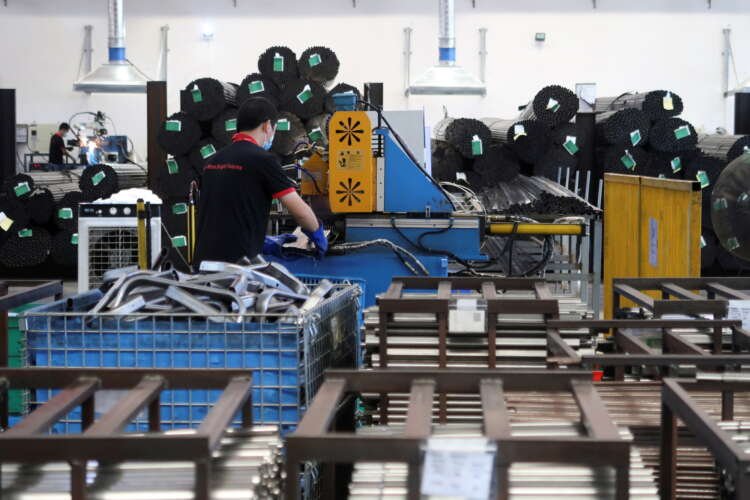
    This image illustrates the decline in China's factory output and retail sales growth in July 2021, highlighting the impact of COVID-19 and economic pressures. It is relevant to the article discussing China's slowing economic momentum.
    Graph depicting China's factory output and retail sales growth decline amid COVID-19 - Global Banking & Finance Review
    Why waste money on news and opinion when you can access them for free?

    Take advantage of our newsletter subscription and stay informed on the go!

    Subscribe

    By Kevin Yao and Gabriel Crossley

    BEIJING (Reuters) – China’s factory output and retail sales growth slowed sharply and missed expectations in July, as new COVID-19 outbreaks and floods disrupted business operations, adding to signs the economic recovery is losing momentum.

    Industrial production in the world’s second largest economy increased 6.4% year-on-year in July, data from the National Bureau of Statistics (NBS) showed on Monday. Analysts had expected output to rise 7.8% after growing 8.3% in June.

    Retail sales increased 8.5% in July from a year ago, far lower than the forecast 11.5% rise and June’s 12.1% uptick.

    China’s economy has rebounded to its pre-pandemic growth levels, but the expansion is losing steam as businesses grapple with higher costs and supply bottlenecks. New COVID-19 infections in July also led to fresh restrictions, disrupting the country’s factory output already hit by severe weather this summer.

    Asian share markets slipped on Monday after the data showed a surprisingly sharp slowdown in the engine of global growth.

    Data earlier this month also showed export growth, which has been a key driver of China’s impressive rebound from the COVID-19 slump in early 2020, unexpectedly slowed in July.

    Consumption, industrial production and investment could all slow further in August, analysts from Nomura said in a note, due to COVID-19 controls and tightening measures in the property sector and high-polluting industries.

    Production controls sent crude steel output to the lowest monthly level since April 2020 in July.

    Meanwhile China tightened social restrictions to fight its latest COVID-19 outbreak in several cities, hitting the services sector, especially travel and hospitality in the country.

    “Given China’s ‘zero tolerance’ approach to Covid, future outbreaks will continue to pose significant risk to the outlook, even though around 60% of the population is now vaccinated,” said Louis Kuijs, head of Asia economics at Oxford Economics, in a note.

    The country has also faced severe weather in several provinces, with record rainfall in Henan province last month causing floods that killed more than 300 people.

    Higher commodity prices are also pressuring small and medium-sized firms in particular. Smaller companies are unable to pass on recent rises in raw material costs to buyers, said a sales manager at a medical equipment factory in the eastern province of Jiangsu.

    “We don’t dare to increase our prices…but our prices cannot fall, otherwise there will be no profit at all,” he said.

    China’s producer price inflation, which grew 9.0% from a year earlier in July, will likely remain high for some time, the NBS said on Monday.

    GROWTH OUTLOOK

    A growing number of analysts have been cutting their third quarter growth estimates for China. The country’s gross domestic product (GDP) expanded 7.9% in the April-June quarter from a year earlier.

    ANZ downgraded its GDP forecast for 2021 to 8.3% from 8.8% after the disappointing July data.

    “Although they are unlikely to inject massive stimulus to boost headline growth, the central bank will maintain an easing bias,” said ANZ analysts in a note.

    After the central bank reduced the amount of cash banks must hold as reserves in July, many analysts expect another cut later this year to support growth.

    China’s central bank injected billions of yuan through medium-term loans into the financial system on Monday, which many market participants interpreted as an effort to prop up the economy, although the cost of such borrowing was left unchanged.

    Policy insiders told Reuters earlier in August that China is poised to quicken spending on infrastructure projects while the central bank supports the economy with modest easing steps.

    Fixed asset investment grew 10.3% in January-July from the same period a year ago, compared with an 11.3% rise tipped by a Reuters poll and a 12.6% increase in January-June.

    Property investment, a crucial growth driver of China’s recovery from COVID-19 disruptions, grew 12.7% in January-July, versus a 15% rise in the first half of this year.

    China’s new home prices rose at the slowest clip in six months in July, as authorities further tightened rules in the red-hot property sector.

    (Reporting by Kevin Yao, Gabriel Crossley, Liangping Gao and Beijing newsroom; Editing by Ana Nicolaci da Costa)

    By Kevin Yao and Gabriel Crossley

    BEIJING (Reuters) – China’s factory output and retail sales growth slowed sharply and missed expectations in July, as new COVID-19 outbreaks and floods disrupted business operations, adding to signs the economic recovery is losing momentum.

    Industrial production in the world’s second largest economy increased 6.4% year-on-year in July, data from the National Bureau of Statistics (NBS) showed on Monday. Analysts had expected output to rise 7.8% after growing 8.3% in June.

    Retail sales increased 8.5% in July from a year ago, far lower than the forecast 11.5% rise and June’s 12.1% uptick.

    China’s economy has rebounded to its pre-pandemic growth levels, but the expansion is losing steam as businesses grapple with higher costs and supply bottlenecks. New COVID-19 infections in July also led to fresh restrictions, disrupting the country’s factory output already hit by severe weather this summer.

    Asian share markets slipped on Monday after the data showed a surprisingly sharp slowdown in the engine of global growth.

    Data earlier this month also showed export growth, which has been a key driver of China’s impressive rebound from the COVID-19 slump in early 2020, unexpectedly slowed in July.

    Consumption, industrial production and investment could all slow further in August, analysts from Nomura said in a note, due to COVID-19 controls and tightening measures in the property sector and high-polluting industries.

    Production controls sent crude steel output to the lowest monthly level since April 2020 in July.

    Meanwhile China tightened social restrictions to fight its latest COVID-19 outbreak in several cities, hitting the services sector, especially travel and hospitality in the country.

    “Given China’s ‘zero tolerance’ approach to Covid, future outbreaks will continue to pose significant risk to the outlook, even though around 60% of the population is now vaccinated,” said Louis Kuijs, head of Asia economics at Oxford Economics, in a note.

    The country has also faced severe weather in several provinces, with record rainfall in Henan province last month causing floods that killed more than 300 people.

    Higher commodity prices are also pressuring small and medium-sized firms in particular. Smaller companies are unable to pass on recent rises in raw material costs to buyers, said a sales manager at a medical equipment factory in the eastern province of Jiangsu.

    “We don’t dare to increase our prices…but our prices cannot fall, otherwise there will be no profit at all,” he said.

    China’s producer price inflation, which grew 9.0% from a year earlier in July, will likely remain high for some time, the NBS said on Monday.

    GROWTH OUTLOOK

    A growing number of analysts have been cutting their third quarter growth estimates for China. The country’s gross domestic product (GDP) expanded 7.9% in the April-June quarter from a year earlier.

    ANZ downgraded its GDP forecast for 2021 to 8.3% from 8.8% after the disappointing July data.

    “Although they are unlikely to inject massive stimulus to boost headline growth, the central bank will maintain an easing bias,” said ANZ analysts in a note.

    After the central bank reduced the amount of cash banks must hold as reserves in July, many analysts expect another cut later this year to support growth.

    China’s central bank injected billions of yuan through medium-term loans into the financial system on Monday, which many market participants interpreted as an effort to prop up the economy, although the cost of such borrowing was left unchanged.

    Policy insiders told Reuters earlier in August that China is poised to quicken spending on infrastructure projects while the central bank supports the economy with modest easing steps.

    Fixed asset investment grew 10.3% in January-July from the same period a year ago, compared with an 11.3% rise tipped by a Reuters poll and a 12.6% increase in January-June.

    Property investment, a crucial growth driver of China’s recovery from COVID-19 disruptions, grew 12.7% in January-July, versus a 15% rise in the first half of this year.

    China’s new home prices rose at the slowest clip in six months in July, as authorities further tightened rules in the red-hot property sector.

    (Reporting by Kevin Yao, Gabriel Crossley, Liangping Gao and Beijing newsroom; Editing by Ana Nicolaci da Costa)

    More from Business

    Explore more articles in the Business category

    Image for Empire Lending helps SMEs secure capital faster, without bank delays
    Empire Lending helps SMEs secure capital faster, without bank delays
    Image for Why Leen Kawas is Prioritizing Strategic Leadership at Propel Bio Partners
    Why Leen Kawas is Prioritizing Strategic Leadership at Propel Bio Partners
    Image for How Commercial Lending Software Platforms Are Structured and Utilized
    How Commercial Lending Software Platforms Are Structured and Utilized
    Image for Oil Traders vs. Tech Startups: Surprising Lessons from Two High-Stakes Worlds | Said Addi
    Oil Traders vs. Tech Startups: Surprising Lessons from Two High-Stakes Worlds | Said Addi
    Image for Why More Mortgage Brokers Are Choosing to Join a Network
    Why More Mortgage Brokers Are Choosing to Join a Network
    Image for From Recession Survivor to Industry Pioneer: Ed Lewis's Data Revolution
    From Recession Survivor to Industry Pioneer: Ed Lewis's Data Revolution
    Image for From Optometry to Soul Vision: The Doctor Helping Entrepreneurs Lead With Purpose
    From Optometry to Soul Vision: The Doctor Helping Entrepreneurs Lead With Purpose
    Image for Global Rankings Revealed: Top PMO Certifications Worldwide
    Global Rankings Revealed: Top PMO Certifications Worldwide
    Image for World Premiere of Midnight in the War Room to be Hosted at Black Hat Vegas
    World Premiere of Midnight in the War Room to be Hosted at Black Hat Vegas
    Image for Role of Personal Accident Cover in 2-Wheeler Insurance for Owners and Riders
    Role of Personal Accident Cover in 2-Wheeler Insurance for Owners and Riders
    Image for The Young Rich Lister Who Also Teaches: How Aaron Sansoni Built a Brand Around Execution
    The Young Rich Lister Who Also Teaches: How Aaron Sansoni Built a Brand Around Execution
    Image for Q3 2025 Priority Leadership: Tom Priore and Tim O'Leary Balance Near-Term Challenges with Long-Term Strategic Wins
    Q3 2025 Priority Leadership: Tom Priore and Tim O'Leary Balance Near-Term Challenges with Long-Term Strategic Wins
    View All Business Posts
    Previous Business PostFirst Hong Kong election under revamped system to be largely uncontested
    Next Business PostEDF Energy to raise retail energy prices in UK by 12%