Search
00
GBAF Logo
trophy
Top StoriesInterviewsBusinessFinanceBankingTechnologyInvestingTradingVideosAwardsMagazinesHeadlinesTrends

Subscribe to our newsletter

Get the latest news and updates from our team.

Global Banking & Finance Review®

Global Banking & Finance Review® - Subscribe to our newsletter

Company

    GBAF Logo
    • About Us
    • Profile
    • Privacy & Cookie Policy
    • Terms of Use
    • Contact Us
    • Advertising
    • Submit Post
    • Latest News
    • Research Reports
    • Press Release
    • Awards▾
      • About the Awards
      • Awards TimeTable
      • Submit Nominations
      • Testimonials
      • Media Room
      • Award Winners
      • FAQ
    • Magazines▾
      • Global Banking & Finance Review Magazine Issue 79
      • Global Banking & Finance Review Magazine Issue 78
      • Global Banking & Finance Review Magazine Issue 77
      • Global Banking & Finance Review Magazine Issue 76
      • Global Banking & Finance Review Magazine Issue 75
      • Global Banking & Finance Review Magazine Issue 73
      • Global Banking & Finance Review Magazine Issue 71
      • Global Banking & Finance Review Magazine Issue 70
      • Global Banking & Finance Review Magazine Issue 69
      • Global Banking & Finance Review Magazine Issue 66
    Top StoriesInterviewsBusinessFinanceBankingTechnologyInvestingTradingVideosAwardsMagazinesHeadlinesTrends

    Global Banking & Finance Review® is a leading financial portal and online magazine offering News, Analysis, Opinion, Reviews, Interviews & Videos from the world of Banking, Finance, Business, Trading, Technology, Investing, Brokerage, Foreign Exchange, Tax & Legal, Islamic Finance, Asset & Wealth Management.
    Copyright © 2010-2026 GBAF Publications Ltd - All Rights Reserved. | Sitemap | Tags | Developed By eCorpIT

    Editorial & Advertiser disclosure

    Global Banking & Finance Review® is an online platform offering news, analysis, and opinion on the latest trends, developments, and innovations in the banking and finance industry worldwide. The platform covers a diverse range of topics, including banking, insurance, investment, wealth management, fintech, and regulatory issues. The website publishes news, press releases, opinion and advertorials on various financial organizations, products and services which are commissioned from various Companies, Organizations, PR agencies, Bloggers etc. These commissioned articles are commercial in nature. This is not to be considered as financial advice and should be considered only for information purposes. It does not reflect the views or opinion of our website and is not to be considered an endorsement or a recommendation. We cannot guarantee the accuracy or applicability of any information provided with respect to your individual or personal circumstances. Please seek Professional advice from a qualified professional before making any financial decisions. We link to various third-party websites, affiliate sales networks, and to our advertising partners websites. When you view or click on certain links available on our articles, our partners may compensate us for displaying the content to you or make a purchase or fill a form. This will not incur any additional charges to you. To make things simpler for you to identity or distinguish advertised or sponsored articles or links, you may consider all articles or links hosted on our site as a commercial article placement. We will not be responsible for any loss you may suffer as a result of any omission or inaccuracy on the website.

    Home > Business > As Taliban advances, China lays groundwork to accept an awkward reality
    Business

    As Taliban advances, China lays groundwork to accept an awkward reality

    Published by maria gbaf

    Posted on August 16, 2021

    7 min read

    Last updated: January 21, 2026

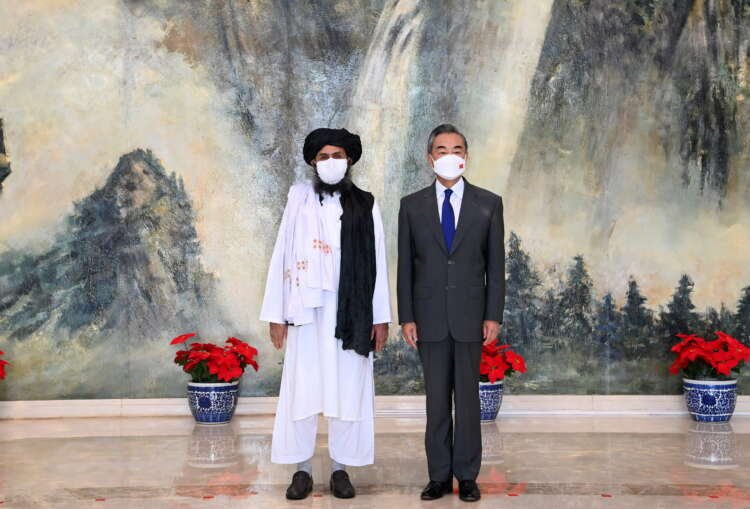
    Image of Chinese Foreign Minister Wang Yi with Taliban officials in Tianjin, highlighting China's strategic shift as the Taliban gains power in Afghanistan. This meeting reflects China's potential recognition of the Taliban amidst concerns over regional stability.
    Chinese Foreign Minister Wang Yi meets Taliban officials in Tianjin - Global Banking & Finance Review

    By Yew Lun Tian

    BEIJING (Reuters) -A series of photos published last month by Chinese state media of Foreign Minister Wang Yi standing shoulder to shoulder with visiting Taliban officials decked out in traditional tunic and turban raised eyebrows on the country’s social media.

    Since then, China’s propaganda machinery has quietly begun preparing its people to accept an increasingly likely scenario that Beijing might have to recognize the Taliban, the hard line Islamist movement that is rapidly gaining territory in Afghanistan, as a legitimate regime.

    “Even if they can’t control the whole country, they would still be a significant force to reckon with”, an influential social media commentator known to be familiar with China’s foreign policy thinking wrote on Thursday. The commentator, who goes by the pen name Niutanqin, or “Zither-Playing Cow”, made the remarks on his WeChat channel.

    On Friday, the Global Times, a major state-backed tabloid, published an interview with the leader of an Afghan opposition party who said “the transitional government must include the Taliban”.

    The Taliban’s momentum as U.S. forces withdraw is awkward for China, which has blamed religious extremism as a destabilizing force in its western Xinjiang region and has long worried that Taliban-controlled territory would be used to harbour separatist forces.

    But China also hews to a policy of non-interference in the internal affairs of other countries.

    It has also drastically tightened security in Xinjiang, hardening its borders and putting what UN experts and rights groups estimate were at least a million ethnic Uyghurs and other Muslims in detention centres that China describes as vocational training facilities to help stamp out Islamist extremism and separatism.

    Last month’s meeting in the northern Chinese city of Tianjin followed a similar visit by a Taliban delegation in 2019, but comes as the group is much more powerful, with Wang saying he hoped Afghanistan can have a “moderate Islamist policy”.

    “Isn’t this the same Taliban that blew up the Buddhas of Bamiyan in front of world media? Shouldn’t we have a bottom line?” a Chinese netizen commented on the Twitter-like Weibo below a news clip showing Wang standing next to a Taliban official.

    PRAGMATIC CHINA

    In dealing with the Taliban, an increasingly powerful China may be able to leverage the fact that, unlike Russia or the United States, it has never fought them.

    When the Taliban were last in power between 1996-2001, China had already suspended relations with Afghanistan, having pulled out its diplomats in 1993 following the outbreak of civil war.

    “This is us being pragmatic. How you want to rule your country is largely your own business, just don’t let that affect China,” said Lin Minwang, a South Asia expert with Shanghai’s Fudan University.

    “When a major Asian power like China shows it recognizes Taliban’s political legitimacy by meeting them so openly, it is giving the Taliban a big diplomatic win,” Lin said.

    State media published at least two analytical stories this week highlighting that Afghanistan had been the “graveyard of empires” and cautioning China not to be mired in the “Great Game”, reinforcing a message that China harbours neither the intentions of sending troops into Afghanistan nor the illusion that it can fill the power vacuum left by the United States.

    After their meeting with Wang, the Taliban said they hope China can play a bigger economic role.

    “This shows that China might have dangled promises of economic aid and investment to a post-war Afghanistan as a carrot to encourage both sides to stop fighting and reach a political settlement,” said Zhang Li, a professor of South Asian studies at Sichuan University.

    The risks to China of regional instability were highlighted last month when 13 people, including nine Chinese workers, were killed in Pakistan in a suicide bombing on a bus. China is building massive infrastructure projects in Pakistan under its Belt & Road initiative.

    “China’s number one priority is for the fighting to stop, as chaos breeds religious extremism and terrorism,” Zhang said.

    (Reporting by Yew Lun TianEditing by Tony Munroe and Kim Coghill)

    By Yew Lun Tian

    BEIJING (Reuters) -A series of photos published last month by Chinese state media of Foreign Minister Wang Yi standing shoulder to shoulder with visiting Taliban officials decked out in traditional tunic and turban raised eyebrows on the country’s social media.

    Since then, China’s propaganda machinery has quietly begun preparing its people to accept an increasingly likely scenario that Beijing might have to recognize the Taliban, the hard line Islamist movement that is rapidly gaining territory in Afghanistan, as a legitimate regime.

    “Even if they can’t control the whole country, they would still be a significant force to reckon with”, an influential social media commentator known to be familiar with China’s foreign policy thinking wrote on Thursday. The commentator, who goes by the pen name Niutanqin, or “Zither-Playing Cow”, made the remarks on his WeChat channel.

    On Friday, the Global Times, a major state-backed tabloid, published an interview with the leader of an Afghan opposition party who said “the transitional government must include the Taliban”.

    The Taliban’s momentum as U.S. forces withdraw is awkward for China, which has blamed religious extremism as a destabilizing force in its western Xinjiang region and has long worried that Taliban-controlled territory would be used to harbour separatist forces.

    But China also hews to a policy of non-interference in the internal affairs of other countries.

    It has also drastically tightened security in Xinjiang, hardening its borders and putting what UN experts and rights groups estimate were at least a million ethnic Uyghurs and other Muslims in detention centres that China describes as vocational training facilities to help stamp out Islamist extremism and separatism.

    Last month’s meeting in the northern Chinese city of Tianjin followed a similar visit by a Taliban delegation in 2019, but comes as the group is much more powerful, with Wang saying he hoped Afghanistan can have a “moderate Islamist policy”.

    “Isn’t this the same Taliban that blew up the Buddhas of Bamiyan in front of world media? Shouldn’t we have a bottom line?” a Chinese netizen commented on the Twitter-like Weibo below a news clip showing Wang standing next to a Taliban official.

    PRAGMATIC CHINA

    In dealing with the Taliban, an increasingly powerful China may be able to leverage the fact that, unlike Russia or the United States, it has never fought them.

    When the Taliban were last in power between 1996-2001, China had already suspended relations with Afghanistan, having pulled out its diplomats in 1993 following the outbreak of civil war.

    “This is us being pragmatic. How you want to rule your country is largely your own business, just don’t let that affect China,” said Lin Minwang, a South Asia expert with Shanghai’s Fudan University.

    “When a major Asian power like China shows it recognizes Taliban’s political legitimacy by meeting them so openly, it is giving the Taliban a big diplomatic win,” Lin said.

    State media published at least two analytical stories this week highlighting that Afghanistan had been the “graveyard of empires” and cautioning China not to be mired in the “Great Game”, reinforcing a message that China harbours neither the intentions of sending troops into Afghanistan nor the illusion that it can fill the power vacuum left by the United States.

    After their meeting with Wang, the Taliban said they hope China can play a bigger economic role.

    “This shows that China might have dangled promises of economic aid and investment to a post-war Afghanistan as a carrot to encourage both sides to stop fighting and reach a political settlement,” said Zhang Li, a professor of South Asian studies at Sichuan University.

    The risks to China of regional instability were highlighted last month when 13 people, including nine Chinese workers, were killed in Pakistan in a suicide bombing on a bus. China is building massive infrastructure projects in Pakistan under its Belt & Road initiative.

    “China’s number one priority is for the fighting to stop, as chaos breeds religious extremism and terrorism,” Zhang said.

    (Reporting by Yew Lun TianEditing by Tony Munroe and Kim Coghill)

    Why waste money on news and opinion when you can access them for free?

    Take advantage of our newsletter subscription and stay informed on the go!

    Subscribe

    More from Business

    Explore more articles in the Business category

    Image for Empire Lending helps SMEs secure capital faster, without bank delays
    Empire Lending helps SMEs secure capital faster, without bank delays
    Image for Why Leen Kawas is Prioritizing Strategic Leadership at Propel Bio Partners
    Why Leen Kawas is Prioritizing Strategic Leadership at Propel Bio Partners
    Image for How Commercial Lending Software Platforms Are Structured and Utilized
    How Commercial Lending Software Platforms Are Structured and Utilized
    Image for Oil Traders vs. Tech Startups: Surprising Lessons from Two High-Stakes Worlds | Said Addi
    Oil Traders vs. Tech Startups: Surprising Lessons from Two High-Stakes Worlds | Said Addi
    Image for Why More Mortgage Brokers Are Choosing to Join a Network
    Why More Mortgage Brokers Are Choosing to Join a Network
    Image for From Recession Survivor to Industry Pioneer: Ed Lewis's Data Revolution
    From Recession Survivor to Industry Pioneer: Ed Lewis's Data Revolution
    Image for From Optometry to Soul Vision: The Doctor Helping Entrepreneurs Lead With Purpose
    From Optometry to Soul Vision: The Doctor Helping Entrepreneurs Lead With Purpose
    Image for Global Rankings Revealed: Top PMO Certifications Worldwide
    Global Rankings Revealed: Top PMO Certifications Worldwide
    Image for World Premiere of Midnight in the War Room to be Hosted at Black Hat Vegas
    World Premiere of Midnight in the War Room to be Hosted at Black Hat Vegas
    Image for Role of Personal Accident Cover in 2-Wheeler Insurance for Owners and Riders
    Role of Personal Accident Cover in 2-Wheeler Insurance for Owners and Riders
    Image for The Young Rich Lister Who Also Teaches: How Aaron Sansoni Built a Brand Around Execution
    The Young Rich Lister Who Also Teaches: How Aaron Sansoni Built a Brand Around Execution
    Image for Q3 2025 Priority Leadership: Tom Priore and Tim O'Leary Balance Near-Term Challenges with Long-Term Strategic Wins
    Q3 2025 Priority Leadership: Tom Priore and Tim O'Leary Balance Near-Term Challenges with Long-Term Strategic Wins
    View All Business Posts
    Previous Business PostExclusive-Olam seeking about $3 billion for London IPO of food ingredients unit – sources
    Next Business PostBHP in talks to sell petroleum business to Australia’s Woodside