Search
00
GBAF Logo
trophy
Top StoriesInterviewsBusinessFinanceBankingTechnologyInvestingTradingVideosAwardsMagazinesHeadlinesTrends

Subscribe to our newsletter

Get the latest news and updates from our team.

Global Banking & Finance Review®

Global Banking & Finance Review® - Subscribe to our newsletter

Company

    GBAF Logo
    • About Us
    • Profile
    • Privacy & Cookie Policy
    • Terms of Use
    • Contact Us
    • Advertising
    • Submit Post
    • Latest News
    • Research Reports
    • Press Release
    • Awards▾
      • About the Awards
      • Awards TimeTable
      • Submit Nominations
      • Testimonials
      • Media Room
      • Award Winners
      • FAQ
    • Magazines▾
      • Global Banking & Finance Review Magazine Issue 79
      • Global Banking & Finance Review Magazine Issue 78
      • Global Banking & Finance Review Magazine Issue 77
      • Global Banking & Finance Review Magazine Issue 76
      • Global Banking & Finance Review Magazine Issue 75
      • Global Banking & Finance Review Magazine Issue 73
      • Global Banking & Finance Review Magazine Issue 71
      • Global Banking & Finance Review Magazine Issue 70
      • Global Banking & Finance Review Magazine Issue 69
      • Global Banking & Finance Review Magazine Issue 66
    Top StoriesInterviewsBusinessFinanceBankingTechnologyInvestingTradingVideosAwardsMagazinesHeadlinesTrends

    Global Banking & Finance Review® is a leading financial portal and online magazine offering News, Analysis, Opinion, Reviews, Interviews & Videos from the world of Banking, Finance, Business, Trading, Technology, Investing, Brokerage, Foreign Exchange, Tax & Legal, Islamic Finance, Asset & Wealth Management.
    Copyright © 2010-2026 GBAF Publications Ltd - All Rights Reserved. | Sitemap | Tags | Developed By eCorpIT

    Editorial & Advertiser disclosure

    Global Banking & Finance Review® is an online platform offering news, analysis, and opinion on the latest trends, developments, and innovations in the banking and finance industry worldwide. The platform covers a diverse range of topics, including banking, insurance, investment, wealth management, fintech, and regulatory issues. The website publishes news, press releases, opinion and advertorials on various financial organizations, products and services which are commissioned from various Companies, Organizations, PR agencies, Bloggers etc. These commissioned articles are commercial in nature. This is not to be considered as financial advice and should be considered only for information purposes. It does not reflect the views or opinion of our website and is not to be considered an endorsement or a recommendation. We cannot guarantee the accuracy or applicability of any information provided with respect to your individual or personal circumstances. Please seek Professional advice from a qualified professional before making any financial decisions. We link to various third-party websites, affiliate sales networks, and to our advertising partners websites. When you view or click on certain links available on our articles, our partners may compensate us for displaying the content to you or make a purchase or fill a form. This will not incur any additional charges to you. To make things simpler for you to identity or distinguish advertised or sponsored articles or links, you may consider all articles or links hosted on our site as a commercial article placement. We will not be responsible for any loss you may suffer as a result of any omission or inaccuracy on the website.

    Home > Business > As online grocery booms in Britain, will new habits die hard?
    Business

    As online grocery booms in Britain, will new habits die hard?

    Published by linker 5

    Posted on March 1, 2021

    5 min read

    Last updated: January 21, 2026

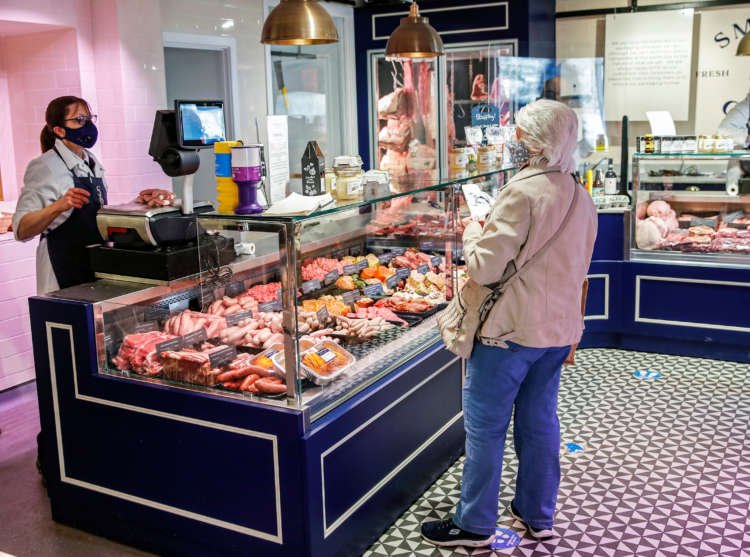
    An inside view of a busy British supermarket showcasing consumers shopping for groceries. This image reflects the growing trend of online grocery shopping in Britain amid changing consumer habits during the pandemic.
    A shopper selects groceries inside a British supermarket - Global Banking & Finance Review
    Why waste money on news and opinion when you can access them for free?

    Take advantage of our newsletter subscription and stay informed on the go!

    Subscribe

    By James Davey

    LONDON (Reuters) – Britain’s multi-billion pound supermarket industry is placing its bets on whether big-spending older shoppers will stick with buying their groceries online when months of lockdown end.

    Having more than doubled during the COVID-19 pandemic to represent 16% of Britain’s roughly 200 billion pound ($281 billion) food retail market, the country has one of the world’s highest take-ups of online grocery.

    Ocado boss Tim Steiner says it’s here to stay and will carry on growing quickly.

    Not so fast, say bosses of some established rivals.

    “A lot of people are talking about the new normal, I’m absolutely convinced that we are not in this new normal right now, we are in the temporary normal, we are in an extraordinary time,” Christian Härtnagel, CEO of Lidl GB, told Reuters.

    He believes that as the crisis recedes, so will online grocery penetration, not back to pre-COVID-19 levels of 7% but a lot less than 16%.

    Lidl does not offer home delivery and for many the jury is out on whether online sales can ever be as profitable as instore purchasing, where shoppers make more impulse buys and extra transport and logistic costs are avoided.

    Older shoppers have led the rapid growth of Britain’s online sector.

    A third national lockdown boosted retired households’ online grocery spending in January by 229% year-on-year, making up 28% of the 6.4 million who ordered online in the month, market researcher Kantar found.

    Whether they stick with it after restrictions end, possibly in June, remains to be seen. The rollout of vaccine will make people less risk averse and months of isolation have left many eager for the social contact of a visit to the shops.

    Stephen Pfeffer, a 75-year old retired bank worker from South Woodford in east London, was classified as a vulnerable person at the start of the pandemic so for much of 2020, he took online deliveries from Waitrose.

    “I was forced into online shopping with the first lockdown,” he said.

    But after regaining his confidence to venture out, he returned to shopping at stores. Now, he has been vaccinated, he uses online only occasionally for bulky items like wine.

    “I thought, you can’t isolate all the time – let’s get out there and start living again,” he said.

    GROWTH ON GROWTH

    Ocado’s Steiner told Reuters that once customers have experienced the ease of online shopping, they are likely to be converted and he expected online grocery in Britain would double in size again over the next few years.

    “When customers have done this three-to-five times they tend to stick with it,” he said last month.

    He said similar trends were evident in France, Japan, Sweden and the United States – countries where Ocado has won partnership deals.

    Steiner co-founded Ocado in 2000 and has seen its stock market value double over the last year to about 17 billion pounds, much of that based on its potential for further overseas deals.

    However, sceptics say traditional supermarket groups in Britain struggle to match online profits with those generated by in-store shopping.

    “They’ll tell you they make money out of online,” Fraser McKevitt, head of retail and consumer insight at Kantar, said.

    “Whether they do or they don’t, they make less money than if I go to the supermarket.”

    He said the big chains have the ability to curb demand by restricting delivery slots and raising delivery charges once social distancing rules are relaxed and they can get more shoppers in their stores.

    WHERE’S THE EVIDENCE?

    In any case, some in the industry say it would be wrong to see the shift to online grocery shopping as being as decisive as for newspapers and video and music streaming.

    “Anyone who’s saying this is a permanent change in the grocery sector, there’s no evidence to back that up,” said one executive of a major British grocer who declined to be named.

    Much will depend on the investment strategies of Britain’s major supermarket groups – market leader Tesco, Sainsbury’s, Asda and Morrisons – as well as Amazon, which has a less than 1% share of the UK grocery market.

    Some critics draw parallels with the space race of the nineties and first decade of this century, when Tesco and Asda in particular built ever bigger superstores.

    That fizzled out as shoppers fell out of love with massive out-of-town stores and supermarkets realised they could not make much profit from selling large items, such as furniture.

    Some say it is symptomatic of people’s attachment to stores that the supermarkets’ heavy investment in digital capacity had led to only a small proportion of shoppers opting for online purchases until the pandemic struck.

    For the big four supermarkets, increased take-up has improved the economics of online, but it still dilutes profits.

    Kantar’s McKevitt said he expected online grocery demand to taper, at least in the short term.

    The supermarket groups are in a quandary, he said.

    “They’re between the devil and the deep blue sea,” he said.

    “They don’t want to lose out on market share that will go to rivals if they don’t offer enough online slots or at the right price, but, on the other hand, they would probably rather that people went to their shops.”

    ($1 = 0.7129 pounds)

    (Reporting by James Davey; editing by Barbara Lewis)

    More from Business

    Explore more articles in the Business category

    Image for Empire Lending helps SMEs secure capital faster, without bank delays
    Empire Lending helps SMEs secure capital faster, without bank delays
    Image for Why Leen Kawas is Prioritizing Strategic Leadership at Propel Bio Partners
    Why Leen Kawas is Prioritizing Strategic Leadership at Propel Bio Partners
    Image for How Commercial Lending Software Platforms Are Structured and Utilized
    How Commercial Lending Software Platforms Are Structured and Utilized
    Image for Oil Traders vs. Tech Startups: Surprising Lessons from Two High-Stakes Worlds | Said Addi
    Oil Traders vs. Tech Startups: Surprising Lessons from Two High-Stakes Worlds | Said Addi
    Image for Why More Mortgage Brokers Are Choosing to Join a Network
    Why More Mortgage Brokers Are Choosing to Join a Network
    Image for From Recession Survivor to Industry Pioneer: Ed Lewis's Data Revolution
    From Recession Survivor to Industry Pioneer: Ed Lewis's Data Revolution
    Image for From Optometry to Soul Vision: The Doctor Helping Entrepreneurs Lead With Purpose
    From Optometry to Soul Vision: The Doctor Helping Entrepreneurs Lead With Purpose
    Image for Global Rankings Revealed: Top PMO Certifications Worldwide
    Global Rankings Revealed: Top PMO Certifications Worldwide
    Image for World Premiere of Midnight in the War Room to be Hosted at Black Hat Vegas
    World Premiere of Midnight in the War Room to be Hosted at Black Hat Vegas
    Image for Role of Personal Accident Cover in 2-Wheeler Insurance for Owners and Riders
    Role of Personal Accident Cover in 2-Wheeler Insurance for Owners and Riders
    Image for The Young Rich Lister Who Also Teaches: How Aaron Sansoni Built a Brand Around Execution
    The Young Rich Lister Who Also Teaches: How Aaron Sansoni Built a Brand Around Execution
    Image for Q3 2025 Priority Leadership: Tom Priore and Tim O'Leary Balance Near-Term Challenges with Long-Term Strategic Wins
    Q3 2025 Priority Leadership: Tom Priore and Tim O'Leary Balance Near-Term Challenges with Long-Term Strategic Wins
    View All Business Posts
    Previous Business PostExclusive: EU audits Indian vaccine maker as AstraZeneca looks to boost supplies to the bloc – source By Emilio Parodi
    Next Business PostLogitech warns on FY 2022 outlook after pandemic-boosted FY 2021