Search
00
GBAF Logo
trophy
Top StoriesInterviewsBusinessFinanceBankingTechnologyInvestingTradingVideosAwardsMagazinesHeadlinesTrends

Subscribe to our newsletter

Get the latest news and updates from our team.

Global Banking & Finance Review®

Global Banking & Finance Review® - Subscribe to our newsletter

Company

    GBAF Logo
    • About Us
    • Profile
    • Privacy & Cookie Policy
    • Terms of Use
    • Contact Us
    • Advertising
    • Submit Post
    • Latest News
    • Research Reports
    • Press Release
    • Awards▾
      • About the Awards
      • Awards TimeTable
      • Submit Nominations
      • Testimonials
      • Media Room
      • Award Winners
      • FAQ
    • Magazines▾
      • Global Banking & Finance Review Magazine Issue 79
      • Global Banking & Finance Review Magazine Issue 78
      • Global Banking & Finance Review Magazine Issue 77
      • Global Banking & Finance Review Magazine Issue 76
      • Global Banking & Finance Review Magazine Issue 75
      • Global Banking & Finance Review Magazine Issue 73
      • Global Banking & Finance Review Magazine Issue 71
      • Global Banking & Finance Review Magazine Issue 70
      • Global Banking & Finance Review Magazine Issue 69
      • Global Banking & Finance Review Magazine Issue 66
    Top StoriesInterviewsBusinessFinanceBankingTechnologyInvestingTradingVideosAwardsMagazinesHeadlinesTrends

    Global Banking & Finance Review® is a leading financial portal and online magazine offering News, Analysis, Opinion, Reviews, Interviews & Videos from the world of Banking, Finance, Business, Trading, Technology, Investing, Brokerage, Foreign Exchange, Tax & Legal, Islamic Finance, Asset & Wealth Management.
    Copyright © 2010-2026 GBAF Publications Ltd - All Rights Reserved. | Sitemap | Tags | Developed By eCorpIT

    Editorial & Advertiser disclosure

    Global Banking & Finance Review® is an online platform offering news, analysis, and opinion on the latest trends, developments, and innovations in the banking and finance industry worldwide. The platform covers a diverse range of topics, including banking, insurance, investment, wealth management, fintech, and regulatory issues. The website publishes news, press releases, opinion and advertorials on various financial organizations, products and services which are commissioned from various Companies, Organizations, PR agencies, Bloggers etc. These commissioned articles are commercial in nature. This is not to be considered as financial advice and should be considered only for information purposes. It does not reflect the views or opinion of our website and is not to be considered an endorsement or a recommendation. We cannot guarantee the accuracy or applicability of any information provided with respect to your individual or personal circumstances. Please seek Professional advice from a qualified professional before making any financial decisions. We link to various third-party websites, affiliate sales networks, and to our advertising partners websites. When you view or click on certain links available on our articles, our partners may compensate us for displaying the content to you or make a purchase or fill a form. This will not incur any additional charges to you. To make things simpler for you to identity or distinguish advertised or sponsored articles or links, you may consider all articles or links hosted on our site as a commercial article placement. We will not be responsible for any loss you may suffer as a result of any omission or inaccuracy on the website.

    Home > Business > Apple’s weak iPhone sales drive first profit miss since 2016
    Business

    Apple’s weak iPhone sales drive first profit miss since 2016

    Published by Jessica Weisman-Pitts

    Posted on February 2, 2023

    5 min read

    Last updated: February 2, 2026

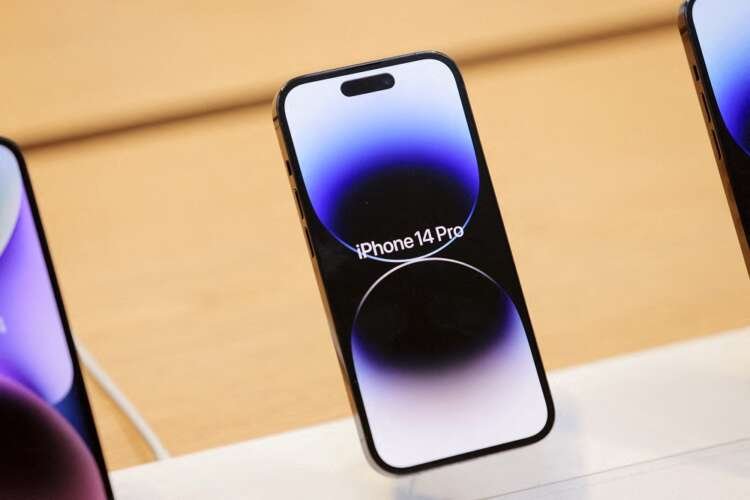
    The Apple iPhone 14 Pro showcased at the Fifth Avenue store in New York, reflecting the recent decline in iPhone sales and the company's first profit miss since 2016 as reported in the article.
    Apple iPhone 14 Pro displayed at store amid weak sales reports - Global Banking & Finance Review
    Why waste money on news and opinion when you can access them for free?

    Take advantage of our newsletter subscription and stay informed on the go!

    Subscribe

    Tags:technologyfinancial marketsinvestment

    By Stephen Nellis

    (Reuters) – Apple Inc on Thursday reported sales and profits that missed Wall Street expectations driven by weak iPhone sales after COVID lockdowns in China disrupted production of the company’s biggest seller.

    Shares of Apple fell 5% after publication of the results.

    Apple sales fell 5% to $117.2 billion and were down in every part of the world in the quarter. Sales from each product category dropped, except for gains in services and iPads. Earnings per share were $1.88, Apple’s first miss of Wall Street’s profits expectations since 2016.

    Analysts had expected sales of $121.1 billion and profits of $1.94 per share, according to IBES data from Refinitiv. Apple Chief Executive Tim Cook told Reuters that the production disruptions that plagued Apple’s key quarter were now over.

    During its fiscal first quarter ended Dec. 31, Apple faced a wave of challenges that left Wall Street expecting lower sales. Chief among those were supply chain pressures when COVID lockdowns at a production facility in Zhengzhou, China, slowed production of iPhone 14 Pro and Pro Max devices, both premium priced models that would traditionally help drive Apple’s margins higher.

    In an interview with Reuters, Cook said that production disruptions “lasted through most of December” but that “production is now back where we want it to be.” Cook said the lockdowns in China created a dual challenge where both supply and demand were constrained, with greater China sales falling 7% to $23.9 billion.

    “When things started to reopen in December (in China), we did see an increase in traffic to our stores as compared to November and an increase in demand as December rolled around,” Cook told Reuters.

    The strong U.S. dollar also hurt Apple, which derives more than half its sales from outside the Americas, but the effect was less than anticipated as the dollar eased from last year’s highs. Apple had warned investors that such foreign-exchange issues would put a 10% on drag on sales but said on Thursday that the actual effect was 8%.

    “I would point out that 8% is still a very severe headwind,” Cook told Reuters. “I wouldn’t want to underestimate that. We would have grown on a constant currency basis.”

    On top of supply chain problems for the iPhone, Wall Street analysts had expected iPhone sales to fall this year as part of a larger pattern in which the iPhone 14 family released last year sells more slowly after two straight years of strong sales of iPhone 12 and 13 models. Apple said iPhone sales were $65.8 billion, down 8% from the year before and below analyst estimates of $68.3 billion.

    The company’s services segment, which includes content businesses such as Apple TV+ and software business like the App Store, rose 6% to $20.8 billion in revenue, compared with analyst expectations of $20.7 billion, according to Refinitiv data.

    Cook told Reuters that the company now has a base of 2 billion active devices, up from 1.8 billion a year ago. The company now has 935 million paid subscriptions, up from 900 million the quarter before, and that services sales set a record in several markets, including China, he said.

    Sales of the company’s Mac computers, which had boomed during the wave of working from home during the pandemic, declined 29% year over year to $7.7 billion, compared with expectations of $9.6 billion, according to Refinitiv data. Apple executives had warned last year that Mac sales were likely to decline year over year because the previous year’s results included a burst of sales associated with the release of new MacBook Pro computers with Apple’s house-designed processors.

    Sales of the iPad, which also saw a pandemic-related boost, grew 30% to $9.4 billion, compared with analyst expectations of $7.8 billion, according to Refinitiv data. The wearable and accessories segment, which includes the Apple Watch and AirPods, fell 8% to $13.5 billion compared with analyst estimates of $15.2 billion, according to Refinitiv data.

    Cook told Reuters the iPad’s strong performance stemmed from the launch of new models and the absence of supply constraints that had hindered sales of the device a year earlier.

    Apple investors are waiting to see whether the company dives into new markets this year. Technology publication The Information has reported that Apple plans to launch a mixed-reality headset that could retail for around $3,000 this year and is also working on a more affordable follow-up device.

    Apple is one of the few large technology firms that has not announced major layoffs, though its ranks never grew as rapidly as that of its peers. In late 2022 it said it had 164,000 employees, up less than 20% from its 2019 headcount. By contrast, other companies such as Meta Platforms Inc, which is laying off about 11,000 employees, had roughly doubled its headcount between 2019 and 2022.

    (Reporting by Stephen Nellis in San Francisco; Additional reporting by Akash Sriram in Bengaluru; Editing by Peter Henderson and Lisa Shumaker)

    Frequently Asked Questions about Apple’s weak iPhone sales drive first profit miss since 2016

    1What is earnings per share?

    Earnings per share (EPS) is a financial metric that indicates the profitability of a company, calculated by dividing net income by the number of outstanding shares.

    2What is foreign exchange?

    Foreign exchange, or forex, refers to the global marketplace for trading national currencies against one another, influencing international trade and investment.

    3What is a market response?

    Market response refers to how investors react to news or events affecting a company, which can lead to fluctuations in stock prices.

    4What is a profit miss?

    A profit miss occurs when a company's reported earnings fall short of analysts' expectations, often leading to a decline in stock price.

    More from Business

    Explore more articles in the Business category

    Image for Empire Lending helps SMEs secure capital faster, without bank delays
    Empire Lending helps SMEs secure capital faster, without bank delays
    Image for Why Leen Kawas is Prioritizing Strategic Leadership at Propel Bio Partners
    Why Leen Kawas is Prioritizing Strategic Leadership at Propel Bio Partners
    Image for How Commercial Lending Software Platforms Are Structured and Utilized
    How Commercial Lending Software Platforms Are Structured and Utilized
    Image for Oil Traders vs. Tech Startups: Surprising Lessons from Two High-Stakes Worlds | Said Addi
    Oil Traders vs. Tech Startups: Surprising Lessons from Two High-Stakes Worlds | Said Addi
    Image for Why More Mortgage Brokers Are Choosing to Join a Network
    Why More Mortgage Brokers Are Choosing to Join a Network
    Image for From Recession Survivor to Industry Pioneer: Ed Lewis's Data Revolution
    From Recession Survivor to Industry Pioneer: Ed Lewis's Data Revolution
    Image for From Optometry to Soul Vision: The Doctor Helping Entrepreneurs Lead With Purpose
    From Optometry to Soul Vision: The Doctor Helping Entrepreneurs Lead With Purpose
    Image for Global Rankings Revealed: Top PMO Certifications Worldwide
    Global Rankings Revealed: Top PMO Certifications Worldwide
    Image for World Premiere of Midnight in the War Room to be Hosted at Black Hat Vegas
    World Premiere of Midnight in the War Room to be Hosted at Black Hat Vegas
    Image for Role of Personal Accident Cover in 2-Wheeler Insurance for Owners and Riders
    Role of Personal Accident Cover in 2-Wheeler Insurance for Owners and Riders
    Image for The Young Rich Lister Who Also Teaches: How Aaron Sansoni Built a Brand Around Execution
    The Young Rich Lister Who Also Teaches: How Aaron Sansoni Built a Brand Around Execution
    Image for Q3 2025 Priority Leadership: Tom Priore and Tim O'Leary Balance Near-Term Challenges with Long-Term Strategic Wins
    Q3 2025 Priority Leadership: Tom Priore and Tim O'Leary Balance Near-Term Challenges with Long-Term Strategic Wins
    View All Business Posts
    Previous Business PostU.S. job growth powers ahead; unemployment rate at 3.4%
    Next Business PostWith home energy prices soaring, offices need to prepare for an influx of workers