
Search
00
GBAF Logo
trophy
Top StoriesInterviewsBusinessFinanceBankingTechnologyInvestingTradingVideosAwardsMagazinesHeadlinesTrends

Subscribe to our newsletter

Get the latest news and updates from our team.

Global Banking & Finance Review®

Global Banking & Finance Review® - Subscribe to our newsletter

Company

    GBAF Logo
    • About Us
    • Advertising and Sponsorship
    • Profile & Readership
    • Contact Us
    • Latest News
    • Privacy & Cookies Policies
    • Terms of Use
    • Advertising Terms
    • Issue 81
    • Issue 80
    • Issue 79
    • Issue 78
    • Issue 77
    • Issue 76
    • Issue 75
    • Issue 74
    • Issue 73
    • Issue 72
    • Issue 71
    • Issue 70
    • View All
    • About the Awards
    • Awards Timetable
    • Awards Winners
    • Submit Nominations
    • Testimonials
    • Media Room
    • FAQ
    • Asset Management Awards
    • Brand of the Year Awards
    • Business Awards
    • Cash Management Banking Awards
    • Banking Technology Awards
    • CEO Awards
    • Customer Service Awards
    • CSR Awards
    • Deal of the Year Awards
    • Corporate Governance Awards
    • Corporate Banking Awards
    • Digital Transformation Awards
    • Fintech Awards
    • Education & Training Awards
    • ESG & Sustainability Awards
    • ESG Awards
    • Forex Banking Awards
    • Innovation Awards
    • Insurance & Takaful Awards
    • Investment Banking Awards
    • Investor Relations Awards
    • Leadership Awards
    • Islamic Banking Awards
    • Real Estate Awards
    • Project Finance Awards
    • Process & Product Awards
    • Telecommunication Awards
    • HR & Recruitment Awards
    • Trade Finance Awards
    • The Next 100 Global Awards
    • Wealth Management Awards
    • Travel Awards
    • Years of Excellence Awards
    • Publishing Principles
    • Ownership & Funding
    • Corrections Policy
    • Editorial Code of Ethics
    • Diversity & Inclusion Policy
    • Fact Checking Policy
    Original content: Global Banking and Finance Review - https://www.globalbankingandfinance.com

    A global financial intelligence and recognition platform delivering authoritative insights, data-driven analysis, and institutional benchmarking across Banking, Capital Markets, Investment, Technology, and Financial Infrastructure.

    Copyright © 2010-2026 - All Rights Reserved. | Sitemap | Tags

    Editorial & Advertiser disclosure

    Global Banking & Finance Review® is an online platform offering news, analysis, and opinion on the latest trends, developments, and innovations in the banking and finance industry worldwide. The platform covers a diverse range of topics, including banking, insurance, investment, wealth management, fintech, and regulatory issues. The website publishes news, press releases, opinion and advertorials on various financial organizations, products and services which are commissioned from various Companies, Organizations, PR agencies, Bloggers etc. These commissioned articles are commercial in nature. This is not to be considered as financial advice and should be considered only for information purposes. It does not reflect the views or opinion of our website and is not to be considered an endorsement or a recommendation. We cannot guarantee the accuracy or applicability of any information provided with respect to your individual or personal circumstances. Please seek Professional advice from a qualified professional before making any financial decisions. We link to various third-party websites, affiliate sales networks, and to our advertising partners websites. When you view or click on certain links available on our articles, our partners may compensate us for displaying the content to you or make a purchase or fill a form. This will not incur any additional charges to you. To make things simpler for you to identity or distinguish advertised or sponsored articles or links, you may consider all articles or links hosted on our site as a commercial article placement. We will not be responsible for any loss you may suffer as a result of any omission or inaccuracy on the website.

    1. Home
    2. >Banking
    3. >An integrated approach for cross-border stress testing compliance
    Banking

    An Integrated Approach for Cross-Border Stress Testing Compliance

    Published by Gbaf News

    Posted on January 9, 2019

    6 min read

    Last updated: January 21, 2026

    Add as preferred source on Google

    A visual representation of the evolving financial services landscape in 2019, highlighting the rise of challenger banks and their impact on traditional banking, as discussed in the article.
    Challenger banks and traditional banking services in 2019 - Global Banking & Finance Review
    Why waste money on news and opinion when you can access them for free?

    Take advantage of our newsletter subscription and stay informed on the go!

    Subscribe

    Tags:Cross-Border LeverageData Governance &ManagementEnterprise Risk managementfinancial crisisModel and Scenario Management

    The aftermath of the 2008 financial crisis saw regulators across the globe coming up with stress testing guidelines for their respective regions.In the US, the stress testing program which is managed by the US Federal reserve initially started in 2009 as SCAP (Supervisory Capital Assessment Program) and has matured into CCAR (Comprehensive Capital Analysis and Review) expanding coverage to 38 US Banks including 5 Foreign Banks with large US operations. In the European region the stress testing guidelines are managed by the EBA (European Banking Association) and impacts close to 100+ Banks, while in the UK the stress testing guidelines come under the purview of PRA (Prudential Regulatory Authority) impacting close to 7 large UK banks.

    The complexity of the stress testing program varies across regions for different regulators in terms of data requirements, modeling methodologies, regulatory scenarios, and granularity of submissions.  However, aspects like Application Architecture, Governance, Model Management, Reporting and Data Management provide a great opportunity for global banks to leverage on the commonalities, which can make stress-testing compliance more efficient and work in an integrated manner across the different regions.

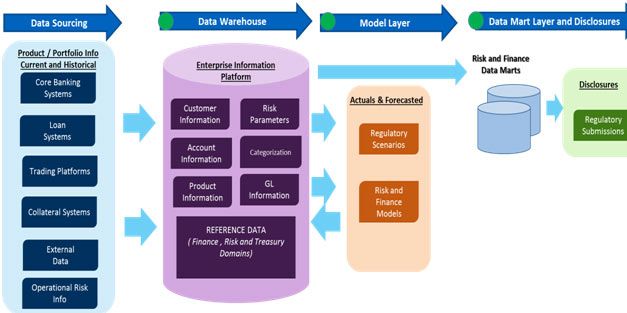
    Furthermore, an integrated approach also helps global banks to reduce overall infrastructure costs and enable them to create a robust and a scalable stress-testing framework with better controls, quality and eventually enabling them to achieve better returns on their investments.Depicted in the chart below are the key components typical stress testing programs globally involve and components that can be potentially explored by global banks for achieving an Integrated Stress Testing approach.
    data-sourcing

    1. Data Governance &Management – Granularity of data submissions may vary across stress testing regimes in different jurisdictions but aspects around data governance and data management are also reviewed in these submissions in varying degrees. Regulators usually insist on establishing data governance policies,adequate controls around data movement, ensuring data quality, data dictionaries, establishing data lineage and maintaining the business and technical metadata. Most global banks invest in multiple 3rd party tools which can effectively be cross-leveraged at an enterprise level to ensure standardization of processes along with the necessary quality and integrity of the data. This can also help banks move towards a target state of risk and finance alignment at a faster pace.
    1. Model and Scenario Management – Regulators provide the stress testing scenarios to the participating banks in their region based on the factors relevant for the region. Maintaining scenario libraries at an enterprise level can also help global banks to extend, leverage and enhance their existing idiosyncratic scenarios for specific regions. Model management platforms and technology can also be cross-leveraged for stress testing requirements. Areas such as model lifecycle management, model hosting, and model documentation management are good candidates which can be maintained at an enterprise level. Many global banks are also exploring an idea of standard unified data model view specifically to cater to modeling requirements across regions.
    1. Stress Testing Regulatory Submissions–Inthe US, CCAR requires participating banks to submit close to 90+ reports, EU regime has close to 36+ reports and the UK regime requires close to 16+ reports from participating banks at varying frequencies. The reporting involved is very granular and many global banks usually rely on third-party solutions to manage the reporting expectations.Enterprise-wide reporting solutions can help the bank to not only leverage the solutions for cross-border stress testing reporting requirements but can also look at moving other regulatory reporting requirements like Basel, liquidity risk management etc. which will also provide more cost efficiencies on the reporting front. 

    Other components of Cross-Border Leverage

    • Forecasted Variables –Banks use a number of variables in their stress testing process and the regulators specific to each geography only publish the forecasted value of select variables leaving the banks to forecast the remaining variables by themselves. Banks can cross leverage some of the variables across geographies.  For e.g.:  Stress Forecast of US GDP rates are published by Fed and if there are a few models which consider US GDP rate in their propriety models in their stress testing regime, then they can use the US stress testing forecasted variables without having to forecast it by themselves.
    • Controls – Stress testing programs across various geographies are at different levels of maturity and currently many regulators are focusing more on only the quantitative aspects as against the qualitative aspects as well as barring the US geography. Banks can leverage the business, technology and data controls established across the stress testing programs as part of their qualitative assessment process in one geography over to the other Regulatory regimes.  

    As the stress testing mandates across regions have more or less stabilized, Global Banks are looking at more and more opportunities to simplify, centralize and automate most of the processes involved in stress testing area to gain better efficiencies and controls.  An integrated approach or framework could enable global banks to  bring in greater efficiency in terms of cost and time to market but also bring in greater depth and consistency in their risk management and capital planning processes

    About the Authors

    Ajay Katara

    Ajay Katara

    Ajay Katara is a Domain Consultant with the Risk Management practice of the Banking and Financial Services (BFS) business unit at Tata Consultancy Services (TCS). He currently leads the BFS Risk Practice’s portfolio on Regulations and Robotics Process Automation. He has extensive experience of more than 13 years in Consulting & Solution design space cutting across CCAR Consulting, AML, Basel II implementation, and credit risk, and has worked with several financial enterprises across geographies. He has significantly contributed to the conceptualization of strategic offerings in the risk management space and has been instrumental in successfully driving various consulting engagements. He has also authored many editorials, details of which can be found in his linked in profile (https://www.linkedin.com/in/ajaykatara/)

    Manoj Reddy

    Manoj Reddy

    Manoj Reddy is the Head of BFS Risk & Compliance Practice for TCS North America with an experience of more than 15 years in the areas of financial services, IT, and business consulting. Reddy has lead several risk consulting and implementation engagements for financial firms globally. He has provided both Regulatory and Strategic Business solution to his customers over the last decade primarily in the area of CCAR, Basel, Liquidity Risk, and Enterprise Risk management and is currently leading TCS efforts in North America with respect to providing cognitive solutions for Risk & Regulatory problems.

    More from Banking

    Explore more articles in the Banking category

    Image for Nominate Today for the Leadership Awards 2026
    Nominate Today for the Leadership Awards 2026
    Image for Submit Your Entries for Insurance & Takaful Awards 2026
    Submit Your Entries for Insurance & Takaful Awards 2026
    Image for Calling for Entries: ESG & Sustainability Awards 2026
    Calling for Entries: ESG & Sustainability Awards 2026
    Image for Call for Entries: Deal of the Year Awards 2026
    Call for Entries: Deal of the Year Awards 2026
    Image for Submit Your Entry Today for Customer Service Awards 2026
    Submit Your Entry Today for Customer Service Awards 2026
    Image for Submit Your Entry Today for CSR Awards 2026
    Submit Your Entry Today for CSR Awards 2026
    Image for Submit Your Entry Today for Retail Banking Awards 2026
    Submit Your Entry Today for Retail Banking Awards 2026
    Image for Nominations Open for Islamic Banking Awards 2026
    Nominations Open for Islamic Banking Awards 2026
    Image for Submit Your Entry Today for Fund & Asset Management Awards 2026
    Submit Your Entry Today for Fund & Asset Management Awards 2026
    Image for Entries Open for Forex Banking Awards 2026
    Entries Open for Forex Banking Awards 2026
    Image for Call for Entries for Brand of the Year Awards 2026
    Call for Entries for Brand of the Year Awards 2026
    Image for Nominations Open for Corporate Banking Awards 2026
    Nominations Open for Corporate Banking Awards 2026
    View All Banking Posts
    Previous Banking PostNorth American Banks Need to Prepare for Digital Change, According to Report Released by Temenos
    Next Banking PostThree Reasons Traditional Machine Learning Can’t Stop Multi-Channel Bank Fraud






