Search
00
GBAF Logo
trophy
Top StoriesInterviewsBusinessFinanceBankingTechnologyInvestingTradingVideosAwardsMagazinesHeadlinesTrends

Subscribe to our newsletter

Get the latest news and updates from our team.

Global Banking and Finance Review

Global Banking and Finance Review - Subscribe to our newsletter

Company

    GBAF Logo
    • About Us
    • Profile
    • Privacy & Cookie Policy
    • Terms of Use
    • Contact Us
    • Advertising
    • Submit Post
    • Latest News
    • Research Reports
    • Press Release
    • Awards▾
      • About the Awards
      • Awards TimeTable
      • Submit Nominations
      • Testimonials
      • Media Room
      • Award Winners
      • FAQ
    • Magazines▾
      • Global Banking & Finance Review Magazine Issue 79
      • Global Banking & Finance Review Magazine Issue 78
      • Global Banking & Finance Review Magazine Issue 77
      • Global Banking & Finance Review Magazine Issue 76
      • Global Banking & Finance Review Magazine Issue 75
      • Global Banking & Finance Review Magazine Issue 73
      • Global Banking & Finance Review Magazine Issue 71
      • Global Banking & Finance Review Magazine Issue 70
      • Global Banking & Finance Review Magazine Issue 69
      • Global Banking & Finance Review Magazine Issue 66
    Top StoriesInterviewsBusinessFinanceBankingTechnologyInvestingTradingVideosAwardsMagazinesHeadlinesTrends

    Global Banking & Finance Review® is a leading financial portal and online magazine offering News, Analysis, Opinion, Reviews, Interviews & Videos from the world of Banking, Finance, Business, Trading, Technology, Investing, Brokerage, Foreign Exchange, Tax & Legal, Islamic Finance, Asset & Wealth Management.
    Copyright © 2010-2026 GBAF Publications Ltd - All Rights Reserved. | Sitemap | Tags | Developed By eCorpIT

    Editorial & Advertiser disclosure

    Global Banking and Finance Review is an online platform offering news, analysis, and opinion on the latest trends, developments, and innovations in the banking and finance industry worldwide. The platform covers a diverse range of topics, including banking, insurance, investment, wealth management, fintech, and regulatory issues. The website publishes news, press releases, opinion and advertorials on various financial organizations, products and services which are commissioned from various Companies, Organizations, PR agencies, Bloggers etc. These commissioned articles are commercial in nature. This is not to be considered as financial advice and should be considered only for information purposes. It does not reflect the views or opinion of our website and is not to be considered an endorsement or a recommendation. We cannot guarantee the accuracy or applicability of any information provided with respect to your individual or personal circumstances. Please seek Professional advice from a qualified professional before making any financial decisions. We link to various third-party websites, affiliate sales networks, and to our advertising partners websites. When you view or click on certain links available on our articles, our partners may compensate us for displaying the content to you or make a purchase or fill a form. This will not incur any additional charges to you. To make things simpler for you to identity or distinguish advertised or sponsored articles or links, you may consider all articles or links hosted on our site as a commercial article placement. We will not be responsible for any loss you may suffer as a result of any omission or inaccuracy on the website.

    Home > Finance > Analysis-BOJ's fresh take on labour crunch opens door for more rate hikes
    Finance

    Analysis-BOJ's fresh take on labour crunch opens door for more rate hikes

    Published by Global Banking and Finance Review

    Posted on February 6, 2025

    5 min read

    Last updated: January 26, 2026

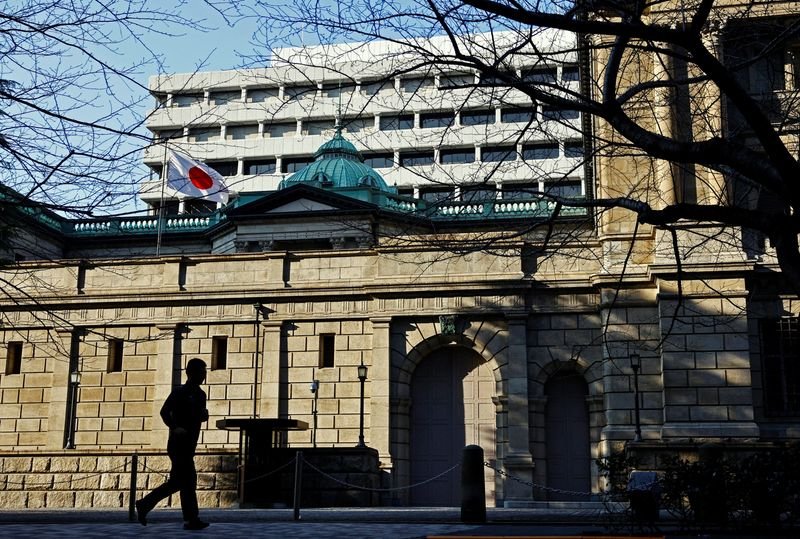
    This image depicts a chart showing the relationship between Japan's labour shortages and potential interest rate hikes by the BOJ. It emphasizes the increasing focus on wage-driven inflation amid tight labor market conditions, relevant to the article's analysis.
    Graph illustrating Japan's labour market and its impact on rate hikes - Global Banking & Finance Review
    Why waste money on news and opinion when you can access them for free?

    Take advantage of our newsletter subscription and stay informed on the go!

    Subscribe

    Quick Summary

    The BOJ is focusing on labour shortages as a key economic issue, suggesting more rate hikes. Wage-driven inflation is a growing concern amid Japan's worker deficit.

    BOJ's New Labour Crunch Focus Could Trigger Rate Hikes

    By Leika Kihara

    TOKYO (Reuters) - The Bank of Japan is increasingly blaming chronic labour shortages, not stagnant demand, as the main reason for its weak economic activity, a justification it may use to lift interest rates beyond what was initially expected.

    From factories to hotels to restaurants, Japanese businesses are struggling to hit full capacity not because they can't find customers but because they can't find workers, goes the commentary now emerging more from the central bank.

    While the tight labour market is not a new trend, the BOJ's more vocal concerns about the resulting wage and inflationary pressures mean it will be more inclined to look past economic weakness as it considers raising interest rates further, analysts and policymakers say.

    "My view is that ... the output gap is already in positive territory in reality and the lack of supply capacity is exerting upward pressure on prices," Naoki Tamura, a hawkish BOJ board member, said on Thursday.

    On paper, Japan's output gap, which measures whether the economy is running at its full potential, remains slightly negative, suggesting demand lacks momentum to ignite inflation. Coupled with soft consumption, it has been seen by analysts as a factor that could discourage the central bank from raising borrowing costs too much.

    But BOJ policymakers are challenging that narrative.

    A close look at the BOJ's quarterly outlook report published in January shows the bank turning more attention to growing signs wage-driven inflation is taking hold due to chronic labour shortages, in turn building the case for sustained, steady rate hikes.

    In that report, the BOJ said a dwindling pool of female and elderly workers meant labour market conditions are tightening even amid subdued economic growth.

    "In this situation, upward pressure on wages and prices is likely to be stronger than suggested by the output gap, given that firms in many industries have started to face labour supply constraints," the report said.

    The report also analysed how labour-intensive sectors such as construction and services were facing serious worker shortages that were curtailing activity.

    The BOJ's increasing focus on wage-driven inflation is another sign Japan is shedding its 25-year battle with deflation and economic stagnation. It also contrasts with former Governor Haruhiko Kuroda's insistence on using radical stimulus to fire up inflation.

    "The BOJ is becoming more convinced that wages and services prices will keep rising," said former BOJ top economist Seisaku Kameda, who is now executive economist at Sompo Institute Plus.

    "Its report, the language of its policy statement and the governor's comments all back up the case for more rate hikes."

    Mindful of the risk of an inflation overshoot, BOJ board members debated the chance of further interest rate hikes even after raising short-term rates to 0.5%, a summary of opinions at the January meeting showed.

    One opinion cited labour shortages as keeping inflation elevated, while another warned of the risk of "stagflation," where high inflation and low growth co-exist, the summary showed.

    The BOJ's hawkish tilt means markets may put greater focus on the bank's language around wage-driven inflation, rather than its views on consumption.

    "The BOJ is becoming increasingly mindful of how labour market conditions could be putting upward pressure on wages and prices, more than what its output gap estimate suggests," said Ryutaro Kono, chief Japan economist at BNP Paribas.

    "While the initial factor may have been the weak yen, the BOJ is beginning to recognise the risk of price rises turning into home-made inflation," he added.

    PERSISTENT PAIN

    Japan's rapidly ageing population has led to a dwindling pool of workers. The country faces a deficit of 3.4 million workers by the end of this decade and 11 million by 2040, according to a 2023 study by Recruit Works Institute.

    Kushikatsu Tanaka Holdings, which runs a restaurant chain nationwide, is among retailers suffering from chronic labour shortages, particularly in regional areas.

    "It's not as if we're suddenly facing shortage of staff - it's a permanent issue," an executive of the company told Reuters.

    "In regional areas, it's not even about hourly pay. There's a lack of people in the first place. We're trying to consolidate our outlets and shut those that are proving unprofitable."

    Keen to retain workers, Japanese companies agreed to an average 5.1% wage hike in 2024, the biggest increase in three decades, a union survey showed.

    In his speech on Thursday, BOJ board member Tamura said labour shortages were forcing hotels to reduce occupancy rates and meant some taxi operators had more cars than drivers.

    As central banks have no power to address supply constraints, their mandate remains squarely on combating subsequent inflationary pressure by raising interest rates.

    With stubbornly high raw material costs and labour shortages keeping inflation above the BOJ's target for nearly three years, markets are now re-assessing their view rates won't rise too much.

    Governor Kazuo Ueda said last month the BOJ's policy rate was still distant from levels deemed neutral to the economy, leaving scope for several more rate increases.

    BOJ staff estimates Japan's nominal neutral rate to be in a range of 1.0% to 2.5%. Having seen Japan's prolonged struggle with deflation, many analysts had bet the highest the BOJ could hike would be up to 1%. But building inflationary pressures may reduce the chance the BOJ will pause there.

    Growing market expectations that the BOJ's terminal rate could be higher have helped lift Japanese government bond yields to multi-year highs and propped up the yen.

    "There's no reason why markets should assume that rates won't rise beyond 1.0%, which is the bottom of the estimated range," said a source familiar with the bank's thinking.

    ($1 = 152.2700 yen)

    (Addition reporting by Makiko Yamazaki; Editing by Sam Holmes)

    Key Takeaways

    • •BOJ attributes weak economic activity to labour shortages.
    • •Labour market pressures may lead to more interest rate hikes.
    • •Wage-driven inflation is a growing concern for BOJ.
    • •Japan faces a significant worker deficit by 2040.
    • •BOJ's stance contrasts with previous stimulus-focused policies.

    Frequently Asked Questions about Analysis-BOJ's fresh take on labour crunch opens door for more rate hikes

    1What is the main topic?

    The article discusses the BOJ's focus on labour shortages and its potential impact on interest rate hikes in Japan.

    2Why is the BOJ concerned about labour shortages?

    Labour shortages are seen as a primary driver of wage-driven inflation, prompting the BOJ to consider further rate hikes.

    3How does this affect Japan's economy?

    Labour shortages may lead to sustained inflation, influencing BOJ's monetary policy and potentially impacting economic growth.

    More from Finance

    Explore more articles in the Finance category

    Image for Norway's Socialist Party backs down from threat to LNG electricity project
    Norway's Socialist Party backs down from threat to LNG electricity project
    Image for Russian central bank says export outlook to worsen in first quarter
    Russian central bank says export outlook to worsen in first quarter
    Image for MSF says airstrike hit its hospital in South Sudan's Jonglei state
    MSF says airstrike hit its hospital in South Sudan's Jonglei state
    Image for Italy police search House of Doge-owned soccer club in money laundering probe
    Italy police search House of Doge-owned soccer club in money laundering probe
    Image for Four people, including two Chinese nationals, arrested in France on suspicion of spying
    Four people, including two Chinese nationals, arrested in France on suspicion of spying
    Image for Explainer-Why is UN warning of 'imminent financial collapse'?
    Explainer-Why is UN warning of 'imminent financial collapse'?
    Image for US software stocks hit by Anthropic wake-up call on AI disruption
    US software stocks hit by Anthropic wake-up call on AI disruption
    Image for Italy watchdog blocks BYD advert after Stellantis complaint
    Italy watchdog blocks BYD advert after Stellantis complaint
    Image for US proposes critical minerals trade bloc aimed at countering China
    US proposes critical minerals trade bloc aimed at countering China
    Image for EU envoys agree details of 90 billion euro loan for Ukraine
    EU envoys agree details of 90 billion euro loan for Ukraine
    Image for Germany seeks broader spy powers to counter rising hybrid threats
    Germany seeks broader spy powers to counter rising hybrid threats
    Image for Hungary's Orban orders tax lawsuit dropped, mayor says it's an attack on rule of law
    Hungary's Orban orders tax lawsuit dropped, mayor says it's an attack on rule of law
    View All Finance Posts
    Previous Finance PostElectric-truck maker Nikola nears bankruptcy filing, WSJ reports (February 6)
    Next Finance PostUnipol-backed BPER joins Italy's M&A frenzy with $4.5 billion Pop Sondrio bid