Search
00
GBAF Logo
trophy
Top StoriesInterviewsBusinessFinanceBankingTechnologyInvestingTradingVideosAwardsMagazinesHeadlinesTrends

Subscribe to our newsletter

Get the latest news and updates from our team.

Global Banking & Finance Review®

Global Banking & Finance Review® - Subscribe to our newsletter

Company

    GBAF Logo
    • About Us
    • Profile
    • Privacy & Cookie Policy
    • Terms of Use
    • Contact Us
    • Advertising
    • Submit Post
    • Latest News
    • Research Reports
    • Press Release
    • Awards▾
      • About the Awards
      • Awards TimeTable
      • Submit Nominations
      • Testimonials
      • Media Room
      • Award Winners
      • FAQ
    • Magazines▾
      • Global Banking & Finance Review Magazine Issue 79
      • Global Banking & Finance Review Magazine Issue 78
      • Global Banking & Finance Review Magazine Issue 77
      • Global Banking & Finance Review Magazine Issue 76
      • Global Banking & Finance Review Magazine Issue 75
      • Global Banking & Finance Review Magazine Issue 73
      • Global Banking & Finance Review Magazine Issue 71
      • Global Banking & Finance Review Magazine Issue 70
      • Global Banking & Finance Review Magazine Issue 69
      • Global Banking & Finance Review Magazine Issue 66
    Top StoriesInterviewsBusinessFinanceBankingTechnologyInvestingTradingVideosAwardsMagazinesHeadlinesTrends

    Global Banking & Finance Review® is a leading financial portal and online magazine offering News, Analysis, Opinion, Reviews, Interviews & Videos from the world of Banking, Finance, Business, Trading, Technology, Investing, Brokerage, Foreign Exchange, Tax & Legal, Islamic Finance, Asset & Wealth Management.
    Copyright © 2010-2026 GBAF Publications Ltd - All Rights Reserved. | Sitemap | Tags | Developed By eCorpIT

    Editorial & Advertiser disclosure

    Global Banking & Finance Review® is an online platform offering news, analysis, and opinion on the latest trends, developments, and innovations in the banking and finance industry worldwide. The platform covers a diverse range of topics, including banking, insurance, investment, wealth management, fintech, and regulatory issues. The website publishes news, press releases, opinion and advertorials on various financial organizations, products and services which are commissioned from various Companies, Organizations, PR agencies, Bloggers etc. These commissioned articles are commercial in nature. This is not to be considered as financial advice and should be considered only for information purposes. It does not reflect the views or opinion of our website and is not to be considered an endorsement or a recommendation. We cannot guarantee the accuracy or applicability of any information provided with respect to your individual or personal circumstances. Please seek Professional advice from a qualified professional before making any financial decisions. We link to various third-party websites, affiliate sales networks, and to our advertising partners websites. When you view or click on certain links available on our articles, our partners may compensate us for displaying the content to you or make a purchase or fill a form. This will not incur any additional charges to you. To make things simpler for you to identity or distinguish advertised or sponsored articles or links, you may consider all articles or links hosted on our site as a commercial article placement. We will not be responsible for any loss you may suffer as a result of any omission or inaccuracy on the website.

    Home > Headlines > 'Next time we'll come first': German far-right celebrates breakthrough
    Headlines

    'Next time we'll come first': German far-right celebrates breakthrough

    Published by Global Banking & Finance Review®

    Posted on February 23, 2025

    5 min read

    Last updated: January 26, 2026

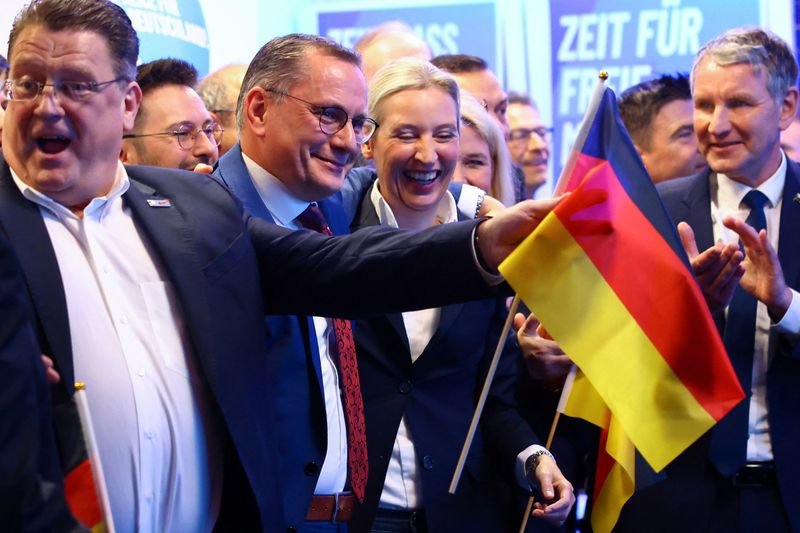
    Supporters of the German far-right party, Alternative for Germany (AfD), celebrate their significant election success, marking a historic moment in German politics. This breakthrough positions them as a formidable opponent in future elections.
    German far-right party supporters celebrating election success - Global Banking & Finance Review
    Why waste money on news and opinion when you can access them for free?

    Take advantage of our newsletter subscription and stay informed on the go!

    Subscribe

    Quick Summary

    The German far-right party AfD achieved a historic second place in the national election, reshaping political debate despite being kept out of government.

    German Far-Right Party Celebrates Historic Election Success

    By Thomas Escritt

    BERLIN (Reuters) - For the first time since the Second World War, a far-right party has come second in a German national election, a result that will keep it outside government but make it a fearsome opponent of the ruling parties.

    The Alternative for Germany, which has morphed since it was founded in 2013 from a party of libertarian economists to an anti-immigration, pro-Russia group, is forecast to have won the backing of one-in-five Germans.

    The AfD has little chance of joining the government as the other parties maintain a "fire wall" to keep it out of office, but leader Alice Weidel implied in her victory speech that it was only a matter of time before that changed.

    "Our hand remains outstretched to form a government," she told supporters, adding that it would be tantamount to "electoral fraud" if the first-placed conservatives chose to govern with left-wing parties rather than them.

    If that happened, she said, "next time we'll come first."

    Weidel, the leader of a nativist party that preaches traditional family values while raising her children with a Swiss-based woman of Sri Lankan background, said the AfD was now "a mainstream party".

    Once internationally isolated, it now has an ally in the White House, where Donald Trump's adviser Elon Musk, the world's richest person, regularly posts his support.

    "It's the most amazing feeling. I've been here since its founding and to see it on 20% is amazing. We'll be kept out of coalition, but as you can see, the conservatives are taking all of our positions," said Gilbert Kalb, an AfD member celebrating at the party's headquarters.

    If cheers were slightly muted, that was because, although its vote share doubled since 2021, the result fell short of the more optimistic expectations.

    Traditionally a pensioners' party, the AfD made inroads among the young, many of whom have experienced years of sluggish economic growth. Exit poll data indicated 22% of 25-to-34-year-olds voted for the party, compared to 10% of those aged 70 and over.

    Ahead of the result, young men in close-fitting suits milled around at the headquarters, drinking beer and eating bratwurst.

    The AfD has undergone successive waves of radicalisation since its founding and is today under surveillance by security services as an anti-democratic threat to Germany's constitutional order.

    Policies include drastically restricting migration, disbanding the European Union and dropping support for Ukraine in its war with Russia.

    One leading figure is regional boss Bjoern Hoecke, twice convicted for shouting slogans of Adolf Hitler's Nazis. Honorary chairman Alexander Gauland has described the Nazis' genocide of Europe's Jews as a lone stain that could not disfigure the glorious sweep of German history.

    It became the largest party in Hoecke's home state of Thuringia last year, and did sufficiently well elsewhere that only improbable and tricky coalitions of centre-right and far left could keep them out of office.

    Even outside government it reshaped debate away from the "welcome culture" under which former Chancellor Angela Merkel let a million refugees settle in 2015, with all mainstream parties now pledging to tighten immigration controls.

    STILL ISOLATED?

    Forecasts suggest it will have 23% of seats in parliament, just under the number needed to set up parliamentary committees of inquiry that can summon witnesses and set the news agenda.

    In a sign of quite how far outside Europe's mainstream it is, other far right parties, including Marine Le Pen's National Rally, have refused to work with a party that reminds many Europeans of Germany's Nazi past.

    Some legislators nurture close ties with Russia and China: one European Parliament member, Petr Bystron is under investigation for taking payment from a Russian-backed disinformation outlet. Another, Maximilian Krah, was suspended after prosecutors said one of his assistants was spying for China.

    There are still formidable barriers in its way: its headquarters, next to an African restaurant on a side street in a distant suburb, is far removed from the other parties' imposing central offices because the stigma surrounding the party is so great that no landlord agreed to let to them.

    But there are signs its political isolation is crumbling: Weidel received an invitation to Budapest to see Viktor Orban, who praised her as a "brave woman" after she lambasted a journalist for describing her party as far-right.

    Other populists such as Italian Deputy Prime Minister Matteo Salvini and Dutch anti-Islam nationalist Geert Wilders offered congratulations on Sunday.

    A year ago, the party seemed to be at a low ebb, buffeted by revelations by investigative journalists that several of its most senior members had met at a secret conference outside Berlin to discuss "remigration" - the deportation of non-ethnic German holders of German citizenship.

    Nationwide protests followed, and the party briefly slipped in polls, but with the economy in crisis and a population disconcerted by war, it scored record results in four successive regional elections in the autumn.

    The president of Germany's Central Jewish Council, Josef Schuster, told Welt newspaper he was shocked at the strength of the AfD's result.

    "This should worry all of us, that a fifth of German voters have voted for a party that in at least some of its policies is far-right, and which in its language and ideology seeks clear links with the radical right and neo-Nazism ...," he said.

    (Reporting by Thomas Escritt; editing by Giles Elgood)

    Key Takeaways

    • •AfD comes second in German national election for the first time since WWII.
    • •The party is excluded from government due to other parties' 'fire wall'.
    • •AfD leader Alice Weidel claims the party is now mainstream.
    • •Young voters increasingly support AfD, with 22% of 25-to-34-year-olds voting for them.
    • •AfD's policies include restricting migration and opposing EU and Ukraine support.

    Frequently Asked Questions about 'Next time we'll come first': German far-right celebrates breakthrough

    1What is the main topic?

    The article discusses the German far-right party AfD's historic second-place finish in a national election.

    2Why is the AfD's result significant?

    It's the first time a far-right party has achieved such a position since WWII, impacting German politics.

    3What are the AfD's key policies?

    The AfD focuses on restricting migration, opposing the EU, and reducing support for Ukraine.

    More from Headlines

    Explore more articles in the Headlines category

    Image for WANTED: Volunteers to host nuclear waste, forever
    WANTED: Volunteers to host nuclear waste, forever
    Image for German exports rise more than expected, industrial production falls
    German exports rise more than expected, industrial production falls
    Image for LG Energy Solution to end Canada battery JV with Stellantis
    LG Energy Solution to end Canada battery JV with Stellantis
    Image for German exports rise 4% in December
    German exports rise 4% in December
    Image for Offshore developer Orsted Q4 core profit slightly lags forecast
    Offshore developer Orsted Q4 core profit slightly lags forecast
    Image for Hungary's deficit to be around 5% of GDP this year and next, Orban says
    Hungary's deficit to be around 5% of GDP this year and next, Orban says
    Image for Germany's Merz to visit Washington in March, Die Welt reports
    Germany's Merz to visit Washington in March, Die Welt reports
    Image for In Hasina’s hometown in Bangladesh, voters face an unfamiliar ballot
    In Hasina’s hometown in Bangladesh, voters face an unfamiliar ballot
    Image for SocGen lifts profit target as retail bank offsets trading drop
    SocGen lifts profit target as retail bank offsets trading drop
    Image for Germany's PNE loses bid for Vietnam wind project, in new blow to foreign investors
    Germany's PNE loses bid for Vietnam wind project, in new blow to foreign investors
    Image for Iran, US to negotiate in Oman amid deep rifts and mounting war fears
    Iran, US to negotiate in Oman amid deep rifts and mounting war fears
    Image for Oil set for first weekly decline in seven weeks ahead of US-Iran talks
    Oil set for first weekly decline in seven weeks ahead of US-Iran talks
    View All Headlines Posts
    Previous Headlines PostAnalysis-Tricky German coalition talks augur more economic pain
    Next Headlines PostInternational reaction to German election