Trading
Why Traders Do Not Need to Return to Old-School Methods
Published by Gbaf News
Posted on May 16, 2020
5 min readLast updated: January 21, 2026
Add as preferred source on Google
Published by Gbaf News
Posted on May 16, 2020
5 min readLast updated: January 21, 2026
Add as preferred source on GoogleBy Terry Ewin, Vice President, EMEA, IPC
We are living in unprecedented times and the world is now several weeks into a new way of living and working due to the novel coronavirus pandemic. Many of us will have now established a new routine whilst having to work remotely and follow strict social distancing measures. For some industries though, this transition has been more challenging for their workforces than others.
The swift influx of demand on internet and telecommunications providers in recent weeks has meant many people have been experiencing unstable connections and dropped calls. Due to these connectivity issues, an article in The Wall Street Journal recently reported how some London traders are going back to pen and paper to continue to comply with the FCA’s regulatory requirement of recording telephone conversations when conducting trades.
Manually recording calls is a slow and arduous process, and it will no doubt be impacting traders’ productivity as they aim to navigate one of the most chaotic markets in their lifetimes. However, traders do not have to return to old-school methods and this article will explore the different ways that they can successfully work remotely and overcome the current crisis.
Voice recording technology to save the day
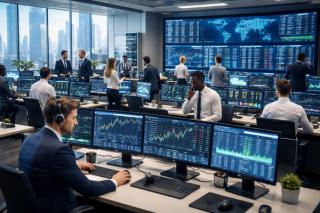
Across the country, banks have had to limit access to their main trading floors so that many traders are either working from back-up sites or from home, where some may not be equipped to electronically record calls. Although the FCA has relaxed the rules slightly on the recording of trade calls owing to the rise of people working away from their usual desks, the UK market regulator still expects firms to record as many calls as possible.
The advice from regulators so far has been that where traders are unable to record calls, they should use written minutes or notes of telephone conversations instead which has seen many traders resort to pen and paper.
This may have been how calls were recorded back in the day, but over the years innovative new recording technologies have enabled traders to work more efficiently. We now have voice trading and dictation-as-a-service (DaaS) solutions with natural language processing as part of this digital transformation.
Many voice trading technologies that are available to traders are also integrated with cloud-based services that can be accessed from any location at any time. Hence, during these challenging circumstances the global trading community can still be provided with a secure and compliant endpoint device or application. This eradicates the need of resorting to old-school methods again.
The challenges to going remote for traders
Traditionally, the financial services industry has been at the forefront of technology adoption. However, financial firms have largely been cautious of cloud services and allowing traders to work remotely. This is understandable as when cloud technologies were first introduced, many feared that moving out of official and highly regulated trading floors increased the risk of security, regulatory and compliance failures.
Other industries had already slowly migrated towards a remote and flexible business model and so were perhaps better prepared to react to these times. For traders and the financial markets though, transitioning the workforce online felt as though participants would be exposed to a multitude of security risks and scams.
Whilst it may have seldom been done before and in order to continue to conduct business throughout the pandemic, financial firms have had no choice but to adapt to a remote working model.
By executing already-established business continuity plans or quickly investing in new technologies and processes, the financial markets have realised that the security capabilities delivered by public and private hyper-scale cloud infrastructure providers have come a long way. These services are indeed comprehensive and quell any doubts that the cloud could reduce security or introduce risk.
Why business continuity plans need Disaster Recovery as a Service
In more stable times, it is easy to forget the critical role that the financial markets play in underpinning world trade, commerce and supply chains. Several governments around the world have even classified many financial market participants as ‘essential’ workers, therefore it is important that they can continue to be supported throughout this global crisis.
Nearly every financial firm will have developed and executed their business continuity plans to enable traders to fulfil their critical roles, but business continuity plans are not comprehensive enough if they don’t include Disaster-Recovery-as-a-Service (DRaaS).
Downtime caused by lost or compromised IT systems can be devastating for the financial markets, so businesses need to be able to mitigate these financial risks by taking sensible precautions. Disaster recovery technologies offer traders a complete replication of an IT environment. The recovery site sits in the cloud to permit continuation of business during the current pandemic.
By leveraging the cloud, financial firms can make significant savings on infrastructure and management costs. It can also provide a huge sense of relief throughout any unexpected downtime or necessity to work in alternative locations.
None of us are in any doubt that this pandemic is here to stay and that our new way of working and living will be the norm for the foreseeable future. It is crucial that all of us learn to adapt to the situation, but this is especially true for traders and financial markets.
The resilience of the financial services industry underpins the success of all other businesses around the world. It is therefore crucial that traders are not slowed down or hampered in any way by returning to old-school methods. Instead, financial firms should be taking advantage of cloud-based services such as voice trading, DaaS and DRaaS to ensure traders can reap the benefits and overcome the numerous challenges presented by the coronavirus.
Explore more articles in the Trading category