
Search
00
GBAF Logo
trophy
Top StoriesInterviewsBusinessFinanceBankingTechnologyInvestingTradingVideosAwardsMagazinesHeadlinesTrends

Subscribe to our newsletter

Get the latest news and updates from our team.

Global Banking and Finance Review

Global Banking & Finance Review

Company

    GBAF Logo
    • About Us
    • Profile
    • Privacy & Cookie Policy
    • Terms of Use
    • Contact Us
    • Advertising
    • Submit Post
    • Latest News
    • Research Reports
    • Press Release
    • Awards▾
      • About the Awards
      • Awards TimeTable
      • Submit Nominations
      • Testimonials
      • Media Room
      • Award Winners
      • FAQ
    • Magazines▾
      • Global Banking & Finance Review Magazine Issue 79
      • Global Banking & Finance Review Magazine Issue 78
      • Global Banking & Finance Review Magazine Issue 77
      • Global Banking & Finance Review Magazine Issue 76
      • Global Banking & Finance Review Magazine Issue 75
      • Global Banking & Finance Review Magazine Issue 73
      • Global Banking & Finance Review Magazine Issue 71
      • Global Banking & Finance Review Magazine Issue 70
      • Global Banking & Finance Review Magazine Issue 69
      • Global Banking & Finance Review Magazine Issue 66
    Top StoriesInterviewsBusinessFinanceBankingTechnologyInvestingTradingVideosAwardsMagazinesHeadlinesTrends

    Global Banking & Finance Review® is a leading financial portal and online magazine offering News, Analysis, Opinion, Reviews, Interviews & Videos from the world of Banking, Finance, Business, Trading, Technology, Investing, Brokerage, Foreign Exchange, Tax & Legal, Islamic Finance, Asset & Wealth Management.
    Copyright © 2010-2025 GBAF Publications Ltd - All Rights Reserved.

    ;
    Editorial & Advertiser disclosure

    Global Banking and Finance Review is an online platform offering news, analysis, and opinion on the latest trends, developments, and innovations in the banking and finance industry worldwide. The platform covers a diverse range of topics, including banking, insurance, investment, wealth management, fintech, and regulatory issues. The website publishes news, press releases, opinion and advertorials on various financial organizations, products and services which are commissioned from various Companies, Organizations, PR agencies, Bloggers etc. These commissioned articles are commercial in nature. This is not to be considered as financial advice and should be considered only for information purposes. It does not reflect the views or opinion of our website and is not to be considered an endorsement or a recommendation. We cannot guarantee the accuracy or applicability of any information provided with respect to your individual or personal circumstances. Please seek Professional advice from a qualified professional before making any financial decisions. We link to various third-party websites, affiliate sales networks, and to our advertising partners websites. When you view or click on certain links available on our articles, our partners may compensate us for displaying the content to you or make a purchase or fill a form. This will not incur any additional charges to you. To make things simpler for you to identity or distinguish advertised or sponsored articles or links, you may consider all articles or links hosted on our site as a commercial article placement. We will not be responsible for any loss you may suffer as a result of any omission or inaccuracy on the website.

    Home > Top Stories > TWO THIRDS OF UK FINANCE PROFESSIONALS BELIEVE SCOTTISH INDEPENDENCE MAKES NO FINANCIAL OR ECONOMIC SENSE
    Top Stories

    TWO THIRDS OF UK FINANCE PROFESSIONALS BELIEVE SCOTTISH INDEPENDENCE MAKES NO FINANCIAL OR ECONOMIC SENSE

    TWO THIRDS OF UK FINANCE PROFESSIONALS BELIEVE SCOTTISH INDEPENDENCE MAKES NO FINANCIAL OR ECONOMIC SENSE

    Published by Gbaf News

    Posted on August 8, 2014

    Featured image for article about [object Object]
    • Just one in ten (11%) finance professionals support the financial and economic arguments for Scottish independence, with 22% remaining on the fence
    • Scotland sees 23% increase in financial services roles since 2007 – with 9,000 new jobs in the past year
    • Sector set to weaken if Scotland becomes independent, with leading finance firms considering relocating elsewhere in the UK

    The majority of UK finance professionals disagree with the economic and financial arguments for Scottish independence, according to specialist accountancy and finance recruiter Marks Sattin*.

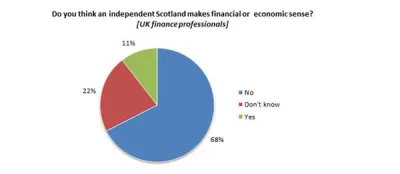
    The research found that over two thirds (68%) of finance professionals practising across the UK believe that Scottish independence makes no economic or financial sense.

    By comparison, only one in ten (11%) agree with the financial arguments put forward for Scottish independence and a fifth (22%) remain undecided on the issue.
    Two thirds of uk finance professionals believe scottish independence makes no financial or economic sense

    Economic and fiscal forecasts for Scotland

    The consensus among UK finance professionals appears to be supported by recent reports from the Office for Budgetary Responsibility (OBR) and the Scottish Government – which downgraded their original forecasts for North Sea oil revenues.

    In 2012-13, Scotland ran an underlying fiscal deficit of 8.3% of GDP compared with 7.3% for the whole of the UK, even after factoring in a geographical allocation of North Sea oil revenues [1].

    The Confederation of British Industry (CBI) predicts that under the OBR’s revised oil revenue forecast, by 2016-17 – the first year of proposed independence – Scotland’s fiscal deficit will widen to 2.4% higher than the UK’s.

    The UK’s main political parties have also ruled out continuing a currency union should Scotland become independent. Without the relative stability of the pound, it is expected that uncertainty for Scottish exporters and importers would heighten. Similarly many expect the creation of a new trade border would increase costs for businesses that currently benefit from a common set of rules.

    Scotland’s financial services sector

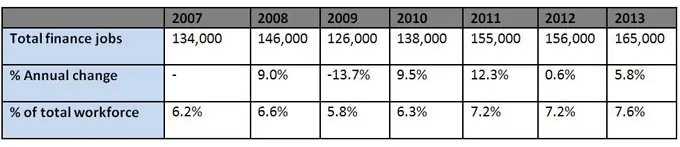
    There are an estimated 165,000 people employed in financial services in Scotland, equating to 7.6% of Scotland’s total workforce and contributing 12% towards its Gross Value Added (GVA)[2] – the economic value of goods and services produced. Such a contribution to the regional economy by financial and professional services is larger in Scotland than in any other area outside London.

    Marks Sattin’s research also found the number of financial services jobs in Scotland has grown by nearly a quarter (23%) since 2007. This averages out at a growth rate of 6% per year. By comparison financial services jobs in the UK have increased by only a fifth (20%) over the same period.

    Scotland Employment in Financial Services
    uk finance professionals believe scottish independence makes no financial or economic sense

    Should the outcome of the Scottish referendum be a “Yes” vote there may be significant ramifications for the region’s financial sector, with a number of leading firms considering relocating their headquarters elsewhere in the UK.

    Conversely, a recent Government Scottish Affairs select committee concluded that were financial companies to stay in an independent Scotland it would result in an “exceptionally large” financial industry, which could threaten financial stability [3].

    Dave Way, Managing Director of Marks Sattin said,

    “Our research suggests the overwhelming consensus among UK finance professionals is that the numbers simply don’t stack up in favour of Scottish independence. With the debate hotting up as campaigns turn the final corner towards September’s referendum, it may well be the fiscal fight that clinches public opinion.

    “Scotland’s financial services sector has clearly thrived in recent years, increasing by a quarter since 2007. While the tangible impact of an independent Scotland remains to be seen, there are clearly question marks shrouding the potential impact on financial services and the prospects for continued growth.

    “On the other hand a ‘yes’ vote will inevitably usher in radical changes in terms of currency, interest and exchange rates and wider business finance. The challenge of setting out Scotland’s stall as an independent nation would call for significant fiscal and monetary expertise, not to mention fundamental leadership and change management skills.”

     

    Related Posts
    'This is the end': Australian teens mourn loss of social media as ban begins
    'This is the end': Australian teens mourn loss of social media as ban begins
    EU firms in China accelerating supply chain diversification, report finds
    EU firms in China accelerating supply chain diversification, report finds
    Justice Department unveils new charges in alleged Russia-backed cyberattacks
    Justice Department unveils new charges in alleged Russia-backed cyberattacks
    Asia shares ease as Fed cut priced, guidance uncertain
    Asia shares ease as Fed cut priced, guidance uncertain
    Venture Global hits back at Shell's fraud claims in LNG arbitration battle
    Venture Global hits back at Shell's fraud claims in LNG arbitration battle
    Australia begins enforcing world-first teen social media ban
    Australia begins enforcing world-first teen social media ban
    Australia social media watchdog sees common cause with US as age ban begins
    Australia social media watchdog sees common cause with US as age ban begins
    French power supply outpacing demand as electrification lags, grid operator says
    French power supply outpacing demand as electrification lags, grid operator says

    Why waste money on news and opinions when you can access them for free?

    Take advantage of our newsletter subscription and stay informed on the go!

    Subscribe