Search
00
GBAF Logo
trophy
Top StoriesInterviewsBusinessFinanceBankingTechnologyInvestingTradingVideosAwardsMagazinesHeadlinesTrends

Subscribe to our newsletter

Get the latest news and updates from our team.

Global Banking & Finance Review®

Global Banking & Finance Review® - Subscribe to our newsletter

Company

    GBAF Logo
    • About Us
    • Advertising and Sponsorship
    • Profile & Readership
    • Contact Us
    • Latest News
    • Privacy & Cookies Policies
    • Terms of Use
    • Advertising Terms
    • Issue 81
    • Issue 80
    • Issue 79
    • Issue 78
    • Issue 77
    • Issue 76
    • Issue 75
    • Issue 74
    • Issue 73
    • Issue 72
    • Issue 71
    • Issue 70
    • View All
    • About the Awards
    • Awards Timetable
    • Awards Winners
    • Submit Nominations
    • Testimonials
    • Media Room
    • FAQ
    • Asset Management Awards
    • Brand of the Year Awards
    • Business Awards
    • Cash Management Banking Awards
    • Banking Technology Awards
    • CEO Awards
    • Customer Service Awards
    • CSR Awards
    • Deal of the Year Awards
    • Corporate Governance Awards
    • Corporate Banking Awards
    • Digital Transformation Awards
    • Fintech Awards
    • Education & Training Awards
    • ESG & Sustainability Awards
    • ESG Awards
    • Forex Banking Awards
    • Innovation Awards
    • Insurance & Takaful Awards
    • Investment Banking Awards
    • Investor Relations Awards
    • Leadership Awards
    • Islamic Banking Awards
    • Real Estate Awards
    • Project Finance Awards
    • Process & Product Awards
    • Telecommunication Awards
    • HR & Recruitment Awards
    • Trade Finance Awards
    • The Next 100 Global Awards
    • Wealth Management Awards
    • Travel Awards
    • Years of Excellence Awards
    • Publishing Principles
    • Ownership & Funding
    • Corrections Policy
    • Editorial Code of Ethics
    • Diversity & Inclusion Policy
    • Fact Checking Policy
    Original content: Global Banking and Finance Review - https://www.globalbankingandfinance.com

    A global financial intelligence and recognition platform delivering authoritative insights, data-driven analysis, and institutional benchmarking across Banking, Capital Markets, Investment, Technology, and Financial Infrastructure.

    Copyright © 2010-2026 - All Rights Reserved. | Sitemap | Tags

    Editorial & Advertiser disclosure

    Global Banking & Finance Review® is an online platform offering news, analysis, and opinion on the latest trends, developments, and innovations in the banking and finance industry worldwide. The platform covers a diverse range of topics, including banking, insurance, investment, wealth management, fintech, and regulatory issues. The website publishes news, press releases, opinion and advertorials on various financial organizations, products and services which are commissioned from various Companies, Organizations, PR agencies, Bloggers etc. These commissioned articles are commercial in nature. This is not to be considered as financial advice and should be considered only for information purposes. It does not reflect the views or opinion of our website and is not to be considered an endorsement or a recommendation. We cannot guarantee the accuracy or applicability of any information provided with respect to your individual or personal circumstances. Please seek Professional advice from a qualified professional before making any financial decisions. We link to various third-party websites, affiliate sales networks, and to our advertising partners websites. When you view or click on certain links available on our articles, our partners may compensate us for displaying the content to you or make a purchase or fill a form. This will not incur any additional charges to you. To make things simpler for you to identity or distinguish advertised or sponsored articles or links, you may consider all articles or links hosted on our site as a commercial article placement. We will not be responsible for any loss you may suffer as a result of any omission or inaccuracy on the website.

    1. Home
    2. >Trading
    3. >The dollar’s primacy will not be threatened by sanctions against Russia
    Trading

    The Dollar’s Primacy Will Not Be Threatened by Sanctions Against Russia

    Published by Jessica Weisman-Pitts

    Posted on May 17, 2022

    6 min read

    Last updated: February 7, 2026

    Add as preferred source on Google
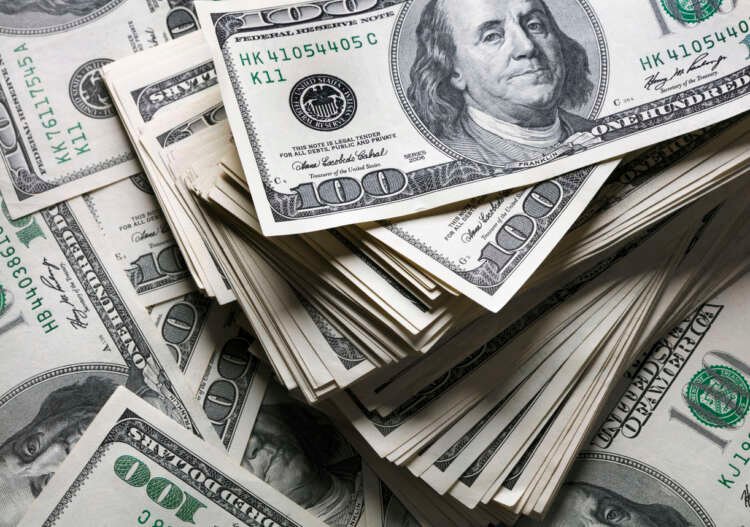
    This image features a stack of one hundred dollar bills, symbolizing the diminishing role of cash in modern finance and trading. It relates to the article discussing the rise of digital currencies and the challenges facing traditional cash systems.
    Stack of one hundred dollar bills illustrating the decline of cash in digital finance - Global Banking & Finance Review
    Why waste money on news and opinion when you can access them for free?

    Take advantage of our newsletter subscription and stay informed on the go!

    Subscribe

    Tags:international financial institutionforeign exchangefinancial marketseconomic growthmonetary policy

    By Nicholas Sargen, Darden School of Business

    Russia’s invasion of Ukraine poses one of the biggest challenges to the post-World War II order, and it could portend further problems ahead if the conflict is protracted, as General Mark Milley recently warned.

    Shortly after the invasion began, the United States and its NATO allies invoked sanctions against Russia that a VOX CEPR report called “the most powerful and costly punishments imposed on a major economy at least since the Cold War.” The actions included freezing Russia’s foreign exchange reserves that resulted in an initial plunge of the rouble. They forced Russia to impose capital controls, hike the central bank’s policy rate to 20 percent and close the stock market while Russia’s sovereign credit rating was lowered to junk status.

    As a result, Russia’s economy is on the brink of a steep recession that could exceed what it experienced in the 2008 global financial crisis. But the sanctions have not deterred Russia from committing war crimes, as the U.S. government and others claim.

    Consequently, the United States and the European Union are now contemplating additional measures. The most impactful would be for European countries to cut back purchases of Russian oil and natural gas, as Russia earns about $1 billion per day exporting energy. Reaching a consensus on this issue is not easy, because European economies import about 40 percent of their oil and gas from Russia, and 55 percent of Germany’s gas came from Russia before the conflict. The dilemma is determining how much economic pain Europe is willing to accept to deter Russia.

    Beyond this, some observers are concerned that the “weaponization of finance” could undermine the international financial system and the dollar’s role in it.

    In an interview with the Financial Times, Gita Gopinath, the IMF’s first deputy managing director, indicated that financial sanctions on Russia could gradually dilute the dominance of the dollar and result in a more fragmented international monetary system. Others go much farther. In an Asia Times commentary, David P. Goldman writes: “Pessimism used to be for monetary cranks; now even Goldman Sachs warns the dollar will go the way of the pound.”

    Concerns about international trade have some validity, as pressures to curtail trade have been building for the past four or five years. Former President Trump’s actions to impose tariffs not only on China but also on U.S. allies have yet to be rescinded by President Biden. Meanwhile, the coronavirus pandemic has disrupted global supply chain links, and the fallout from Russia’s invasion resulted in a 2.8 percent decline in the volume of world trade from February to March.

    But worries that sanctions will erode the dollar’s role in international trade and finance are overblown. As Sebastian Mallaby observes: “Russia, China and other U.S. adversaries would love to escape the financial hegemony of Uncle Sam. But they have been trying for years and have little to show for it.”

    To understand why this is so, consider how the U.S. dollar emerged as the pre-eminent currency after World War II.

    As the most powerful country in the world with the strongest economy, the U.S. was widely viewed as a safe haven, and there was a shortage of dollars in the 1950s. Even Soviet bloc countries sought to hold dollars but did so outside the United States, which gave rise to the eurocurrency market. It then took off when the U.S. government enacted the Interest Equalization Tax (IET) in 1963 that levied a federal tax on the purchase of foreign stocks and bonds by Americans. In the process, multinational corporations obtained dollar funding abroad, and the role of the dollar as a vehicle currency for conducting both trade and finance became entrenched.

    The main challenge to the dollar as the world’s key reserve currency occurred in the 1970s, when the U.S. abandoned convertibility between the dollar and gold. As U.S. inflation surged, the Bretton Woods system of fixed exchange rates gave way to flexible exchange rates. Thereafter, the dollar weakened steadily against the West German deutsche mark, the Swiss franc and the Japanese yen. Throughout the decade, the issue of whether the dollar could retain its status with high U.S. inflation was debated in official circles.

    In the end, the dollar prevailed for two reasons. First, the Federal Reserve restored confidence in the dollar when U.S. inflation was reined in from the mid-1980s onward. Second, Europe, Japan and China lacked the breadth and depth of the U.S. capital markets. Also, both Japan and China have been reluctant to allow capital to move into and out of their countries without restrictions, and they prefer trade surpluses.

    Today, the dollar’s share in official foreign exchange reserves is about 60 percent. This compares with 21 percent for the European Union (EU), 6 percent for Japan and 5 percent for the UK. And while China is pushing the use of its currency in international trade and as a reserve asset, the renminbi represents only 2 percent of global reserves.

    Given this perspective, there are two reasons why the dollar’s role conceivably could be called into question. One is the Federal Reserve could encounter difficulty bringing inflation back toward its average annual target of 2 percent. Thus far, however, investors have not lost confidence in the dollar, which has appreciated against other key currencies since the Russian-Ukrainian conflict began.

    The other is the U.S. could use sanctions and/or tariffs more prevalently in the future. In imposing sanctions on Russia, however, the United States wisely did so along with NATO members and Japan rather than acting unilaterally. Even Switzerland adopted the EU sanctions, and both Sweden and Finland announced they are considering joining NATO. This highlights how egregious Russia’s actions are and why no democracy is accusing the United States of acting irresponsibly.

    Nicholas Sargen, Ph.D., is an economic consultant with affiliations with Fort Washington Investment Advisors in Cincinnati and the University of Virginia’s Darden School of Business. He has authored three books, including, “Global Shocks: An Investment Guide for Turbulent Markets.”

    Frequently Asked Questions about The dollar’s primacy will not be threatened by sanctions against Russia

    1What is a foreign exchange?

    Foreign exchange refers to the global marketplace for trading national currencies against one another, allowing for currency conversion and international trade.

    2What is monetary policy?

    Monetary policy is the process by which a central bank manages the supply of money, interest rates, and inflation to achieve economic stability.

    3What is economic growth?

    Economic growth is the increase in the production of goods and services in an economy over a period, typically measured by the rise in Gross Domestic Product (GDP).

    4What is a financial market?

    A financial market is a marketplace where assets such as stocks, bonds, currencies, and derivatives are traded, facilitating the exchange of capital.

    5What is a central bank?

    A central bank is a national institution that manages a country's currency, money supply, and interest rates, and oversees the banking system.

    More from Trading

    Explore more articles in the Trading category
    Image for What Is Goat Funded Trader and How Does It Work?
    What Is Goat Funded Trader and How Does It Work?
    Image for SV-Alan.com Highlights Growing Demand for Trading Platforms Amid Market Volatility
    SV-Alan.com Highlights Growing Demand for Trading Platforms Amid Market Volatility
    Image for Brokerage brand Octa changing ownership: Main highlights
    Brokerage Brand Octa Changing Ownership: Main Highlights
    Image for Nominations Open for Best Multi-Asset Trading Platform South Africa 2026
    Nominations Open for Best Multi-Asset Trading Platform South Africa 2026
    Image for Ziraat Yatırım Menkul Değerler Anonim Şirketi Secures Dual Honors at the 2026 Global Banking & Finance Review Awards®
    Ziraat Yatırım Menkul Değerler Anonim Şirketi Secures Dual Honors at the 2026 Global Banking & Finance Review Awards®
    Image for VPS Securities J.S.C Wins IPO of the Year Vietnam 2026 at the Global Banking & Finance Review Awards®
    Vps Securities J.S.C Wins IPO of the Year Vietnam 2026 at the Global Banking & Finance Review Awards®
    Image for Understand What Is Whipsaw in Trading and How You Can Avoid It?
    Understand What Is Whipsaw in Trading and How You Can Avoid It?
    Image for Committee of SADC Stock Exchanges Wins Best ESG Initiative - Framework for Sustainability & Equality Reporting Africa 2026 by Global Banking & Finance Review®
    Committee of Sadc Stock Exchanges Wins Best ESG Initiative - Framework for Sustainability & Equality Reporting Africa 2026 by Global Banking & Finance Review®
    Image for BIDV Securities Company (BSC) and Mr. Lê Huy Honoured at the 2026 Global Banking & Finance Review Awards®
    Bidv Securities Company (bsc) and Mr. Lê Huy Honoured at the 2026 Global Banking & Finance Review Awards®
    Image for Bao Minh Securities Wins Best Investment Research Vietnam 2026 Award by Global Banking & Finance Review®
    Bao Minh Securities Wins Best Investment Research Vietnam 2026 Award by Global Banking & Finance Review®
    Image for Allianz Trade Wins Best Trade Credit Insurance Company Asia Pacific 2026 at the Global Banking & Finance Review Awards®
    Allianz Trade Wins Best Trade Credit Insurance Company Asia Pacific 2026 at the Global Banking & Finance Review Awards®
    Image for OCBC Securities Pte Ltd Celebrates Major Wins at the 2026 Global Banking & Finance Review Awards®
    Ocbc Securities Pte Ltd Celebrates Major Wins at the 2026 Global Banking & Finance Review Awards®
    View All Trading Posts
    Previous Trading PostPound Falls as UK Inflation Hits 40 Year High
    Next Trading PostHow Do Crypto Exchange Platforms Work: All You Need to Know