This image depicts a remote database administrator engaged in tasks related to digital transformation, emphasizing the evolving role of DBAs in cloud environments as highlighted in the article.
The rising awareness among consumers about a multitude of health benefits of plant-based sources of protein has been aiding the market for texturized vegetable protein. Future Market Insights (FMI) in a new study has forecast the market to reach US$ 1.03 Bn by the end of 2021. Growth forecasts continue to remain positive for the market, thanks to increasing number of vegetarian population worldwide.
Continuously increasing demand for food & beverage products which provide nutritional benefits with sensory taste is one of the major factor driving the demand for texturized vegetable protein. Due to increasing awareness regarding animal cruelty and environmental damages caused by excessive consumption of might the demand for texturized vegetable protein is expected to increase.
These protein sources also contain lower amount of saturated fat and cholesterol as compared to meat products hence are considered to have more health benefits. Among products available, the demand for soy protein is expected to be the highest. As per FMI, the soy protein segment is forecast to account for over 80% of the market through 2031.
Texturized Vegetable Protein Market
Key Takeaways from the Texturized Vegetable Protein Market Study
The North American texturized vegetable protein market leads in terms of market size and accounts for 30.1% of the global texturized vegetable protein market in 2021.
The Soy Protein texturized vegetable protein market is expected to have a market share of 70.0% of the global texturized vegetable protein market in 2031.
In the nature segment, Conventional holds 97.9 % of the texturized vegetable protein market.
In the end-user segment, Industry holds the maximum market share of 76.1% in 2021 of texturized vegetable protein market where Meat Analogues holds 42.8% globally in 2021.
Soy protein has a major share by product type and is anticipated to grow significantly over the forecast period. North America have a large number of companies and thus, majority of companies are emphasizing on offering non-GMO products, which are processed through extrusion-based technology, with enhanced functional properties so that their product can comply with strict requirements of clean label products.
“Benefits of opting vegan proteins are now gaining popularity due to which many big companies are investing in the production and innovation of texturized vegetable protein. Several manufacturers are acquiring or merging with key companies to expand theirproduct portfolio and increase their market share. E-commerce and online stores are easing entry barriers and distribution costs. These factors are expected to make competition fiercer within the market” said a lead analyst at FMI
Who is Winning?
The global population is increasing at a rapid rate and it is expected that the population will be around 9.5 Bn by 2050 from 7 Bn in 2017. The situation is set to put quite a strain on the food and supply of raw material, resulting in the need for alternate protein sources. Key players operating in the market are adopting various strategies, which include expansion of production capacity and launch of various products.
For Instance:
CHS Inc. provides Ultra-Soy, a texturized soy protein with an expectation to improve the customer experience for meat alternatives. The company acquired Legacy Foods in 2008 to makes its own brand of soy-based products and started offering Ultra-Soy in the texturized vegetable protein market.
Roquette Frères expanded the production capacity of its pea protein-producing facility in Europe texturized vegetable protein market to increase the production. The company launched a new vegan pea protein NUTRALYS T70S into the texturized vegetable protein market which is suitable for vegetarians as well as vegan applications.
In 2018 Sotexpro SA, launched Texta Pois 72/90 with 72% vegetable protein.
In October 2015, Archer Daniels Midland acquire more stakes in Wilmar Int. Ltd. from 17.3% to 18% to expand its presence in Asia pacific market. Further company bought shares in Harvest Innovations, which offers pressed soy protein product and many more.
A few of the leading players operating in the texturized vegetable protein market are Archer Daniels Midland Company, CHS Inc., Roquette Frères, Beneo GmbH, Danisco A/S, Vestkron A/S, Cargill Inc., FUJI OIL CO., LTD., Puris Proteins, LLC., MGP Ingredients, Inc., Crown Soya Protein Group, Sotexpro SA, Wilmar International Ltd., Gushen Biotechnology Group Co., Ltd., Ingredion Inc.
Get Valuable Insights into Texturized Vegetable Protein Market
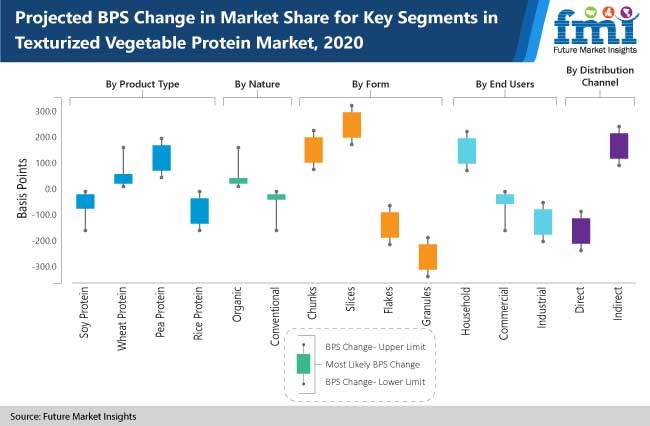
Future Market Insights, in its new offering, provides an unbiased analysis of the texturized vegetable protein Market, presenting historical demand data (2016-2020) and forecast statistics for the period from 2021-2031. The study divulges compelling insights on the texturized vegetable protein market based on Product Type (Soy Protein, Wheat Protein, Pea Protein, and Rice Protein), By Nature (Organic and Conventional), By Form (Chunks, Slices, Flakes, and Granules), By End Users (Household, Commercial, and Industrial) and By Distribution Channel (Direct, Store Based, Hypermarket/ Supermarket, Convenience Store, Traditional Grocery Retail, Online Retail.) across seven major regions.
The rising awareness among consumers about a multitude of health benefits of plant-based sources of protein has been aiding the market for texturized vegetable protein. Future Market Insights (FMI) in a new study has forecast the market to reach US$ 1.03 Bn by the end of 2021. Growth forecasts continue to remain positive for the market, thanks to increasing number of vegetarian population worldwide.
Continuously increasing demand for food & beverage products which provide nutritional benefits with sensory taste is one of the major factor driving the demand for texturized vegetable protein. Due to increasing awareness regarding animal cruelty and environmental damages caused by excessive consumption of might the demand for texturized vegetable protein is expected to increase.
These protein sources also contain lower amount of saturated fat and cholesterol as compared to meat products hence are considered to have more health benefits. Among products available, the demand for soy protein is expected to be the highest. As per FMI, the soy protein segment is forecast to account for over 80% of the market through 2031.
Texturized Vegetable Protein Market
Key Takeaways from the Texturized Vegetable Protein Market Study
The North American texturized vegetable protein market leads in terms of market size and accounts for 30.1% of the global texturized vegetable protein market in 2021.
The Soy Protein texturized vegetable protein market is expected to have a market share of 70.0% of the global texturized vegetable protein market in 2031.
In the nature segment, Conventional holds 97.9 % of the texturized vegetable protein market.
In the end-user segment, Industry holds the maximum market share of 76.1% in 2021 of texturized vegetable protein market where Meat Analogues holds 42.8% globally in 2021.
Soy protein has a major share by product type and is anticipated to grow significantly over the forecast period. North America have a large number of companies and thus, majority of companies are emphasizing on offering non-GMO products, which are processed through extrusion-based technology, with enhanced functional properties so that their product can comply with strict requirements of clean label products.
“Benefits of opting vegan proteins are now gaining popularity due to which many big companies are investing in the production and innovation of texturized vegetable protein. Several manufacturers are acquiring or merging with key companies to expand theirproduct portfolio and increase their market share. E-commerce and online stores are easing entry barriers and distribution costs. These factors are expected to make competition fiercer within the market” said a lead analyst at FMI
Who is Winning?
The global population is increasing at a rapid rate and it is expected that the population will be around 9.5 Bn by 2050 from 7 Bn in 2017. The situation is set to put quite a strain on the food and supply of raw material, resulting in the need for alternate protein sources. Key players operating in the market are adopting various strategies, which include expansion of production capacity and launch of various products.
For Instance:
CHS Inc. provides Ultra-Soy, a texturized soy protein with an expectation to improve the customer experience for meat alternatives. The company acquired Legacy Foods in 2008 to makes its own brand of soy-based products and started offering Ultra-Soy in the texturized vegetable protein market.
Roquette Frères expanded the production capacity of its pea protein-producing facility in Europe texturized vegetable protein market to increase the production. The company launched a new vegan pea protein NUTRALYS T70S into the texturized vegetable protein market which is suitable for vegetarians as well as vegan applications.
In 2018 Sotexpro SA, launched Texta Pois 72/90 with 72% vegetable protein.
In October 2015, Archer Daniels Midland acquire more stakes in Wilmar Int. Ltd. from 17.3% to 18% to expand its presence in Asia pacific market. Further company bought shares in Harvest Innovations, which offers pressed soy protein product and many more.
A few of the leading players operating in the texturized vegetable protein market are Archer Daniels Midland Company, CHS Inc., Roquette Frères, Beneo GmbH, Danisco A/S, Vestkron A/S, Cargill Inc., FUJI OIL CO., LTD., Puris Proteins, LLC., MGP Ingredients, Inc., Crown Soya Protein Group, Sotexpro SA, Wilmar International Ltd., Gushen Biotechnology Group Co., Ltd., Ingredion Inc.
Get Valuable Insights into Texturized Vegetable Protein Market
Future Market Insights, in its new offering, provides an unbiased analysis of the texturized vegetable protein Market, presenting historical demand data (2016-2020) and forecast statistics for the period from 2021-2031. The study divulges compelling insights on the texturized vegetable protein market based on Product Type (Soy Protein, Wheat Protein, Pea Protein, and Rice Protein), By Nature (Organic and Conventional), By Form (Chunks, Slices, Flakes, and Granules), By End Users (Household, Commercial, and Industrial) and By Distribution Channel (Direct, Store Based, Hypermarket/ Supermarket, Convenience Store, Traditional Grocery Retail, Online Retail.) across seven major regions.
Frequently Asked Questions about Texturized Vegetable Protein Market Share, Global Industry Size, Growth, SWOT Analysis, Top Companies, Competitor Landscape, Regional Outlook 2021
1What is texturized vegetable protein?
Texturized vegetable protein (TVP) is a meat substitute made from soy flour. It is often used in vegetarian and vegan dishes to provide a protein-rich alternative to meat.
2What is the significance of soy protein in the market?
Soy protein is a major component of texturized vegetable protein, expected to dominate the market due to its nutritional benefits and versatility in food products.