

With the surge in the demand for smart TVs, leading manufactures have now shifted their focus on technologies that cater to multi-functional consumer needs. Future Market Insights (FMI) in its latest study has forecast the smart TV market to rise at a CAGR of ~24.7% between 2021 and 2031.
Smart Tv Market
Innovations are transforming the television industry by integrating advanced technologies like artificial intelligence (AI), Internet of Things (IoT), Google Assistance, and internet connected services in latest models of smart televisions, which were not available in traditional cathode-ray tube (CRT) televisions.
The smart TV industry consists of several big players like the Samsung Group, TLC Corporation, Panasonic Corporation, and Sony Corporation. The smart TV industry is being viewed as lucrative investment opportunity due to enormous customer interest.
Partnerships between big companies and small players are bolstering the scope for growth. Manufacturers are focusing on developing innovative product features, in addition to effectively developing sales and distribution channels. Most consumers focus on online product research before making a purchase.
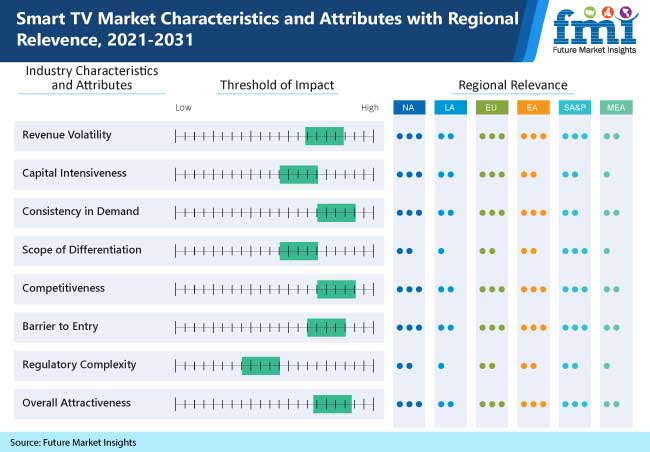
As a result, manufacturers are increasing their product presence and online availability. In addition, the increasing popularity of smart homes among middle-class urban population is a major factor fuelling the demand for smart TVs in the market.
Get more Insights Analysis on this Smart TV Market @ https://www.futuremarketinsights.com/ask-question/rep-gb-3633
Key Takeaways from the Smart TV Market Study
- The 45- 50 inches’ segment accounted for a 22.3% share in 2020, which is attributable to the increasing penetration of 4K TVs in the higher economic consumer class.
- Multi-brand stores are a popular distribution channel, accounting for over 29% of the market. However, online sales are expected rise at 27.3% CAGR.
- The U.S. currently holds the lead accounting for 79.5% of the North America market, driven by increasing consumer expenditure on lifestyle products.
- Japan is expected to register high potential for growth, accounting for an estimated 51.7% share in East Asia market by the end of 2031, supported by easier access to new technologies.
- India followed by Indonesia are projected to emerge as lucrative markets in South Asia, holding over 32% and 23% share.
“Online steaming services and smart TVs have developed a symbiotic relationship, where the latter benefits from the use of the myriad options offered by steaming services- which in turn will complement the growth of the smart TV market through the end of 2031,” says an FMI analyst.
Impact of COVID-19 on the Smart TV Market
The COVID-19 pandemic has adversely impacted the smart TV market. Lockdown imposed by governments, suspended operations in manufacturing facilities. Restrictions were imposed on the movement of non-essential goods and services for months, which hampered the overall supply/distribution for smart TVs across the globe.
Samsung which has manufacturing facilities in Vietnam, the Czech Republic, and Hungary was relatively less affected in 2019. However, with the closing of Hungary’s boarders and the lock down in Czech Republic, Samsung faced difficulties in operating its European facilities.
The outbreak had a negative impact on businesses in 2020 and continued to affect operations in 2021. However, in the current scenario, the smart TV market is expected to recover steadily from the downfall in the forecast period.
Who is Winning?
Key players operating in the smart TV market include Samsung Electronics Co., Ltd, Panasonic Corporation, LG Electronics, Inc., Sony Corporation, Videocon Industries Limited, Haier Electronics Group Co, Ltd, TCL Corporation., Hisense Group, Sansui Electric Co., Ltd., Micromax Informatics, Sharp Corporation, VIZIO, Inc., Apple Inc, Toshiba Corporation, Hitachi Ltd and among others.
Players in the moderately consolidated smart TV market are largely involved in strategies for product development and launches in addition to investments for geographical and capacity expansion to sustain long term growth.
- In March 2020, Samsung Electronics Co., Ltd. announced the latest and expanded line of 2020 QLED 4K and 8K TVs at select retailers. The latest and expanded 8K series in the 2020 series has larger screen sizes, improved AI capabilities for the 4K and 8K models, and is designed to provide superior image and sound qualities.
- In July 2020, Indian television brand Shinco, launched its latest television, the S43UQLS 43- inch 4K HDR LED Smart TV. This is one of the most affordable 4K televisions on the market of this size, as most 43-inch televisions at this price have full-HD LED displays.
- In April 2020, Sharp Corporation, announced two new 8K smart TVs for the Japanese market, namely the Sharp Aquas 8T-C70CX1 and the Sharp Aquos 8T-C60XX1, which include 70-inch and 60-inch 8K panels.
- In April 2021, Samsung and Mediatek, announced the world’s first 8K QLED TV – which will deliver the fastest connectivity experience through its cutting-edge WI-FI 6E capabilities.
Get Valuable Insights into Smart TV Market
Future Market Insights, in its new offering, provides an unbiased analysis of the global smart TV market, presenting historical demand data (2016-2020) and forecast statistics for the period from (2021-2031). The study divulges compelling insights on the smart TV market based on the display technology type (LED, QLED, HDR, OLED, LCD, IPS LCD, and XLED), screen type (flat, curved and foldable), screen size (32 inches and under, 33 to 44 inches, 45 to 50 inches, 51 to 55 inches, 56 to 65 inches, 66 inches and above), application type (residential and commercial{ hotels, restaurants, corporate offices, cafeterias, and others}) price (under US$ 500, US$500 – US$ 1000, US$ 1000 – US$ 2000, US$ 2000 – US$ 3000 and US$ 3000 and above), sales channel (hypermarkets/supermarkets, speciality stores, multi-brand stores, online retailers, wholesalers & distributors, and other sales channel), across seven major regions.
The post Smart TV Market Forecast Based on Major Drivers & Trends Up to 2031 first appeared on Market Research Blog.
With the surge in the demand for smart TVs, leading manufactures have now shifted their focus on technologies that cater to multi-functional consumer needs. Future Market Insights (FMI) in its latest study has forecast the smart TV market to rise at a CAGR of ~24.7% between 2021 and 2031.
Smart Tv Market
Innovations are transforming the television industry by integrating advanced technologies like artificial intelligence (AI), Internet of Things (IoT), Google Assistance, and internet connected services in latest models of smart televisions, which were not available in traditional cathode-ray tube (CRT) televisions.
The smart TV industry consists of several big players like the Samsung Group, TLC Corporation, Panasonic Corporation, and Sony Corporation. The smart TV industry is being viewed as lucrative investment opportunity due to enormous customer interest.
Partnerships between big companies and small players are bolstering the scope for growth. Manufacturers are focusing on developing innovative product features, in addition to effectively developing sales and distribution channels. Most consumers focus on online product research before making a purchase.
As a result, manufacturers are increasing their product presence and online availability. In addition, the increasing popularity of smart homes among middle-class urban population is a major factor fuelling the demand for smart TVs in the market.
Get more Insights Analysis on this Smart TV Market @ https://www.futuremarketinsights.com/ask-question/rep-gb-3633
Key Takeaways from the Smart TV Market Study
- The 45- 50 inches’ segment accounted for a 22.3% share in 2020, which is attributable to the increasing penetration of 4K TVs in the higher economic consumer class.
- Multi-brand stores are a popular distribution channel, accounting for over 29% of the market. However, online sales are expected rise at 27.3% CAGR.
- The U.S. currently holds the lead accounting for 79.5% of the North America market, driven by increasing consumer expenditure on lifestyle products.
- Japan is expected to register high potential for growth, accounting for an estimated 51.7% share in East Asia market by the end of 2031, supported by easier access to new technologies.
- India followed by Indonesia are projected to emerge as lucrative markets in South Asia, holding over 32% and 23% share.
“Online steaming services and smart TVs have developed a symbiotic relationship, where the latter benefits from the use of the myriad options offered by steaming services- which in turn will complement the growth of the smart TV market through the end of 2031,” says an FMI analyst.
Impact of COVID-19 on the Smart TV Market
The COVID-19 pandemic has adversely impacted the smart TV market. Lockdown imposed by governments, suspended operations in manufacturing facilities. Restrictions were imposed on the movement of non-essential goods and services for months, which hampered the overall supply/distribution for smart TVs across the globe.
Samsung which has manufacturing facilities in Vietnam, the Czech Republic, and Hungary was relatively less affected in 2019. However, with the closing of Hungary’s boarders and the lock down in Czech Republic, Samsung faced difficulties in operating its European facilities.
The outbreak had a negative impact on businesses in 2020 and continued to affect operations in 2021. However, in the current scenario, the smart TV market is expected to recover steadily from the downfall in the forecast period.
Who is Winning?
Key players operating in the smart TV market include Samsung Electronics Co., Ltd, Panasonic Corporation, LG Electronics, Inc., Sony Corporation, Videocon Industries Limited, Haier Electronics Group Co, Ltd, TCL Corporation., Hisense Group, Sansui Electric Co., Ltd., Micromax Informatics, Sharp Corporation, VIZIO, Inc., Apple Inc, Toshiba Corporation, Hitachi Ltd and among others.
Players in the moderately consolidated smart TV market are largely involved in strategies for product development and launches in addition to investments for geographical and capacity expansion to sustain long term growth.
- In March 2020, Samsung Electronics Co., Ltd. announced the latest and expanded line of 2020 QLED 4K and 8K TVs at select retailers. The latest and expanded 8K series in the 2020 series has larger screen sizes, improved AI capabilities for the 4K and 8K models, and is designed to provide superior image and sound qualities.
- In July 2020, Indian television brand Shinco, launched its latest television, the S43UQLS 43- inch 4K HDR LED Smart TV. This is one of the most affordable 4K televisions on the market of this size, as most 43-inch televisions at this price have full-HD LED displays.
- In April 2020, Sharp Corporation, announced two new 8K smart TVs for the Japanese market, namely the Sharp Aquas 8T-C70CX1 and the Sharp Aquos 8T-C60XX1, which include 70-inch and 60-inch 8K panels.
- In April 2021, Samsung and Mediatek, announced the world’s first 8K QLED TV – which will deliver the fastest connectivity experience through its cutting-edge WI-FI 6E capabilities.
Get Valuable Insights into Smart TV Market
Future Market Insights, in its new offering, provides an unbiased analysis of the global smart TV market, presenting historical demand data (2016-2020) and forecast statistics for the period from (2021-2031). The study divulges compelling insights on the smart TV market based on the display technology type (LED, QLED, HDR, OLED, LCD, IPS LCD, and XLED), screen type (flat, curved and foldable), screen size (32 inches and under, 33 to 44 inches, 45 to 50 inches, 51 to 55 inches, 56 to 65 inches, 66 inches and above), application type (residential and commercial{ hotels, restaurants, corporate offices, cafeterias, and others}) price (under US$ 500, US$500 – US$ 1000, US$ 1000 – US$ 2000, US$ 2000 – US$ 3000 and US$ 3000 and above), sales channel (hypermarkets/supermarkets, speciality stores, multi-brand stores, online retailers, wholesalers & distributors, and other sales channel), across seven major regions.
The post Smart TV Market Forecast Based on Major Drivers & Trends Up to 2031 first appeared on Market Research Blog.