
Finance
Scaling Compliance: How Crypto Exchanges Manage Risk for High-Volume Crypto Markets
Published by Barnali Pal Sinha
Posted on April 8, 2026
6 min readLast updated: April 8, 2026
Add as preferred source on Google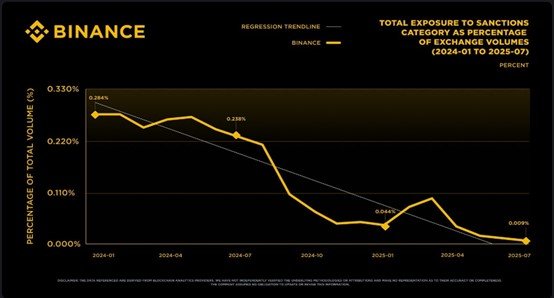
Published by Barnali Pal Sinha
Posted on April 8, 2026
6 min readLast updated: April 8, 2026
Add as preferred source on GoogleProcessing over $125 trillion in cumulative trading volume creates an operational reality that few financial institutions ever face. This staggering metric belongs to Binance. The exchange currently facilitates trades for more than 300 million registered users globally while actively targeting a fut...
Processing over $125 trillion in cumulative trading volume creates an operational reality that few financial institutions ever face. This staggering metric belongs to Binance. The exchange currently facilitates trades for more than 300 million registered users globally while actively targeting a future user base of one billion.
Operating at this magnitude forces a fundamental shift in how cryptocurrency platforms approach risk management. Compliance frameworks designed to handle a few million daily transactions buckle under the weight of global and round-the-clock volume.
The analysis of the systems behind this trillion-dollar throughput reveals exactly what it takes to build infrastructure capable of monitoring, analyzing, and securing crypto markets. We are witnessing an era where managing risk at this scale dwarfs the capabilities of many traditional financial ecosystems. And this requires massive continuous investment to remain efficient.
The operational hurdle of overseeing a global cryptocurrency exchange changes dramatically once a platform reaches hundreds of millions of users. Identity verification and transaction monitoring at this scale require institutional-grade compliance systems operating continuously across jurisdictions.
Binance says it has invested heavily in the frameworks, teams, and technology required to manage these complexities. “Our ambition is to serve 1 billion users,” notes Binance Co-CEO Richard Teng, highlighting the operational trajectory ahead while emphasizing that the company’s global compliance commitments remain unchanged. “There’s no change in that. We will continue with our global footprint.”
The company’s compliance efforts recently drew public attention after media reports alleged the exchange allowed transactions linked to Iran-backed groups and ignored internal warnings. Binance executives strongly rejected those claims, pointing to its extensive sanctions monitoring and law-enforcement cooperation. Binance Global Head of Sanctions Astra Thai commented during a recent interview on The David Lin Report, “Once we get the intelligence from the law enforcement, we act upon that immediately — conducting the investigation in accordance with company policies and procedures — and then take the appropriate action including offboarding certain accounts.”
A related case was later dismissed by a Manhattan federal judge, underscoring the complexity of interpreting blockchain transaction flows at global scale. “The dismissal of terrorism-financing allegations against Binance establishes the reputational and legal stakes driving exchanges to invest at this scale," said Eleanor Hughes, Binance's General Counsel.
Supporting a user base of this size also means managing significant regulatory interaction. Binance processed more than 71,000 requests from law enforcement agencies worldwide last year, reflecting the growing role major exchanges play in assisting investigations and enforcing financial compliance.
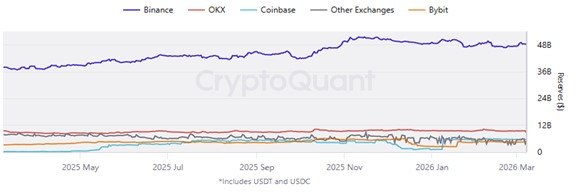
Handling this is an operational necessity (rather than a promotional talking point). Recent market data illustrates this massive concentration of capital, with Binance now holding65% of all centralized exchange stablecoin reserves, totaling $47.5 billion.
When an exchange processes over $125 trillion in cumulative volume and holds this much liquidity, manual compliance processes become obsolete. The challenge lies in building automated, reliable systems capable of detecting illicit activity across massive daily volumes without grinding legitimate market activity to a halt.
Managing risk at this tier requires severe capital allocation. Binance has invested hundreds of millions of dollars into its compliance architecture and dedicated around 25% of its global headcount to the effort. It means that over 1,500 employees operate across specialized functions. These functions include financial crimes investigations, counter-terrorist financing, and sanctions controls.
Technology acts as the backbone of this human effort. The exchange maintains a specialized unit of over 100 engineers devoted strictly to compliance technology, leveraging artificial intelligence for fraud detection, transaction monitoring, and market surveillance.
This level of technical investment yields measurable operational outcomes. Through these advanced monitoring systems, the platform assisted authorities in confiscating more than $131 million in illicit funds in 2025.
Internal data shows the company drove a 96.8% decline in its sanctions-related exposure as a percentage of total volume over an 18-month period. It also cut direct exposure to Iranian exchanges by 97.3%.
For exchanges processing trillion-dollar flows, deploying this depth of capital into security infrastructure is a structural requirement to remain operational and secure the ecosystem against sophisticated bad actors.
Securing and maintaining market access globally means complying with a labyrinth of competing requirements in multiple countries and regions. Binance currently holds registrations and authorizations across 20 jurisdictions. The company must meet specific (and often overlapping) reporting obligations for each local regulator.
A recent milestone illustrates the baseline expected by top-tier financial watchdogs. Securing full authorization under the Financial Services Regulatory Authority of ADGM required the implementation of institutional-grade compliance structures. This involved separating clearing, custody, and trading functions to mirror traditional financial market architecture.
This is a global footprint that takes significant resources to maintain. Doing so requires platforms with millions of international users to undergo relentless scrutiny. For one, Binance faced a rigorous series of independent external reviews, internal audits, regulatory inspections, and supervisory feedback in multiple markets over the past 18 months. But this level of oversight demands strict internal governance as serving global users means meeting the highest standards in every operating region.
Consequently, compliance functions must operate independently, with the Chief Compliance Officer reporting directly to the management committee to ensure regulatory decisions are based on established procedures rather than commercial interests.
When an exchange oversees 300 million users and moves hundreds of trillions of dollars, compliance ceases to be administrative overhead. It has become a core competitive infrastructure.
The sheer cost of building and maintaining these risk management systems creates a formidable barrier to entry. Smaller market participants simply cannot match the capital and headcount required to satisfy global regulators.
Looking toward Teng's ambition of onboarding one billion users with the same rigorous compliance standards, this infrastructure will dictate the pace of future expansion. In the current cryptocurrency market, scale and compliance are not in tension. They fundamentally require each other to survive.
Disclaimer: This article is for informational and educational purposes only. The content reflects publicly available data, and industry analysis. It does not constitute financial, investment, or legal advice, nor an endorsement of any company, product, or service mentioned. Readers should conduct their own independent research and consult professional advisors before making any financial or business decisions.
Explore more articles in the Finance category