
Research Reports
Rain Barrels Market Latest Technology and Market Trends and Forecast – 2030
Published by mark itwired
Posted on September 23, 2021
4 min readLast updated: February 2, 2026
Add as preferred source on Google
Published by mark itwired
Posted on September 23, 2021
4 min readLast updated: February 2, 2026
Add as preferred source on GoogleThe rain barrels market is set to grow, driven by conservation efforts and smart technology integration, with a forecast reaching US$ 1.97 Bn by 2021.
The low supply of water has led to practices such as rainwater harvesting and rainwater conservation. This has fuelled the demand for rain barrels to store and preserve rain water for later use. According to a new study by Future Market Insights (FMI), rain barrel market will reach US$ 1.97 Bn in 2021.
A rainwater barrel is highly useful for preserving water for domestic water uses like washing cars, cleaning laws and even to flush toilet water. Rain barrels not only help in decreasing water bills but also helps in situations like stormwater run-off and wastage of water.
Open head rain barrels are in common use at a global level due to their ease of handling. This segment is estimated to expand 2.4x times than tight head rain barrels by the end of 2030. Also the demand for rain barrels made from plastic is expected to remain considerable high. Ease of use and price competitiveness of plastic rain barrels will aid their sales through the course of the forecast period.
“Erratic climatic conditions in certain parts of the world has caused the demand for rain barrels to rise at an accelerated pace. Rain barrels in-built with the latest technologies are gradually making their way into the market. Recyclability will however remain the foremost factor driving rain barrels adoption. Government initiatives, coupled with focus on water conservation practices, will drive rain barrel sales,” Says an FMI analyst
Uses of a traditional rain barrel were limited to storing water for rainwater harvesting. Technological advancements and recent advents in the Internet of Things (IoT) have created new possibilities. These advancements have made real-time monitoring of rain barrels possible. Integration with smartphone applications is a key game changer, allowing users to monitor from their phone.
Weather forecasts and time-controlled filling are some of the latest features incorporated in smart rain barrels. Better management of water is possible through automatic release and creating buffer capacities in rain barrels. Rain barrels can now study weather forecasts, thanks to the integration of machine learning and artificial intelligence. These developments are expected to be key game changers.
Request Complete TOC Of this Report >>>https://www.futuremarketinsights.com/reports/rain-barrels-market/table-of-content
Rain barrels are made from materials like plastics, metals, wood, ceramic and clay that consume a lot of energy during production. Sure most of these materials are recyclable but they’re also harmful to the environment. Most plastic rain barrels could be re-used for years and but could be recycled only up to a certain number of times.
Disposing plastic is a critical task because it isn’t biodegradable and does not decompose. Metal rain barrels often fall prone to rusting and eventually turning into scrap. Environmental impacts of disposal of rain barrels could act as a setback for the expansion of the rain barrels market.
The global rain barrels market is highly fragmented. Domestic players hold a larger portion of market. Some of the key players operating in the global rain barrels market are ORBIS Corporation, Capi Europe B.V., GRAF GMBH, Koolatron Corporation, ROTO Group UK, WISY AG, The Barrel Makers, Etills Limited., Oaklands Group Ltd., Good Ideas Inc., Algreen Products, Inc., Bosmere Products Ltd. and Emsco Group.
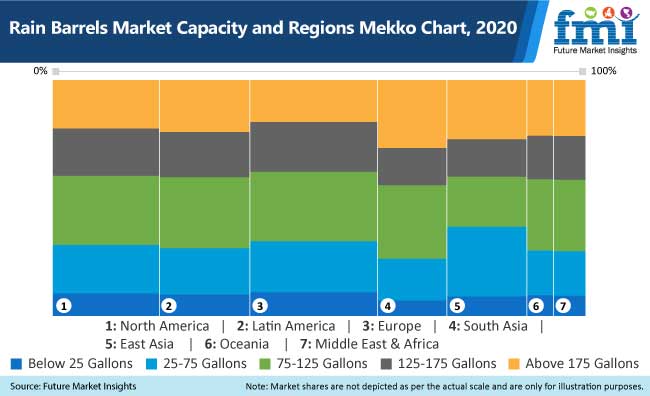
Future Market Insights, in its new report, offers an unbiased analysis of the global rain barrels market, analyzing historical demand from 2015-2019 and forecast statistics for 2020-2030. The study reveals growth projections on the rain barrels market on the basis of capacity (Below 25 gallons, 25-75 gallons, 75-125 gallons, 125-175 gallons, and above 175 gallons), material type (metal, plastic, wood, concrete, and clay), and head type (open head and tight head) across seven regions.
The post Rain Barrels Market Latest Technology and Market Trends And Forecast – 2030 first appeared on Market Research Blog.
The article focuses on the rain barrels market, highlighting technological trends and market forecasts up to 2030.
Smart rain barrels integrate IoT for real-time monitoring and management, enhancing water conservation efforts.
Environmental impacts from disposal and material recyclability pose challenges to market growth.
Explore more articles in the Research Reports category