
Research Reports
Patchouli Oil Market 2021 – Revenue Status and Forecast Report 2028
Published by mark itwired
Posted on September 29, 2021
5 min readLast updated: February 1, 2026
Add as preferred source on Google
Published by mark itwired
Posted on September 29, 2021
5 min readLast updated: February 1, 2026
Add as preferred source on GoogleThe patchouli oil market is projected to grow at a 2.8% CAGR, reaching US$ 86.6 Mn by 2028, driven by demand in cosmetics and pharmaceuticals.
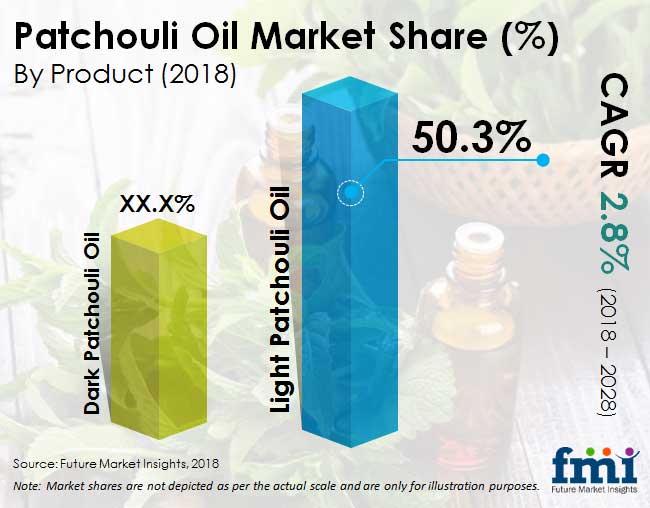
The patchouli oil market, globally, is expected to grow at a CAGR of 2.8% in terms of revenue during the forecast years. Revenue obtained from the global patchouli oil market is projected to reach US$ 86.6 Mn by 2028.
Patchouli oil is extracted from the leaves of the patchouli plant. This extraction is carried out either by steam distillation or hydro distillation. There are two types of patchouli oil depending on the type of equipment used for the extraction procedure – light patchouli oil and dark patchouli oil.
With increased adoption in various end-use industries including cosmetics and personal care—specifically perfumery, aromatherapy, food processing, and pharmaceutical, demand for patchouli oil is projected to grow. However, the patchouli oil demand is anticipated to remain elastic as farmers in the Sumatra Region of Indonesia—largest producer of patchouli oil, are making a shift towards other crops owing to price volatility, thereby impacting the overall development of global patchouli market. However, to reverse such market dynamics associated with patchouli oil, global manufacturers are making notable investment to provide sustainable livelihood to Indonesian farmers of patchouli plants. Recently, Givaudan, in its initiative to develop a sustainable patchouli supply chain in Indonesia, is likely to set up patchouli distillation units in the region, along with training patchouli farmers and their families on efficient distillation and agricultural practices.
Get more Insights Analysis on this Patchouli Oil Market @ https://www.futuremarketinsights.com/ask-question/rep-gb-7298
Joint partnerships between manufactures and farmers in anticipated to translate into good quality patchouli, in the coming years. According to a new research released by Future Market Insights (FMI), the market for patchouli oils in MEA and developing economies of APAC will record comparatively higher growth than in developed markets.
Produced in region pockets of Indonesia, India, China, Malaysia, and Taiwan, patchouli oil is mostly dominated by regional players including PT Mitra Ayu Adi Pratama, PT Aroma Essence Prima, Nusaroma PT, and Eastern Agencies Aromatics Pvt. Ltd, accounting for nearly 45-60 percent market share. However, the multinational players such as Ultra International B.V., Givaudan SA, Takasago International Co., Firmenich SA, and PT Indesso Aroma, having a comparatively larger share in the patchouli oil market than the regional players, hold nearly 20-35 percent market share. Regional players rely on joint partnerships with multinational companies to reach a larger market.
FMI anticipates potential investment opportunities for new players, considering increasing demand for essential oils across several end-use industries, specifically the global fragrance and cosmetics industry in MEA. In addition,
Paradigm shift towards more organic and natural ingredients in the goods coupled with good manufacturing practices, is estimated to increase the demand for natural and organic patchouli oils in the global market. Moreover, as demand grows for minimally processed, plant derived essential oils such as the patchouli oil offers all-natural alternatives to synthetic food additives and preservatives as effective antimicrobial agents. Manufacturers, on the other hand, could experiment with the average pricing of good containing naturally-obtained patchouli oil. Looking ahead, natural and organic skin care products will be also be boosted by demands for clean label products.
Increasing demand for ‘eco-perfumes’ that no longer have animal notes, are also contributing to the sales of patchouli oil in the global market. Manufacturers are increasingly replacing synthetic perfumes with natural ingredients in perfumes including the patchouli oil, as a fixative. Patchouli oil has found widespread adoption in the perfumery industry, owing to its ability to slow the evaporation process of other volatile oils. Moreover, consumers are also demanding organic certifications natural and pure oil including iFEAT, USDA Organic, and FSSC 22000, translating into higher sales of products with such certifications. FMI anticipated higher demand for organic patchouli oil variants in the coming years, representing an annual growth rate of around 4.4% considering increased efforts by manufacturers to cultivate their own organic patchouli plants and further educate farmers.
The post Patchouli Oil Market 2021 – Revenue Status And Forecast Report 2028 first appeared on Market Research Blog.
The article discusses the growth and revenue forecast of the global patchouli oil market by 2028.
Increased adoption in cosmetics, personal care, and pharmaceuticals industries are driving growth.
Price volatility and crop shifts by Indonesian farmers pose challenges to market growth.
Explore more articles in the Research Reports category