
Banking
Monte Dei Paschi Capital Would Be Wiped Out by Slump, EU Bank Stress Test Shows
Published by maria gbaf
Posted on August 2, 2021
10 min readLast updated: January 21, 2026
Add as preferred source on Google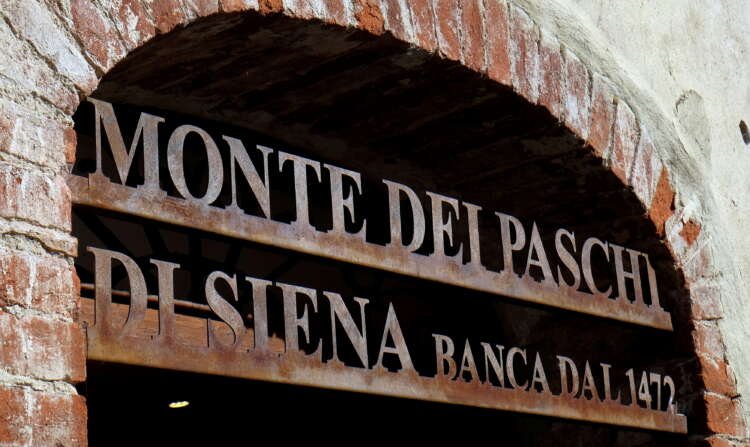
Published by maria gbaf
Posted on August 2, 2021
10 min readLast updated: January 21, 2026
Add as preferred source on GoogleBy Huw Jones, Valentina Za and Jesús Aguado
LONDON (Reuters) -All of Monte dei Paschi’s capital would be wiped out by a long slump, a European Union stress test of banks showed on Friday, as the Italian lender headed for government-sponsored merger talks with domestic peer UniCredit.
The exercise by the European Banking Authority showed that EU banks took a 265 billion euro ($314.7 billion) hit in a test of their resilience to economic shocks, which still left them with two-thirds of their buffers intact.
The EBA tested the resilience of 50 top lenders to economic shocks, though there is no formal pass or fail mark. The banks account for 70% of EU banking assets.
Under the harshest scenario spanning three years to 2023, which baked in a prolonged fallout from COVID, the aggregate core ratio of capital to risk-weighted assets fell by nearly 500 basis points, pushing the ratio down to 10.2% from 15%.
Monte dei Paschi, however, ended the test with a core capital ratio of minus 0.1% under the adverse scenario, the worst performer. UniCredit came in at 9.59%.
Monte dei Paschi said it would have had a core ratio of 6.6% after its proposed 2.5 billion euro capital increase. The bank had also fared worst in the EU’s stress test five years ago, in a sign of how deep-rooted problems at the world’s oldest bank have yet to be sorted out.
None of the other Italian banks tested – Mediobanca, Banco BPM and Intesa Sanpaolo – reached the 10% sector aggregate though several were very close.
HSBC’s French arm was the next worse performer after Monte dei Paschi, with a score of 5.91%. HSBC agreed last month to sell it to Cerberus-backed My Money Group.
Sweden’s banks were all above 10%, with Skandinaviska Enskilda Banken at 17.4%.
Among top banks, France’s Credit Agricole and BPCE and the Netherlands’ ING showed the largest capital buffers over requirements, giving them room for larger payouts via dividends and buybacks, according to consultancy firm Alvarez & Marsal.
Credit Agricole had 565 basis points of excess capital, followed by BPCE at 475 basis points and ING at 440 basis points, said Fernando de la Mora, a managing director at Alvarez & Marsal.
Investment banks Deutsche Bank and Societe Generale, in the midst of turnarounds, both performed below average under the adverse scenario, with scores of 7.56% and 7.73%, respectively. BNP Paribas came in at 8.28%, with Commerzbank at 8.52%.
“This outcome is all the more encouraging because the strong profit growth we delivered in the first half of 2021 is not reflected in this exercise,” said Deutsche’s chief financial officer, James von Moltke.
Just one of four Spanish banks tested, Bankinter, was above 10%.
The results of the tests, which were delayed from last year due to COVID-19, are seen as critical to banks resuming dividend payouts, which were barred during the pandemic in order to conserve capital.
“Since the start of COVID, there has been a problem of visibility of banks’ relative asset quality. This stress test will increase transparency across the industry,” said Javier Garcia, a partner at consultants Oliver Wyman.
ECB-POLICY-3fdc7763-f2c0-4c30-b494-8614852eaf43>ECB-POLICY-SOURCES-e4bab80d-7aeb-4e49-a29a-ce14e1595c6d>ECB-POLICY-3fdc7763-f2c0-4c30-b494-8614852eaf43>ECB TEST
The European Central Bank said the stress test results showed that the euro area banking system is resilient when faced with a challenging macroeconomic scenario.
The ECB-POLICY-3fdc7763-f2c0-4c30-b494-8614852eaf43>ECB-POLICY-SOURCES-e4bab80d-7aeb-4e49-a29a-ce14e1595c6d>ECB-POLICY-3fdc7763-f2c0-4c30-b494-8614852eaf43>ECB’s separate test of 51 medium-sized lenders not part of the EBA exercise showed an average fall in capital from 18.1% at the start of the test to 11.3% at the end.
Three of Greece’s top banks were among those whose capital levels fell below 8% by the end of the ECB-POLICY-3fdc7763-f2c0-4c30-b494-8614852eaf43>ECB-POLICY-SOURCES-e4bab80d-7aeb-4e49-a29a-ce14e1595c6d>ECB-POLICY-3fdc7763-f2c0-4c30-b494-8614852eaf43>ECB test, as well as Portugal’s Novo Banco, Bank of Cyprus, Italy’s Carige and Banque Internationale Luxembourg.
After an ECB-POLICY-3fdc7763-f2c0-4c30-b494-8614852eaf43>ECB-POLICY-SOURCES-e4bab80d-7aeb-4e49-a29a-ce14e1595c6d>ECB-POLICY-3fdc7763-f2c0-4c30-b494-8614852eaf43>ECB ban on dividends last year, which is set to be lifted, some banks this week have already begun guiding shareholders on dividends, and Garcia said this could not have been done without the lenders having emerged unscathed from the stress test.
More domestic focused banks suffered bigger hits to capital in the test compared with their cross-border peers.
The overall result is seen by EU regulators as being in line with stress tests by the Federal Reserve and the Bank of England.
Marco Troiano, an analyst at Scope credit rating agency, said the depletion of capital at each bank under the test’s harshest scenario will be closely scrutinised, and could potentially lead to hostile takeovers.
Last month, U.S. banks cleared a Federal Reserve stress test and will no longer face pandemic-era restrictions on payouts. Britain’s banks this week have also flagged dividends after their stress test results were announced earlier this month.
Although there was no pass or fail mark in the EU test, the results will be used by the bank‘s supervisor, which is the European Central Bank in the euro zone, to determine capital requirements.
Stress tests, now held every two years in the EU, were introduced annually in the aftermath of the global financial crisis over a decade ago, which forced taxpayers to bail out undercapitalised banks.
At the outset, pass or fail results were used to plug capital gaps, but as lenders became sufficiently capitalised, supervisors ditched the thresholds and have used the exercise to spot vulnerabilities and shape supervision.
Friday’s test was the first that did not include UK lenders due to Britain leaving the EU last December.
($1 = 0.8420 euros)
(Reporting by Huw JonesAdditonal reporting by Valentina Za, Jesus Aguado Tom Sims, Balazs Koranyi and Francesco CanepaEditing by Jane Merriman, Rachel Armstrong, Peter Graff)
By Huw Jones, Valentina Za and Jesús Aguado
LONDON (Reuters) -All of Monte dei Paschi’s capital would be wiped out by a long slump, a European Union stress test of banks showed on Friday, as the Italian lender headed for government-sponsored merger talks with domestic peer UniCredit.
The exercise by the European Banking Authority showed that EU banks took a 265 billion euro ($314.7 billion) hit in a test of their resilience to economic shocks, which still left them with two-thirds of their buffers intact.
The EBA tested the resilience of 50 top lenders to economic shocks, though there is no formal pass or fail mark. The banks account for 70% of EU banking assets.
Under the harshest scenario spanning three years to 2023, which baked in a prolonged fallout from COVID, the aggregate core ratio of capital to risk-weighted assets fell by nearly 500 basis points, pushing the ratio down to 10.2% from 15%.
Monte dei Paschi, however, ended the test with a core capital ratio of minus 0.1% under the adverse scenario, the worst performer. UniCredit came in at 9.59%.
Monte dei Paschi said it would have had a core ratio of 6.6% after its proposed 2.5 billion euro capital increase. The bank had also fared worst in the EU’s stress test five years ago, in a sign of how deep-rooted problems at the world’s oldest bank have yet to be sorted out.
None of the other Italian banks tested – Mediobanca, Banco BPM and Intesa Sanpaolo – reached the 10% sector aggregate though several were very close.
HSBC’s French arm was the next worse performer after Monte dei Paschi, with a score of 5.91%. HSBC agreed last month to sell it to Cerberus-backed My Money Group.
Sweden’s banks were all above 10%, with Skandinaviska Enskilda Banken at 17.4%.
Among top banks, France’s Credit Agricole and BPCE and the Netherlands’ ING showed the largest capital buffers over requirements, giving them room for larger payouts via dividends and buybacks, according to consultancy firm Alvarez & Marsal.
Credit Agricole had 565 basis points of excess capital, followed by BPCE at 475 basis points and ING at 440 basis points, said Fernando de la Mora, a managing director at Alvarez & Marsal.
Investment banks Deutsche Bank and Societe Generale, in the midst of turnarounds, both performed below average under the adverse scenario, with scores of 7.56% and 7.73%, respectively. BNP Paribas came in at 8.28%, with Commerzbank at 8.52%.
“This outcome is all the more encouraging because the strong profit growth we delivered in the first half of 2021 is not reflected in this exercise,” said Deutsche’s chief financial officer, James von Moltke.
Just one of four Spanish banks tested, Bankinter, was above 10%.
The results of the tests, which were delayed from last year due to COVID-19, are seen as critical to banks resuming dividend payouts, which were barred during the pandemic in order to conserve capital.
“Since the start of COVID, there has been a problem of visibility of banks’ relative asset quality. This stress test will increase transparency across the industry,” said Javier Garcia, a partner at consultants Oliver Wyman.
ECB-POLICY-3fdc7763-f2c0-4c30-b494-8614852eaf43>ECB-POLICY-SOURCES-e4bab80d-7aeb-4e49-a29a-ce14e1595c6d>ECB-POLICY-3fdc7763-f2c0-4c30-b494-8614852eaf43>ECB TEST
The European Central Bank said the stress test results showed that the euro area banking system is resilient when faced with a challenging macroeconomic scenario.
The ECB-POLICY-3fdc7763-f2c0-4c30-b494-8614852eaf43>ECB-POLICY-SOURCES-e4bab80d-7aeb-4e49-a29a-ce14e1595c6d>ECB-POLICY-3fdc7763-f2c0-4c30-b494-8614852eaf43>ECB’s separate test of 51 medium-sized lenders not part of the EBA exercise showed an average fall in capital from 18.1% at the start of the test to 11.3% at the end.
Three of Greece’s top banks were among those whose capital levels fell below 8% by the end of the ECB-POLICY-3fdc7763-f2c0-4c30-b494-8614852eaf43>ECB-POLICY-SOURCES-e4bab80d-7aeb-4e49-a29a-ce14e1595c6d>ECB-POLICY-3fdc7763-f2c0-4c30-b494-8614852eaf43>ECB test, as well as Portugal’s Novo Banco, Bank of Cyprus, Italy’s Carige and Banque Internationale Luxembourg.
After an ECB-POLICY-3fdc7763-f2c0-4c30-b494-8614852eaf43>ECB-POLICY-SOURCES-e4bab80d-7aeb-4e49-a29a-ce14e1595c6d>ECB-POLICY-3fdc7763-f2c0-4c30-b494-8614852eaf43>ECB ban on dividends last year, which is set to be lifted, some banks this week have already begun guiding shareholders on dividends, and Garcia said this could not have been done without the lenders having emerged unscathed from the stress test.
More domestic focused banks suffered bigger hits to capital in the test compared with their cross-border peers.
The overall result is seen by EU regulators as being in line with stress tests by the Federal Reserve and the Bank of England.
Marco Troiano, an analyst at Scope credit rating agency, said the depletion of capital at each bank under the test’s harshest scenario will be closely scrutinised, and could potentially lead to hostile takeovers.
Last month, U.S. banks cleared a Federal Reserve stress test and will no longer face pandemic-era restrictions on payouts. Britain’s banks this week have also flagged dividends after their stress test results were announced earlier this month.
Although there was no pass or fail mark in the EU test, the results will be used by the bank‘s supervisor, which is the European Central Bank in the euro zone, to determine capital requirements.
Stress tests, now held every two years in the EU, were introduced annually in the aftermath of the global financial crisis over a decade ago, which forced taxpayers to bail out undercapitalised banks.
At the outset, pass or fail results were used to plug capital gaps, but as lenders became sufficiently capitalised, supervisors ditched the thresholds and have used the exercise to spot vulnerabilities and shape supervision.
Friday’s test was the first that did not include UK lenders due to Britain leaving the EU last December.
($1 = 0.8420 euros)
(Reporting by Huw JonesAdditonal reporting by Valentina Za, Jesus Aguado Tom Sims, Balazs Koranyi and Francesco CanepaEditing by Jane Merriman, Rachel Armstrong, Peter Graff)
Explore more articles in the Banking category









