

Increasing demand for binders and binding agents in production of specialty food products and industrial goods has driven the modification of flours and starches. In the recent past, leading flour producers in the world have shifted to modification techniques, introducing new product lines on modified flours. Specific nutritional requirements have further extended the need for modifying flours, and new techniques are being developed to make flour modification more efficient and economical.
While the demand for modified flours will gain flexible traction in the near future, their production will become relatively less complicated as opposed to the present scenario. However, high prices of modified flours will be observed as a key deterrent for the growth of the global modified flour market. In addition, the supply chain for modified flours is expected to become more entangled with changing policies on distribution and consumption of modified flours. New regulations will distort the global modified flour manufacturing landscape, and products will be subjected to multiple approvals before being used for applications.
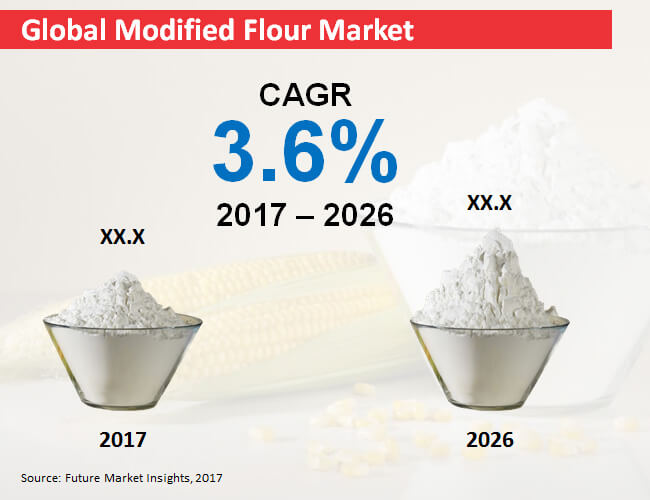
Future Market Insights observes that the global modified flour market will expand at a moderate pace during the forecast period, 2017-2026. Apropos the insights developed in the report, the global market for modified flour is assessed to expand at an estimated CAGR of 3.6% in terms of volume over the forecast period. The report further reveals that by the end of 2026, more than 1,130,000 tons of modified flours will be sold globally.
Global Modified Flour Production to Remain Concentered in the APEJ Region
The report reveals that by the end of 2026, more than 373,000 tons of modified flour will be produced in the Asia-Pacific excluding Japan (APEJ) region. Throughout the forecast period, the APEJ region will register highest production and sales of modified flours. Favorable industrial regulations, higher access to raw materials, and robust growth in the agricultural sector will drive the presence of APEJ countries such as China and India in the global production of modified flour. The report further reveals that Europe will represent the most lucrative consumer marketplace for modified flours. By the end of 2026, Europe will account for more than 25% share on the global modified flour market volumes.
Key Findings from the Report
The report has delivering valuable insights on how the global modified flour market will expand through 2026.
- In 2017, more than half of modified flours sold in the global market have been made of wheat. Wheat flours will continue to remain top-selling products in the global modified flour market. Meanwhile, soy flour products are expected to register high demand, reflecting a volume CAGR of 4.4% over the forecast period.
- Bakery and confectionery will be the largest application of modified flour throughout the forecast period.
- By the end of 2026, direct sales are expected to account for more than 624,000 tons of modified flours. The report also observes a growing demand for modified flours among online stores.
- The report also estimates that activated carbons will be the key ingredients used in the modification of flours during the forecast period.
Global Modified Flour Market: Key Players
- Companies namely,
- Cargill Incorporated,
- The Scoular Company,
- Archer Daniels Midland Company,
- The Hain Celestial Group, Inc.,
- Associated British Foods plc,
- ConAgra Foods, Inc.,
- General Mills,Inc.,
- ITC Limited,
- Parrish and Heimbecker Ltd.,
- Ingredion Inc.,
- The Caremoli Group,
- Bunge Limited,
- Unicorn Grain Specialties,
- Buhler, and
- SunOpta Limited are observed as the key stakeholders in the global modified flour market. These companies are expected to instrument the global modified flour production during the forecast period.
Table Of Content
1. Global Economic Outlook
2. Global Modified Flour Market – Executive Summary
3. Global Modified Flour Market Overview
3.1. Introduction
3.1.1. Global Modified Flour Market Taxonomy
3.1.2. Global Modified Flour Market Definition
3.2. Global Modified Flour Market Size (US$ Mn) and Forecast, 2012-2026
3.2.1. Global Modified Flour Market Y-o-Y Growth
3.3. Global Modified Flour Market Dynamics
3.4. Food Market Overview
3.5. Cost Structure
3.6. PESTLE Analysis
3.7. Supply Chain
3.8. Macro-Economic Factors
3.9. Key Regulatory Framework
3.10. Wheel of Fortune
3.11. Investment Feasibility Analysis
3.12. Market Forecast Scenario
3.13. Forecast Factors
3.14. Service Provider List
3.15. Product Life Cycle
3.16. Porters Five Forces Analysis
3.17. Key Participants Market Presence (Intensity Map) By Region
The post Modified Flour Market 2021 Industry Research, Segmentation, Key Players Analysis, and Forecast to 2025 first appeared on Market Research Blog.
Increasing demand for binders and binding agents in production of specialty food products and industrial goods has driven the modification of flours and starches. In the recent past, leading flour producers in the world have shifted to modification techniques, introducing new product lines on modified flours. Specific nutritional requirements have further extended the need for modifying flours, and new techniques are being developed to make flour modification more efficient and economical.
While the demand for modified flours will gain flexible traction in the near future, their production will become relatively less complicated as opposed to the present scenario. However, high prices of modified flours will be observed as a key deterrent for the growth of the global modified flour market. In addition, the supply chain for modified flours is expected to become more entangled with changing policies on distribution and consumption of modified flours. New regulations will distort the global modified flour manufacturing landscape, and products will be subjected to multiple approvals before being used for applications.
Future Market Insights observes that the global modified flour market will expand at a moderate pace during the forecast period, 2017-2026. Apropos the insights developed in the report, the global market for modified flour is assessed to expand at an estimated CAGR of 3.6% in terms of volume over the forecast period. The report further reveals that by the end of 2026, more than 1,130,000 tons of modified flours will be sold globally.
Global Modified Flour Production to Remain Concentered in the APEJ Region
The report reveals that by the end of 2026, more than 373,000 tons of modified flour will be produced in the Asia-Pacific excluding Japan (APEJ) region. Throughout the forecast period, the APEJ region will register highest production and sales of modified flours. Favorable industrial regulations, higher access to raw materials, and robust growth in the agricultural sector will drive the presence of APEJ countries such as China and India in the global production of modified flour. The report further reveals that Europe will represent the most lucrative consumer marketplace for modified flours. By the end of 2026, Europe will account for more than 25% share on the global modified flour market volumes.
Key Findings from the Report
The report has delivering valuable insights on how the global modified flour market will expand through 2026.
- In 2017, more than half of modified flours sold in the global market have been made of wheat. Wheat flours will continue to remain top-selling products in the global modified flour market. Meanwhile, soy flour products are expected to register high demand, reflecting a volume CAGR of 4.4% over the forecast period.
- Bakery and confectionery will be the largest application of modified flour throughout the forecast period.
- By the end of 2026, direct sales are expected to account for more than 624,000 tons of modified flours. The report also observes a growing demand for modified flours among online stores.
- The report also estimates that activated carbons will be the key ingredients used in the modification of flours during the forecast period.
Global Modified Flour Market: Key Players
- Companies namely,
- Cargill Incorporated,
- The Scoular Company,
- Archer Daniels Midland Company,
- The Hain Celestial Group, Inc.,
- Associated British Foods plc,
- ConAgra Foods, Inc.,
- General Mills,Inc.,
- ITC Limited,
- Parrish and Heimbecker Ltd.,
- Ingredion Inc.,
- The Caremoli Group,
- Bunge Limited,
- Unicorn Grain Specialties,
- Buhler, and
- SunOpta Limited are observed as the key stakeholders in the global modified flour market. These companies are expected to instrument the global modified flour production during the forecast period.
Table Of Content
1. Global Economic Outlook
2. Global Modified Flour Market – Executive Summary
3. Global Modified Flour Market Overview
3.1. Introduction
3.1.1. Global Modified Flour Market Taxonomy
3.1.2. Global Modified Flour Market Definition
3.2. Global Modified Flour Market Size (US$ Mn) and Forecast, 2012-2026
3.2.1. Global Modified Flour Market Y-o-Y Growth
3.3. Global Modified Flour Market Dynamics
3.4. Food Market Overview
3.5. Cost Structure
3.6. PESTLE Analysis
3.7. Supply Chain
3.8. Macro-Economic Factors
3.9. Key Regulatory Framework
3.10. Wheel of Fortune
3.11. Investment Feasibility Analysis
3.12. Market Forecast Scenario
3.13. Forecast Factors
3.14. Service Provider List
3.15. Product Life Cycle
3.16. Porters Five Forces Analysis
3.17. Key Participants Market Presence (Intensity Map) By Region
The post Modified Flour Market 2021 Industry Research, Segmentation, Key Players Analysis, and Forecast to 2025 first appeared on Market Research Blog.