
Mobile device displaying financial communication app - Global Banking & Finance Review
An image illustrating a mobile device used for financial transactions, highlighting the necessity for in-network call recording as mandated by regulations. This visual relates to the Ovum report on compliance challenges for banks.
Finance

MARKET READINESS FOR HOST CARD EMULATION (HCE) MOBILE PAYMENTS?

Published by Gbaf News

Posted on July 29, 2014

2 min read

· Last updated: October 31, 2023

Add as preferred source on Google

The Evolution of Mobile Payments

Mobile payments continue to make headlines. Trials have come and gone and cross-industry relationships have been set up and crumbled after the honeymoon period. Many of us, I’m sure, have questioned whether mobile NFC payments would ever become a mass-market reality.

Google’s Introduction of HCE Technology

Google changed all of this with one announcement in 2013. The incorporation of host card emulation (HCE) into the Android platform brought significant relief to many of the key banks and service providers that have been trying to make progress in launching mobile payments using USIM secure elements.

Key Statistics on HCE Market Readiness

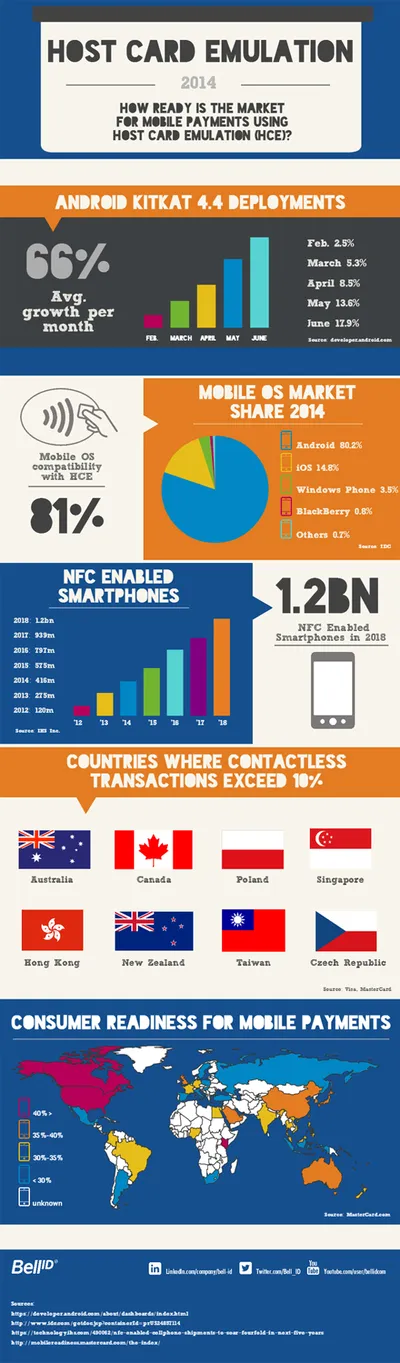
We have developed the below infographic to highlight some of the key statistics that demonstrate the readiness of the market for mass market delivery of mobile services using HCE. The infographic highlights the month-on-month growth of the deployment of Android KitKat 4.4, the percentage of global mobile operating systems that have the potential to support HCE, the countries where contactless mobile payments are likely to achieve swift adoption and global consumer readiness for mobile payments.

The Turning Point for Banks and Providers

No more talking and no more trials. HCE is a turning point for the delivery of mobile services and many banks and services providers around the globe are already seizing this opportunity. Interested to learn more, check out our short video on HCE.
Key Takeaways

  • HCE enables NFC mobile payments without hardware secure elements, lowering deployment complexity.
  • Android 4.4's inclusion of HCE catalyzed mass-market readiness for mobile NFC payments due to broader device support.
  • HCE offers flexibility and faster rollout for banks, but raises security and standardization concerns.
  • Major card networks (Visa, MasterCard) committed to HCE early, facilitating issuer adoption globally.
  • Solutions like tokenization, TEE and centralized credential storage help mitigate HCE security risks.

References

Frequently Asked Questions

What is Host Card Emulation (HCE)?
HCE is a software method for emulating NFC payment cards directly via the Android OS without needing a hardware secure element ([en.wikipedia.org](https://en.wikipedia.org/wiki/Host_card_emulation?utm_source=openai)).
Why was HCE important for banks?
By eliminating dependence on secure elements managed by third parties, HCE allowed banks to deploy NFC payment services faster and with lower complexity ([cpl.thalesgroup.com](https://cpl.thalesgroup.com/resources/webinars/host-card-emulation-hce-how-take-direct-control-mobile-payments?utm_source=openai)).
When did HCE become broadly supported?
Google added HCE support in Android 4.4 (KitKat) in 2013; Visa and MasterCard backed HCE in early 2014, and RBC launched the first commercial HCE mobile payment in North America in December 2014 ([en.wikipedia.org](https://en.wikipedia.org/wiki/Host_card_emulation?utm_source=openai)).
What security concerns surround HCE?
Since payment credentials are software-based, risks include device rooting, malware access, and reliance on Android OS; mitigation requires tokenization, TEE, root detection, and secure backend systems ([bostonfed.org](https://www.bostonfed.org/-/media/Documents/PaymentStrategies/understanding-the-role-of-host-card-emulation-in-mobile-wallets-brief-rmay-2016.pdf?utm_source=openai)).
Which solutions improve HCE security?
Approaches include using Trusted Execution Environments (TEE) for secure processing, tokenization, Public Key Infrastructure, SDKs, and PCI‑DSS‑compliant cloud platforms ([trustonic.com](https://www.trustonic.com/technical-articles/what-is-host-card-emulation/?utm_source=openai)).

Tags

Related Articles

More from Finance

Explore more articles in the Finance category