Finance
Maksym Sakharov, WeFi’s Group CEO: The Future of Banking Depends on Onchain Infrastructure
Published by Barnali Pal Sinha
Posted on March 26, 2026
5 min readLast updated: March 26, 2026
Add as preferred source on Google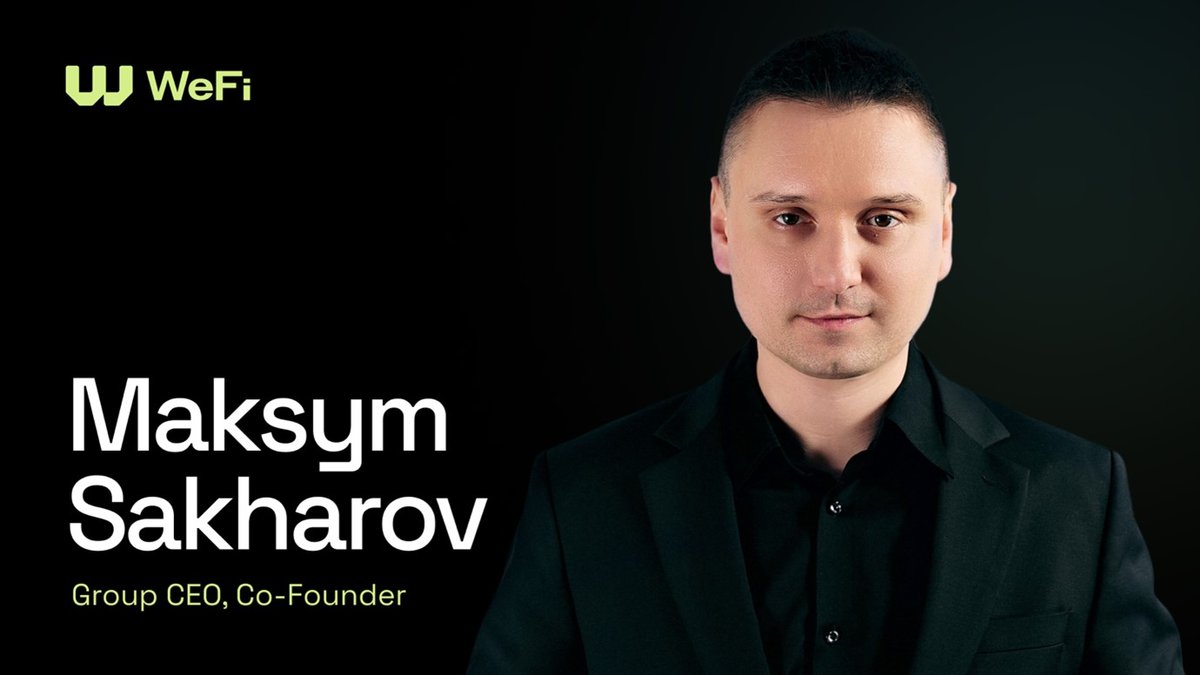
Published by Barnali Pal Sinha
Posted on March 26, 2026
5 min readLast updated: March 26, 2026
Add as preferred source on GoogleTraditional banking still works for billions of people, but much of its core machinery belongs to an earlier era. Cross-border payments still move through long chains of intermediaries, and progress on cost, speed, and transparency remains uneven. The Financial Stability Board
Traditional banking still works for billions of people, but much of its core machinery belongs to an earlier era. Cross-border payments still move through long chains of intermediaries, and progress on cost, speed, and transparency remains uneven. The Financial Stability Board said in October 2025 that reform efforts have “not yet translated into tangible improvements for end-users at the global level.” The World Bank still puts the global average cost of sending remittances at 6.49% of the amount sent.
For Maksym Sakharov, co-founder and group CEO of WeFi, that is a sign that banking needs a deeper infrastructure upgrade. He argues that the next chapter in finance will be shaped by the rails underneath the interface: ledgers, settlement logic, identity layers, and access rules, working in real time and with clearer visibility.
“The problem is not that banks stopped mattering,” Sakharov says. “The problem is that much of the underlying stack was built for a slower, more fragmented financial world. If the ledger is shared, programmable, and verifiable, a huge amount of friction disappears before the customer ever sees it.”
Banking still runs on fragmented ledgers
The traditional system is not broken. It clears salaries, finances trade, extends credit, and supports economic life at enormous scale. Yet it also relies on siloed databases, reconciliation between institutions, and messaging layers that often sit apart from actual settlement.
That creates familiar pain points. A payment can be initiated in seconds and still take far longer to settle with finality. In cross-border flows, each extra intermediary adds delay, cost, and operational complexity. The better-connected payment systems could reduce costs, increase speed and transparency, and shorten transaction chains.
Sakharov says the industry has spent too long treating these as service issues when many of them are infrastructure issues. “Banking keeps adding new user experiences on top of old coordination models,” he says. “That helps at the interface level, but it doesn’t change the fact that too many institutions still need to reconcile the same transaction across separate books.”
Why blockchain changes the conversation
Distributed ledger technology offers a shared transaction environment where recordkeeping, settlement, and auditability can sit much closer together. The appeal is architectural.
Public blockchains can provide neutral, independent, and immutable infrastructure for financial transactions, with data that is available and verifiable in real time. For Sakharov, that makes sense because modern finance is increasingly constrained by the coordination of trust.
“Onchain infrastructure changes the source of truth,” he argues. “When participants are reading from the same state, you reduce manual reconciliation, lower operational ambiguity, and create a cleaner base for compliance, reporting, and automation.”
This is also one reason younger users are increasingly open to systems that offer more control. The younger Americans trust and use crypto more than traditional finance, with control, access, and asset visibility playing a central role.
The future is not bankless
Sakharov doesn’t see onchain infrastructure as a case for removing banks from finance. Banks still originate credit, manage risk, support businesses, connect consumers to everyday services, and operate inside the legal and supervisory frameworks, holding modern finance together.
Tokenised central bank reserves, tokenised commercial bank money, and tokenised government bonds on a unified ledger could form the foundation of a tokenised financial system. Also, tokenised commercial bank money can build on the existing two-tier model while preserving trust and stability.
“Banks are not obsolete,” Sakharov comments. “They are essential. But the infrastructure they operate on is changing. The winners will be institutions that keep the strengths of banking, but move onto rails that support instant settlement, programmability, and transparent asset movement.”
From closed systems to interoperable rails
The real test will be interoperability. No serious transformation happens if every institution builds its own isolated chain and recreates the same fragmentation in a new form. Sakharov says the goal should be systems that connect bank-grade compliance and service layers with open, auditable transaction infrastructure.
That ambition is already visible across public-sector and market discussions. The interlinking payment systems are seen as a way to improve cross-border transactions. The Financial Stability Board continues to push for faster, cheaper, and more transparent payments.
“Finance needs interoperable rails, not another generation of black boxes,” Sakharov shares. “If deposits, stablecoins, payment instructions, and identity credentials can interact through clear standards, banks can offer better products without losing control of risk management or customer protection.”
That thinking also helps explain why firms such as WeFi are trying to build infrastructure that sits closer to the ledger itself. WeFi offers an EU IBAN mapped to an onchain stablecoin ledger in self-custody. currently in development. Adoption and functionality may evolve as the model matures, but it highlights banking services that connect familiar access points with natively digital settlement layers.
The upgrade will be gradual, then hard to ignore
No core financial system gets rebuilt overnight. Regulation, customer protection, operational resilience, and institutional inertia all slow the pace, and for good reason.
Maksym Sakharov believes banking is approaching a structural shift. “The long-term question is not whether finance becomes digital,” he says. “It already has. The real question is – whether its underlying infrastructure becomes native to the internet era, or stays tied to ledgers and messaging models that were never designed for always-on global value exchange.”
His argument is not that every bank should become a crypto company. It is that banking now needs infrastructure that matches the speed, transparency, and composability expected in other digital systems. In the next phase of financial modernization, the institutions that move first at the infrastructure layer may define how banking works for the next generation.
Disclaimer: The solutions and infrastructure discussed are in development and subject to regulatory, operational, and market considerations; adoption timelines and outcomes may vary.
Explore more articles in the Finance category