The image depicts Prime Minister Keir Starmer discussing new measures to remove illegal migrants in the UK. This coincides with the Labour government's record pace of removals since 2018, emphasizing their commitment to tackling illegal migration and people smuggling.
Global Industrial Protective Clothing Fabrics Market: Key Trends
The global demand for Industrial Protective Clothing Fabrics stood nearly US$ 2.3 Bn in 2018 and is projected to reach over US$ 4.2 Bn by 2027. Increasing awareness about worker safety and stricter implementation of governmental norms are expected to boost the demand forindustrial protective clothing fabrics market.
Ordinary clothing usually ignites when exposed to a source of ignition and will continue to burn until either the fire is extinguished or all flammable materials are consumed. Industrial protective clothing on the other hand, have useful functional properties such as flame resistance, cut resistance arc resistance and chemical resistance.
Strong expertise with attention to detail makes our market research reports stand apart. Download PDF Brochure –
Protective clothing can be either manufactured from synthetic fibers (polyester, aramid, and acrylic) or from natural fibers (cotton, wool, and silk). The synthetic fibers are used to manufacture inherently fire resistant (FR) fabrics wherein the FR properties of the fibers are generally derived from the polymer backbone of which they are composed.
Request for Covid-19 Impact Analysis on Industrial Protective Clothing Fabrics Market:
The flame resistant trait of these fabrics is permanent i.e. these fabrics will not lose their FR property even after repeated cycles of washing. Treated FR fabrics, on the other hand, are usually manufactured by applying flame retardant chemical finish to a fabric or through chemical treatment of natural fibers before they are knitted or woven into the fabric.
Global Industrial Protective Clothing Fabrics Market: Opportunities to Explore
Governments in emerging economies are trying to establish stringent health and safety regulations and create an effective safety awareness program.
Buy our Premium Research Report on Industrial Protective Clothing Fabrics Market@
Manufacturers are broadening their customer base through e-commerce. Usually, safety managers are responsible for the purchase of personal protective equipment (PPE) for industrial workers. Recently, however, workers have started to purchase their own protective gear from online stores.
More Trending Reports by Transparency Market Research –
Protective clothing equipment are usually bought in sizes that are suitable for male workers. Female workers are forced to wear oversized, poor-fitting gear that were not conducive to the movement required in their job. Companies are now introducing protective clothing equipment engineered specifically for women.
Global Industrial Protective Clothing Fabrics: Segmental Viewpoint
In terms of application, oil & gas was the largest segment of the industrial protective clothing fabrics market, accounting for more than 20% share in 2018. However, due to volatile nature of oil & gas industry, growth in this segment is expected to be sluggish in the near future. The Mining and welding segments are anticipated to grow at the decent pace over the forecast period. Improved safety standards coupled with stiff penalties in case of failure in complying with these standards is likely to be primarily responsible for the high growth of the mining and welding segments. Other important application segments of industrial protective clothing fabrics are utilities and electricians.
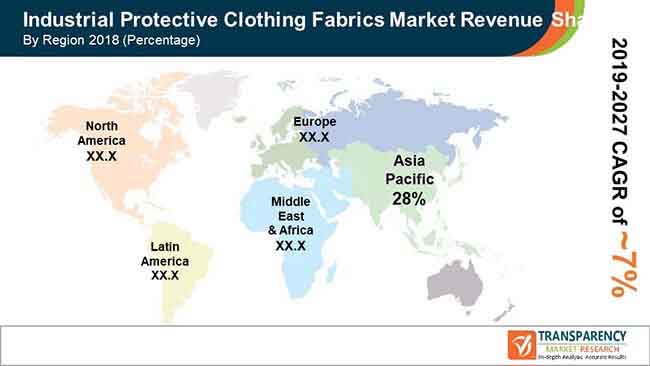
Asia Pacific is projected to be the fastest growing region for industrial protective clothing fabrics during the forecast period. The large-scale industrialization of nations in Asia Pacific is expected to increase the number of workers employed in the industrial sector. This, in turn, is expected to boost the demand for industrial protective clothing fabrics in this region. Growing worker safety awareness and stricter implementation of government safety norms is also anticipated to be important drivers of the market during the forecast period. Regions such as China, ASEAN and India have a large number of unprotected industrial workers which offers huge opportunities for the industrial protective clothing fabrics market.
Global Industrial Protective Clothing Fabrics: Competition Landscape
The global industrial protective clothing fabrics market is dominated by large companies that use propriety technology for manufacturing the fabrics. Key players in the market include
PBI Performance Products Inc
Solvay S.A.
Koninklijke Ten Cate nv (TenCate)
Teijin Aramid B.V.
Gunei Chemical Industry Co., Ltd.
Huntsman International LLC
Milliken & Company & Glen Raven, Inc.
In November 2019, Teijin Aramid announced the second round of activities to increase its production capacity for Twaron fiber
In April 2018, Teijin Aramid introduced Teijinconex Coolnex Stretch: a unique flame resistant and durable stretch fabric. This fabric inherts stretch and recovery functionality over the time.
Transparency Market Research is a global market intelligence company, providing global business information reports and services. Our exclusive blend of quantitative forecasting and trends analysis provides forward-looking insight for thousands of decision makers. Our experienced team of Analysts, Researchers, and Consultants, use proprietary data sources and various tools and techniques to gather, and analyze information.
Our data repository is continuously updated and revised by a team of research experts, so that it always reflects the latest trends and information. With a broad research and analysis capability, Transparency Market Research employs rigorous primary and secondary research techniques in developing distinctive data sets and research material for business reports.
Global Industrial Protective Clothing Fabrics Market: Key Trends
The global demand for Industrial Protective Clothing Fabrics stood nearly US$ 2.3 Bn in 2018 and is projected to reach over US$ 4.2 Bn by 2027. Increasing awareness about worker safety and stricter implementation of governmental norms are expected to boost the demand forindustrial protective clothing fabrics market.
Ordinary clothing usually ignites when exposed to a source of ignition and will continue to burn until either the fire is extinguished or all flammable materials are consumed. Industrial protective clothing on the other hand, have useful functional properties such as flame resistance, cut resistance arc resistance and chemical resistance.
Strong expertise with attention to detail makes our market research reports stand apart. Download PDF Brochure –
Protective clothing can be either manufactured from synthetic fibers (polyester, aramid, and acrylic) or from natural fibers (cotton, wool, and silk). The synthetic fibers are used to manufacture inherently fire resistant (FR) fabrics wherein the FR properties of the fibers are generally derived from the polymer backbone of which they are composed.
Request for Covid-19 Impact Analysis on Industrial Protective Clothing Fabrics Market:
The flame resistant trait of these fabrics is permanent i.e. these fabrics will not lose their FR property even after repeated cycles of washing. Treated FR fabrics, on the other hand, are usually manufactured by applying flame retardant chemical finish to a fabric or through chemical treatment of natural fibers before they are knitted or woven into the fabric.
Global Industrial Protective Clothing Fabrics Market: Opportunities to Explore
Governments in emerging economies are trying to establish stringent health and safety regulations and create an effective safety awareness program.
Buy our Premium Research Report on Industrial Protective Clothing Fabrics Market@
Manufacturers are broadening their customer base through e-commerce. Usually, safety managers are responsible for the purchase of personal protective equipment (PPE) for industrial workers. Recently, however, workers have started to purchase their own protective gear from online stores.
More Trending Reports by Transparency Market Research –
Protective clothing equipment are usually bought in sizes that are suitable for male workers. Female workers are forced to wear oversized, poor-fitting gear that were not conducive to the movement required in their job. Companies are now introducing protective clothing equipment engineered specifically for women.
Global Industrial Protective Clothing Fabrics: Segmental Viewpoint
In terms of application, oil & gas was the largest segment of the industrial protective clothing fabrics market, accounting for more than 20% share in 2018. However, due to volatile nature of oil & gas industry, growth in this segment is expected to be sluggish in the near future. The Mining and welding segments are anticipated to grow at the decent pace over the forecast period. Improved safety standards coupled with stiff penalties in case of failure in complying with these standards is likely to be primarily responsible for the high growth of the mining and welding segments. Other important application segments of industrial protective clothing fabrics are utilities and electricians.
Asia Pacific is projected to be the fastest growing region for industrial protective clothing fabrics during the forecast period. The large-scale industrialization of nations in Asia Pacific is expected to increase the number of workers employed in the industrial sector. This, in turn, is expected to boost the demand for industrial protective clothing fabrics in this region. Growing worker safety awareness and stricter implementation of government safety norms is also anticipated to be important drivers of the market during the forecast period. Regions such as China, ASEAN and India have a large number of unprotected industrial workers which offers huge opportunities for the industrial protective clothing fabrics market.
Global Industrial Protective Clothing Fabrics: Competition Landscape
The global industrial protective clothing fabrics market is dominated by large companies that use propriety technology for manufacturing the fabrics. Key players in the market include
PBI Performance Products Inc
Solvay S.A.
Koninklijke Ten Cate nv (TenCate)
Teijin Aramid B.V.
Gunei Chemical Industry Co., Ltd.
Huntsman International LLC
Milliken & Company & Glen Raven, Inc.
In November 2019, Teijin Aramid announced the second round of activities to increase its production capacity for Twaron fiber
In April 2018, Teijin Aramid introduced Teijinconex Coolnex Stretch: a unique flame resistant and durable stretch fabric. This fabric inherts stretch and recovery functionality over the time.
Transparency Market Research is a global market intelligence company, providing global business information reports and services. Our exclusive blend of quantitative forecasting and trends analysis provides forward-looking insight for thousands of decision makers. Our experienced team of Analysts, Researchers, and Consultants, use proprietary data sources and various tools and techniques to gather, and analyze information.
Our data repository is continuously updated and revised by a team of research experts, so that it always reflects the latest trends and information. With a broad research and analysis capability, Transparency Market Research employs rigorous primary and secondary research techniques in developing distinctive data sets and research material for business reports.
Frequently Asked Questions about Industrial Protective Clothing Fabrics Market to generate US$3.36 bn by the end of 2024
1What is industrial protective clothing?
Industrial protective clothing refers to garments designed to protect workers from hazards such as chemicals, flames, and physical injuries in various industrial environments.
2What are synthetic fibers?
Synthetic fibers are man-made fibers produced from chemical processes, commonly used in industrial protective clothing for their durability and resistance to fire and chemicals.
3What is flame resistance?
Flame resistance is a property of materials that allows them to withstand exposure to fire without igniting or burning easily, crucial for protective clothing.
4What is chemical resistance?
Chemical resistance refers to the ability of materials to resist degradation or damage when exposed to chemicals, important for safety in industrial settings.
5What is e-commerce in the context of protective clothing?
E-commerce refers to the buying and selling of goods online, which has become a significant channel for purchasing protective clothing directly by consumers.