Search
00
GBAF Logo
trophy
Top StoriesInterviewsBusinessFinanceBankingTechnologyInvestingTradingVideosAwardsMagazinesHeadlinesTrends

Subscribe to our newsletter

Get the latest news and updates from our team.

Global Banking and Finance Review

Global Banking & Finance Review

Company

    GBAF Logo
    • About Us
    • Profile
    • Privacy & Cookie Policy
    • Terms of Use
    • Contact Us
    • Advertising
    • Submit Post
    • Latest News
    • Research Reports
    • Press Release
    • Awards▾
      • About the Awards
      • Awards TimeTable
      • Submit Nominations
      • Testimonials
      • Media Room
      • Award Winners
      • FAQ
    • Magazines▾
      • Global Banking & Finance Review Magazine Issue 79
      • Global Banking & Finance Review Magazine Issue 78
      • Global Banking & Finance Review Magazine Issue 77
      • Global Banking & Finance Review Magazine Issue 76
      • Global Banking & Finance Review Magazine Issue 75
      • Global Banking & Finance Review Magazine Issue 73
      • Global Banking & Finance Review Magazine Issue 71
      • Global Banking & Finance Review Magazine Issue 70
      • Global Banking & Finance Review Magazine Issue 69
      • Global Banking & Finance Review Magazine Issue 66
    Top StoriesInterviewsBusinessFinanceBankingTechnologyInvestingTradingVideosAwardsMagazinesHeadlinesTrends

    Global Banking & Finance Review® is a leading financial portal and online magazine offering News, Analysis, Opinion, Reviews, Interviews & Videos from the world of Banking, Finance, Business, Trading, Technology, Investing, Brokerage, Foreign Exchange, Tax & Legal, Islamic Finance, Asset & Wealth Management.
    Copyright © 2010-2025 GBAF Publications Ltd - All Rights Reserved.

    Editorial & Advertiser disclosure

    Global Banking and Finance Review is an online platform offering news, analysis, and opinion on the latest trends, developments, and innovations in the banking and finance industry worldwide. The platform covers a diverse range of topics, including banking, insurance, investment, wealth management, fintech, and regulatory issues. The website publishes news, press releases, opinion and advertorials on various financial organizations, products and services which are commissioned from various Companies, Organizations, PR agencies, Bloggers etc. These commissioned articles are commercial in nature. This is not to be considered as financial advice and should be considered only for information purposes. It does not reflect the views or opinion of our website and is not to be considered an endorsement or a recommendation. We cannot guarantee the accuracy or applicability of any information provided with respect to your individual or personal circumstances. Please seek Professional advice from a qualified professional before making any financial decisions. We link to various third-party websites, affiliate sales networks, and to our advertising partners websites. When you view or click on certain links available on our articles, our partners may compensate us for displaying the content to you or make a purchase or fill a form. This will not incur any additional charges to you. To make things simpler for you to identity or distinguish advertised or sponsored articles or links, you may consider all articles or links hosted on our site as a commercial article placement. We will not be responsible for any loss you may suffer as a result of any omission or inaccuracy on the website.

    Home > Trading > How traders can maintain a ‘business as usual’ stance during COVID-19
    Trading

    How traders can maintain a ‘business as usual’ stance during COVID-19

    How traders can maintain a ‘business as usual’ stance during COVID-19

    Published by Gbaf News

    Posted on April 13, 2020

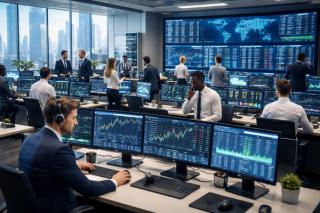
    Featured image for article about Trading

    By Craig Campestre, Chief Revenue Officer, IPC

    The world has never experienced anything quite like the current global pandemic, and uncertainty continues to grow with each passing day around the new disease. No one can guarantee when there will be an end in sight so until then, the enforced work from home policy that many businesses have had to follow will become the new normal.

    Although already a popular policy in many sectors, remote working has rarely been an option for traders. Now, it is the only option. Forbes reported that the New York Stock Exchange’s iconic trading floor is temporarily closed, and traders have moved to electronic trading which shows the severe impact that the coronavirus is having on global financial hubs and the industry overall.

    Everyone has been affected by the rapid restrictions imposed on our personal and business lives in these unprecedented times, but how can traders and the financial markets maintain a ‘business as usual’ stance during the COVID-19 crisis?

     Why the subscription economy is the future 

    Craig Campestre

    Craig Campestre

    Behind the shock and threat of the coronavirus is also the underlying fear that world’s economy is about to plunge into another recession. During this frightful financial backdrop, organisations will understandably be cautious of increasing their spending on additional technology.

    However, as many companies have had to suddenly shift to remote working for the long-term, firms either need to invest or risk closure. This quandary has been great news for fintechs that help companies work remotely as they have thrived so far with the sudden boom in adoption of cloud-based and digital applications and technologies in the wake of the global outbreak.

    Traders and financial firms must make remote working as sustainable as possible and will be seeking flexibility and scalability for their infrastructure. This is where the subscription economy comes in as businesses can offer their products and service as subscriptions to customers, allowing for less commitment and lower upfront costs.

    In the past few years, organisations and individuals have gone through a fundamental change in relation to the concept of ownership and possessions. Traditionally, businesses needed to buy multi-year leases for software and hardware. These were often big, costly decisions that needed to be thoroughly weighed in boardrooms.

    Thanks to the rise of the subscription economy though, new technologies and applications are more affordable for businesses and much more easily installed, managed and updated. Subscriptions are transforming the way in which businesses consume services for the foreseeable future. This is particularly true for firms that need to invest in new technologies to continue ‘business as usual’ but also keep costs as low as possible.

    Maintaining business continuity during uncertainty 

    There are a great range of subscriptions available for the financial community, including SaaS (Software as a Service), DRaaS (Disaster Recovery as a Service) and the cloud, that make it easier for businesses to cope with the pandemic or other unexpected shocks with its flexible model.

    However, many financial firms may have still found themselves unprepared for the widespread enablement of remote working following the outbreak. Without an effective business continuity plan in place that allowed all employees to work remotely in times of crisis, some firms were left scrambling to quickly install key equipment and communications software for their trading teams.

    It is easy to see why this was the case for so many companies as planning for unforeseen disasters is a time consuming and challenging task. Prior to the coronavirus, no one knew the severity and nature of unpredictable events and there was an argument that spending money on redundant infrastructure is impractical and unlikely to achieve the desired business results.

    However, it will have become evident to everyone now how important investing in an appropriate infrastructure is for a business to continue to function as usual and avoid any unnecessary upheaval or lapse in regulatory standards.

    Technological solutions for regularity 

    The businesses that were able to smoothly transition to working remotely was most likely due to them having had an effective business continuity plan (BCP) which also leverages technological solutions, such as IPC and Cloud9’s Disaster Recovery as a Service solution (DRaaS).

    DRaaS allows traders to have ubiquitous access to a custom-designed virtual trading desk from any global location during an emergency, such as the current coronavirus pandemic but also earthquakes, political unrests, and any other event that would otherwise disrupt operations. With many employees now unable to access their offices, a cloud-based service that provides a comprehensive turnkey solution for recovery is a crucial way that traders can continue working as usual.

    A thorough BCP for traders needs to also consider whether the technology in place is meeting compliance and regulatory obligations, as well as being able to scale up home-based operations to maintain uninterrupted trading activities.

    For traders and the financial markets, this can be solved with DRaaS as the technology can utilise global financial ecosystems and trader platforms to extend voice trading capabilities to alternative locations without needing to notify counterparties or even compromising on functionality, compliance and regulations.

    Buy-side firms and sell-side firms will also have had to extend their trader connectivity beyond financial dealing rooms and front-line offices to remote locations in a way that continues to meet the highest security and compliance standards regulating the capital markets. In this way, traders will be able to maintain a business as usual stance during the coronavirus outbreak.

    As the pandemic continues to play out, there will be many more questions and issues that need to be ironed out, but one thing that we know for certain is that wide-scale remote working will be how most of the world operates for the next few months at least.

    The importance of financial market participants maintaining firm operations and profitability to promote global financial market stability has never been more profound than during this time of heightened volatility. It is vital during these uncertain times that financial firms and traders are equipped with a scalable and resilient trading communications and networking environment that is integrated with the global trading ecosystem to maintain a business as usual stance and securely interact with clients and counterparties until this pandemic eases and offices reopen.

    Related Posts
    What Is a Liquidity Provider – And Why Modern Brokers Can’t Function Without One
    What Is a Liquidity Provider – And Why Modern Brokers Can’t Function Without One
    OneFunded: Prop Firm Overview and Program Structure
    OneFunded: Prop Firm Overview and Program Structure
    What if You Can Actually Chat with Your Crypto Wallet?
    What if You Can Actually Chat with Your Crypto Wallet?
    The Growing Importance of Choosing the Right Crypto Broker in 2025
    The Growing Importance of Choosing the Right Crypto Broker in 2025
    The Rise of Algorithmic Trading Among Retail Investors in the UK
    The Rise of Algorithmic Trading Among Retail Investors in the UK
    Forex Trading for the 9-to-5er: A Realistic Path to a Second Income
    Forex Trading for the 9-to-5er: A Realistic Path to a Second Income
    Quality Matters: ZiNRai’s Focus on Empowering Traders with Precision and Purpose
    Quality Matters: ZiNRai’s Focus on Empowering Traders with Precision and Purpose
    MiCA Regulations and the Legal Requirements for Crypto Presales and Token Offerings in the European Union
    MiCA Regulations and the Legal Requirements for Crypto Presales and Token Offerings in the European Union
    Top Ways Forex Traders Benefit From Peer-to-Peer Learning
    Top Ways Forex Traders Benefit From Peer-to-Peer Learning
    Why High Leverage Remains Attractive to Forex Traders Worldwide
    Why High Leverage Remains Attractive to Forex Traders Worldwide
    XDC Network’s ETP Listing Signals the Maturing Convergence of Blockchain and Trade Finance
    XDC Network’s ETP Listing Signals the Maturing Convergence of Blockchain and Trade Finance
    Inside the Perp DEX Landscape: How Platforms Like Grvt and Hyperliquid Are Shaping Their Long-Term Vision
    Inside the Perp DEX Landscape: How Platforms Like Grvt and Hyperliquid Are Shaping Their Long-Term Vision

    Why waste money on news and opinions when you can access them for free?

    Take advantage of our newsletter subscription and stay informed on the go!

    Subscribe

    Previous Trading PostHow is COVID-19 affecting the financial markets
    Next Trading PostTrading floor risks amid the COVID-19 crisis

    More from Trading

    Explore more articles in the Trading category

    Blending Theory and Practice: Building Stronger Forex Strategies

    Blending Theory and Practice: Building Stronger Forex Strategies

    Strategies for Professional CFD Traders: Tools and Company Support

    Strategies for Professional CFD Traders: Tools and Company Support

    Trust as the Cornerstone of Capital Markets

    Trust as the Cornerstone of Capital Markets

    UK Investors Reassess Trading Venues as Liquidity Shifts

    UK Investors Reassess Trading Venues as Liquidity Shifts

    Bitcoin Price Live: What Factors Influence Its Value?

    Bitcoin Price Live: What Factors Influence Its Value?

    Offshore Forex Brokers vs. U.S.-Regulated Brokers: A Risk Assessment

    Offshore Forex Brokers vs. U.S.-Regulated Brokers: A Risk Assessment

    The Broker Expo, Its Role in the Small Business World, and Everest Business Funding’s Role as Sponsor

    The Broker Expo, Its Role in the Small Business World, and Everest Business Funding’s Role as Sponsor

    Finding Your Edge with a Crypto-First Prop Firm

    Finding Your Edge with a Crypto-First Prop Firm

    Evaluating the Most Reliable Tools for Tracking Real-Time Cryptocurrency Prices

    Evaluating the Most Reliable Tools for Tracking Real-Time Cryptocurrency Prices

    MT5 vs MT4: Why More Brokers Are Moving to MetaTrader 5

    MT5 vs MT4: Why More Brokers Are Moving to MetaTrader 5

    From Central Banks to Retail Traders: Who Drives the Forex Market?

    From Central Banks to Retail Traders: Who Drives the Forex Market?

    Building a Winning Forex Portfolio: Tools and Resources You Can’t Ignore

    Building a Winning Forex Portfolio: Tools and Resources You Can’t Ignore

    View All Trading Posts