Search
00
GBAF Logo
trophy
Top StoriesInterviewsBusinessFinanceBankingTechnologyInvestingTradingVideosAwardsMagazinesHeadlinesTrends

Subscribe to our newsletter

Get the latest news and updates from our team.

Global Banking and Finance Review

Global Banking & Finance Review

Company

    GBAF Logo
    • About Us
    • Profile
    • Privacy & Cookie Policy
    • Terms of Use
    • Contact Us
    • Advertising
    • Submit Post
    • Latest News
    • Research Reports
    • Press Release
    • Awards▾
      • About the Awards
      • Awards TimeTable
      • Submit Nominations
      • Testimonials
      • Media Room
      • Award Winners
      • FAQ
    • Magazines▾
      • Global Banking & Finance Review Magazine Issue 79
      • Global Banking & Finance Review Magazine Issue 78
      • Global Banking & Finance Review Magazine Issue 77
      • Global Banking & Finance Review Magazine Issue 76
      • Global Banking & Finance Review Magazine Issue 75
      • Global Banking & Finance Review Magazine Issue 73
      • Global Banking & Finance Review Magazine Issue 71
      • Global Banking & Finance Review Magazine Issue 70
      • Global Banking & Finance Review Magazine Issue 69
      • Global Banking & Finance Review Magazine Issue 66
    Top StoriesInterviewsBusinessFinanceBankingTechnologyInvestingTradingVideosAwardsMagazinesHeadlinesTrends

    Global Banking & Finance Review® is a leading financial portal and online magazine offering News, Analysis, Opinion, Reviews, Interviews & Videos from the world of Banking, Finance, Business, Trading, Technology, Investing, Brokerage, Foreign Exchange, Tax & Legal, Islamic Finance, Asset & Wealth Management.
    Copyright © 2010-2025 GBAF Publications Ltd - All Rights Reserved.

    ;
    Editorial & Advertiser disclosure

    Global Banking and Finance Review is an online platform offering news, analysis, and opinion on the latest trends, developments, and innovations in the banking and finance industry worldwide. The platform covers a diverse range of topics, including banking, insurance, investment, wealth management, fintech, and regulatory issues. The website publishes news, press releases, opinion and advertorials on various financial organizations, products and services which are commissioned from various Companies, Organizations, PR agencies, Bloggers etc. These commissioned articles are commercial in nature. This is not to be considered as financial advice and should be considered only for information purposes. It does not reflect the views or opinion of our website and is not to be considered an endorsement or a recommendation. We cannot guarantee the accuracy or applicability of any information provided with respect to your individual or personal circumstances. Please seek Professional advice from a qualified professional before making any financial decisions. We link to various third-party websites, affiliate sales networks, and to our advertising partners websites. When you view or click on certain links available on our articles, our partners may compensate us for displaying the content to you or make a purchase or fill a form. This will not incur any additional charges to you. To make things simpler for you to identity or distinguish advertised or sponsored articles or links, you may consider all articles or links hosted on our site as a commercial article placement. We will not be responsible for any loss you may suffer as a result of any omission or inaccuracy on the website.

    Home > Technology > How robotic technology will disrupt the manufacturing industry
    Technology

    How robotic technology will disrupt the manufacturing industry

    How robotic technology will disrupt the manufacturing industry

    Published by gbaf mag

    Posted on October 21, 2020

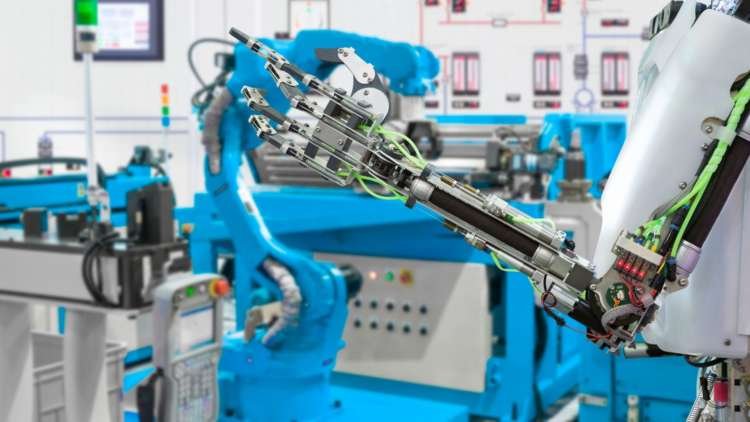
    Featured image for article about Technology

    By Marga Hoek, author of The Trillion Dollar Shift

    Robotics technology has the potential to disrupt industries across all sectors – but its impact on the manufacturing industry will be transformative. Not only can robots increase productivity, efficiency and profit margins but adopting this tech for good will be a key way for the manufacturing industry to transition to a more sustainable future.

    Driving productivity & efficiency

    Manufacturing processes are faster, more efficient, and more cost-effective when humans and robots work together. Studies show that idle time is reduced by 85% when people work collaboratively with a human-aware robot, rather than in an all-human team.[1] Modern robotic automation is key to reshaping production processes to become more efficient and reliable. They deliver significant benefits for companies and investment is often recouped within just 18 months.[2]

    Robots in manufacturing can allow businesses to monitor the production lines from anywhere and pinpoint issues quickly, allowing for production to continue smoothly and efficiently, ensuring companies surpass consumers’ expectations of supply chain speed and reliability. Intelligent industrial service robots are an upcoming industrial tool that will amplify manufacturing capabilities and allow businesses to safely operate faster, in places humans could never go, and with cognitive and physical capabilities not yet imagined.

    Transitioning to a sustainable future

    Robots are a vital way to reduce pollution and emissions from manufacturing operations. For starters, they reduce our reliance on larger vehicles and machines that are harmful to the planet. Robots’ ability to be extremely accurate and minimize errors is also hugely important in sustainability efforts to reduce waste. Robots also aid businesses in their energy-saving process because they do not require as much energy to operate as humans do. Where humans need facilities with sufficient lighting and heat, robots can work under cold and dark conditions. This drastically reduces the amount of energy used in the manufacturing production process. It is estimated that for every 1C reduced in factory heat levels, there is a potential saving of up to 8%.[3] In addition, up to 20% of energy savings can be reached if the plant turns off any unnecessary lighting.

    Case Study: GE

    Tech giant GE is a brilliant example of how robotics technology can both boost the bottom line and sustainability.

    GE is at the forefront of robotics manufacturing technology. Their value proposition is tightly tied to productivity in field service and manufacturing and offers potential cost savings within operations. While delivering industrial-grade service robotic systems that enable automation, productivity and safety for GE and its customers, the company works closely with GE business units, GE customers and strategic partners across the globe to envision, shape and build intelligent robotic technologies from idea to commercialization.

    Marga Hoek

    Marga Hoek

    GE’s recent $125 million investment project at its Decatur refrigerator plant boosted production capacity, added new “smart” technology and increased the site’s workforce.  This includes auto guided vehicles, or AGVs, that move materials through the assembly process and more than 50 robots that perform heavy lifting operations and repetitive tasks.

    The expansion project, announced in June 2018, allowed GE Appliances to increase production to meet growing demand for its freezer-refrigerators, which are top-rated in the industry for both quality and reliability. The expansion created 255 jobs, bringing total employment at the plant to 1,300. The project boosts production capacity by 25 % and ensures early compliance with 2022 refrigerant changes, making the Alabama plant a super site for GE. GE Appliances said Industry 4.0 technology additions at the Decatur facility include data visualization, 3-D scanning, rapid prototyping and other smart automation that provides the operations team with real-time data to make better and faster decisions.

    Achieving the UN’s Sustainable Development Goals

    Utilizing robotics technology within the manufacturing industry can help to meet the UN’s 17 Sustainable Development Goals (SDG) for a healthier planet, to be met by 2030:

    SDG 3 – Good Health & Wellbeing: Collaborating with people, service robots work with shoulder-to-shoulder and over long distances, to fulfil dull, dirty and dangerous work.

    SDG 8 – Decent Work & Economic Growth: Presenting new growth opportunities for businesses and creating new jobs at manufacturing plants

    SDG 9 – Industry, Innovation & Infrastructure:  Manufacturing value proposition of robotics ties tightly to productivity and brings potential cost savings into those operations.

    SDG 12 – Responsible Production & Consumption: Providing a new and rich data source for companies to produce products responsibly

    Marga Hoek is a global thought-leader on sustainable business, international speaker and the author of The Trillion Dollar Shift, a new book revealing the business opportunities provided by the UN’s Sustainable Development Goals. The Trillion Dollar Shift is published by Routledge, in hardback and e-book. For more information go to www.margahoek.com

    [1] https://www.weforum.org/agenda/2020/08/here-s-how-robots-can-help-us-confront-covid/

    [2] https://www.industrialtechnology.co.uk/products–transforming-your-sustainability-with-robotic-automation.html

    [3] https://greencleanguide.com/how-robotics-is-revolutionizing-sustainability/

    Related Posts
    LakeFusion Secures Seed Funding to Advance AI-Native Master Data Management
    LakeFusion Secures Seed Funding to Advance AI-Native Master Data Management
    Clarity, Context, Confidence: Explainable AI and the New Era of Investor Trust
    Clarity, Context, Confidence: Explainable AI and the New Era of Investor Trust
    Data Intelligence Transforms the Future of Credit Risk Strategy
    Data Intelligence Transforms the Future of Credit Risk Strategy
    Architect of Integration Ushers in a New Era for AI in Regulated Industries
    Architect of Integration Ushers in a New Era for AI in Regulated Industries
    How One Technologist is Building Self-Healing AI Systems that Could Transform Financial Regulation
    How One Technologist is Building Self-Healing AI Systems that Could Transform Financial Regulation
    SBS is Doubling Down on SaaS to Power the Next Wave of Bank Modernization
    SBS is Doubling Down on SaaS to Power the Next Wave of Bank Modernization
    Trust Embedding: Integrating Governance into Next-Generation Data Platforms
    Trust Embedding: Integrating Governance into Next-Generation Data Platforms
    The Guardian of Connectivity: How Rohith Kumar Punithavel Is Redefining Trust in Private Networks
    The Guardian of Connectivity: How Rohith Kumar Punithavel Is Redefining Trust in Private Networks
    BNY Partners With HID and SwiftConnect to Provide Mobile Access to its Offices Around the Globe With Employee Badge in Apple Wallet
    BNY Partners With HID and SwiftConnect to Provide Mobile Access to its Offices Around the Globe With Employee Badge in Apple Wallet
    How Integral’s CTO Chidambaram Bhat is helping to solve  transfer pricing problems through cutting edge AI.
    How Integral’s CTO Chidambaram Bhat is helping to solve transfer pricing problems through cutting edge AI.
    Why Physical Infrastructure Still Matters in a Digital Economy
    Why Physical Infrastructure Still Matters in a Digital Economy
    Why Compliance Has Become an Engineering Problem
    Why Compliance Has Become an Engineering Problem

    Why waste money on news and opinions when you can access them for free?

    Take advantage of our newsletter subscription and stay informed on the go!

    Subscribe

    More from Technology

    Explore more articles in the Technology category

    Can AI-Powered Security Prevent $4.2 Billion in Banking Fraud?

    Can AI-Powered Security Prevent $4.2 Billion in Banking Fraud?

    Reimagining Human-Technology Interaction: Sagar Kesarpu’s Mission to Humanize Automation

    Reimagining Human-Technology Interaction: Sagar Kesarpu’s Mission to Humanize Automation

    LeapXpert: How financial institutions can turn shadow messaging from a risk into an opportunity

    LeapXpert: How financial institutions can turn shadow messaging from a risk into an opportunity

    Intelligence in Motion: Building Predictive Systems for Global Operations

    Intelligence in Motion: Building Predictive Systems for Global Operations

    Predictive Analytics and Strategic Operations: Strengthening Supply Chain Resilience

    Predictive Analytics and Strategic Operations: Strengthening Supply Chain Resilience

    How Nclude.ai   turned broken portals into completed applications

    How Nclude.ai turned broken portals into completed applications

    The Silent Shift: Rethinking Services for a Digital World?

    The Silent Shift: Rethinking Services for a Digital World?

    Culture as Capital: How Woxa Corporation Is Redefining Fintech Sustainability

    Culture as Capital: How Woxa Corporation Is Redefining Fintech Sustainability

    Securing the Future: We're Fixing Cyber Resilience by Finally Making Compliance Cool

    Securing the Future: We're Fixing Cyber Resilience by Finally Making Compliance Cool

    Supply chain security risks now innumerable and unmanageable for majority of cybersecurity leaders, IO research reveals

    Supply chain security risks now innumerable and unmanageable for majority of cybersecurity leaders, IO research reveals

    Why AI's Promise of Efficiency May Break Tomorrow's Workforce

    Why AI's Promise of Efficiency May Break Tomorrow's Workforce

    Revolutionizing AppSec: The AI Security Crew Paradigm Shift

    Revolutionizing AppSec: The AI Security Crew Paradigm Shift

    View All Technology Posts
    Previous Technology PostLeading from the front – why decision makers must embrace automation
    Next Technology PostRPA, the software robots that finance and banking professionals need to hear about.