
Search
00
GBAF Logo
trophy
Top StoriesInterviewsBusinessFinanceBankingTechnologyInvestingTradingVideosAwardsMagazinesHeadlinesTrends

Subscribe to our newsletter

Get the latest news and updates from our team.

Global Banking & Finance Review®

Global Banking & Finance Review® - Subscribe to our newsletter

Company

    GBAF Logo
    • About Us
    • Advertising and Sponsorship
    • Profile & Readership
    • Contact Us
    • Latest News
    • Privacy & Cookies Policies
    • Terms of Use
    • Advertising Terms
    • Issue 81
    • Issue 80
    • Issue 79
    • Issue 78
    • Issue 77
    • Issue 76
    • Issue 75
    • Issue 74
    • Issue 73
    • Issue 72
    • Issue 71
    • Issue 70
    • View All
    • About the Awards
    • Awards Timetable
    • Awards Winners
    • Submit Nominations
    • Testimonials
    • Media Room
    • FAQ
    • Asset Management Awards
    • Brand of the Year Awards
    • Business Awards
    • Cash Management Banking Awards
    • Banking Technology Awards
    • CEO Awards
    • Customer Service Awards
    • CSR Awards
    • Deal of the Year Awards
    • Corporate Governance Awards
    • Corporate Banking Awards
    • Digital Transformation Awards
    • Fintech Awards
    • Education & Training Awards
    • ESG & Sustainability Awards
    • ESG Awards
    • Forex Banking Awards
    • Innovation Awards
    • Insurance & Takaful Awards
    • Investment Banking Awards
    • Investor Relations Awards
    • Leadership Awards
    • Islamic Banking Awards
    • Real Estate Awards
    • Project Finance Awards
    • Process & Product Awards
    • Telecommunication Awards
    • HR & Recruitment Awards
    • Trade Finance Awards
    • The Next 100 Global Awards
    • Wealth Management Awards
    • Travel Awards
    • Years of Excellence Awards
    • Publishing Principles
    • Ownership & Funding
    • Corrections Policy
    • Editorial Code of Ethics
    • Diversity & Inclusion Policy
    • Fact Checking Policy
    Original content: Global Banking and Finance Review - https://www.globalbankingandfinance.com

    A global financial intelligence and recognition platform delivering authoritative insights, data-driven analysis, and institutional benchmarking across Banking, Capital Markets, Investment, Technology, and Financial Infrastructure.

    Copyright © 2010-2026 - All Rights Reserved. | Sitemap | Tags

    Editorial & Advertiser disclosure

    Global Banking & Finance Review® is an online platform offering news, analysis, and opinion on the latest trends, developments, and innovations in the banking and finance industry worldwide. The platform covers a diverse range of topics, including banking, insurance, investment, wealth management, fintech, and regulatory issues. The website publishes news, press releases, opinion and advertorials on various financial organizations, products and services which are commissioned from various Companies, Organizations, PR agencies, Bloggers etc. These commissioned articles are commercial in nature. This is not to be considered as financial advice and should be considered only for information purposes. It does not reflect the views or opinion of our website and is not to be considered an endorsement or a recommendation. We cannot guarantee the accuracy or applicability of any information provided with respect to your individual or personal circumstances. Please seek Professional advice from a qualified professional before making any financial decisions. We link to various third-party websites, affiliate sales networks, and to our advertising partners websites. When you view or click on certain links available on our articles, our partners may compensate us for displaying the content to you or make a purchase or fill a form. This will not incur any additional charges to you. To make things simpler for you to identity or distinguish advertised or sponsored articles or links, you may consider all articles or links hosted on our site as a commercial article placement. We will not be responsible for any loss you may suffer as a result of any omission or inaccuracy on the website.

    1. Home
    2. >Business
    3. >HIGH-WAGE OCCUPATIONS PROJECTED TO DRIVE UK LABOUR MARKET
    Business

    High-Wage Occupations Projected to Drive UK Labour Market

    Published by Gbaf News

    Posted on September 22, 2014

    4 min read

    Last updated: January 22, 2026

    Add as preferred source on Google
    This image shows a graph depicting the projected growth of high-wage occupations in the UK labor market, highlighting trends in employment and wage stagnation as discussed in the article.
    Graph illustrating high-wage occupations driving UK labor market growth - Global Banking & Finance Review
    Why waste money on news and opinion when you can access them for free?

    Take advantage of our newsletter subscription and stay informed on the go!

    Subscribe

    by Tony Roy, President, CareerBuilder EMEA

    Recent UK labour market news has been decidedly mixed. On the positive side, British GDP expansion surpassed its pre-financial crisis peak earlier this summer, and earlier this month Bank of England governor Mark Carney stated in a speech to union workers that the recovery “has exceeded all expectations.” He noted that recent momentum should lead to even higher employment and sustained economic expansion.

    However, this encouraging turn has been undercut by persistent wage stagnation. Since the beginning of the crisis, inflation adjusted pay has fallen by a tenth, according to Carney. This has led to understandable frustration among UK workers and calls for a higher minimum wage. But as employment rolls surge, and businesses compete for scarce talent in key occupational sectors, the stagnation will soon subside.

    This outlook is corroborated by new data from CareerBuilder and labour market analysis firm Economic Modeling Specialists International, which looked at job projections across wage, occupation and education categories from 2014 through 2018. Overall, the UK labour market is projected to expand by 2.6 per cent over this period, up from 2.0 per cent over the prior five years. While this may seem like a conservative figure, the picture looks better when broken down by wage classification.

    For this analysis, CareerBuilder and EMSI arrived at wage categories by dividing the UK’s 27.2 million jobs into three roughly-even tiers. The highest tier – defined here as jobs with median hourly pay of £13.81 and above, which represents the top third of the labour force – are projected to grow 3.9 per cent, significantly faster the national average. Lower-wage occupations, representing the bottom third of the labour force, (£9.00 per hour and below) are projected to grow 2.3 per cent, while medium-wage occupations (£9.01-£13.80) lag at 1.8 per cent. These numbers mirror the trends of a similar analysis of the U.S. workforce, which also shows a bifurcation of high and low wage job growth. The fact jobs at the middle of the spectrum are falling behind is not the best news for the UK’s working class; however, there’s reason for optimism so long as higher-wage jobs remain at the foreground of labour market growth.

    Naturally, wage trends correspond closely to job projections sorted by education requirements. The rate of job growth for university educated workers and those with at least certificate will be about double that of those who have only completed A-Level education or below:
    Job Growth Projections by Education Class

    Certificate or Intermediate: 4.0%
    Honours, Bachelor’s and above: 3.8%
    A-Levels and below: 2.0%

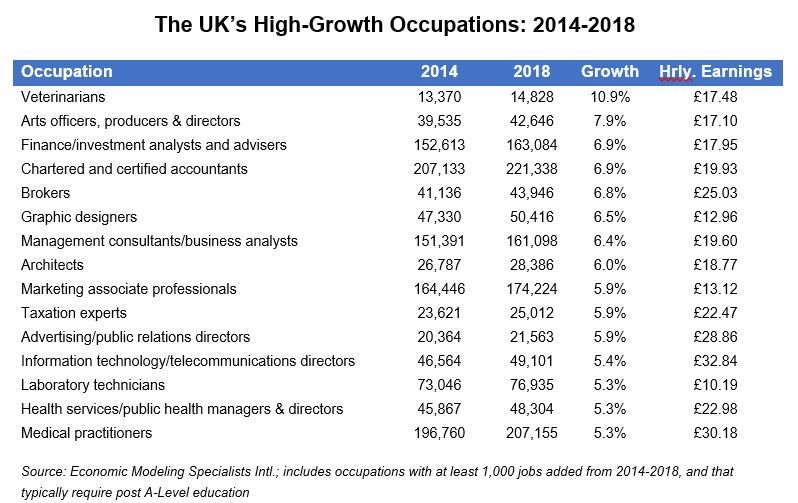
    Looking at the occupations with the most robust growth projections underscores the importance of an increasingly educated labour force. Through 2018, there are 58 occupations in the UK projected to expand at least twice the rate of national growth, 59 per cent of which require more than an A-Level education. The average median hourly pay for these occupations is £19.17 – more than six pounds above the national median hourly rate of £12.87. Below is a look at several of those occupations:

    The diversity of the above occupations is encouraging. Jobs requiring all-important STEM (science, technology, engineering, and mathematics) skills are predictably well represented, as the health care, finance and tech sectors remain integral components of the economy. However, many creative, knowledge-based jobs will expand in the coming years, as well. There is high demand for marketing, advertising, design and entertainment workers – all jobs that typically pay well above average.
    The need for more educated workers with specialized skill sets is already presenting challenges for employers. The phenomena known as the skills gap continues to draw the attention of recruiting leaders and policy makers, even as education attainment continues to increase in the UK. A recent CareerBuilder.co.uk poll found that more than a quarter of employers have open positions for which they cannot find qualified candidates.

    In the short-term, competition for scarce talent should be a positive influence on wage growth. The structural, long-term solution, on the other hand, will be multi-faceted, and may ultimately convince more employers to implement internal training programs that focus on hiring for potential as opposed to waiting for the perfect candidate. The survey found that a vast majority (74 per cent) of employers agree businesses need to take matters into their own hands and train for hard-to-find skills. If the occupational projections hold true, this will most certainly be a critical tactic in the effort to ensure UK’s economic momentum continues into the back half of the decade.

    More from Business

    Explore more articles in the Business category

    Image for Submit Your Entry for Years of Excellence Awards 2026
    Submit Your Entry for Years of Excellence Awards 2026
    Image for Nominations Open for Travel & Hospitality Awards 2026
    Nominations Open for Travel & Hospitality Awards 2026
    Image for Submit Your Entry Today for Telecom Awards 2026
    Submit Your Entry Today for Telecom Awards 2026
    Image for Submit Your Entries for The Next 100 Global Awards 2026
    Submit Your Entries for the Next 100 Global Awards 2026
    Image for Submit Your Entry: Public Sector & Governance Excellence Awards 2026
    Submit Your Entry: Public Sector & Governance Excellence Awards 2026
    Image for Nominations Invited for Real Estate Development Awards 2026
    Nominations Invited for Real Estate Development Awards 2026
    Image for Submit Your Entry: Process & Product Awards 2026
    Submit Your Entry: Process & Product Awards 2026
    Image for Call for Entries: HR & Recruitment Awards 2026
    Call for Entries: HR & Recruitment Awards 2026
    Image for Submit Your Nominations Today for Education & Training Awards 2026
    Submit Your Nominations Today for Education & Training Awards 2026
    Image for Join the Corporate Governance Awards 2026: Showcase Your Organisation’s Leadership
    Join the Corporate Governance Awards 2026: Showcase Your Organisation’s Leadership
    Image for Submit Your Entry Today for Business Awards 2026
    Submit Your Entry Today for Business Awards 2026
    Image for Decentralized Masters’ ‘family culture’ building trust instead of hierarchy
    Decentralized Masters’ ‘family Culture’ Building Trust Instead of Hierarchy
    View All Business Posts
    Previous Business PostContact Centers – Evolution or Revolution?
    Next Business PostUpgrade of Greece’s Tourist Assets Could Help Spur a Stronger Economic Recovery







