Search
00
GBAF Logo
trophy
Top StoriesInterviewsBusinessFinanceBankingTechnologyInvestingTradingVideosAwardsMagazinesHeadlinesTrends

Subscribe to our newsletter

Get the latest news and updates from our team.

Global Banking & Finance Review®

Global Banking & Finance Review® - Subscribe to our newsletter

Company

    GBAF Logo
    • About Us
    • Advertising and Sponsorship
    • Profile & Readership
    • Contact Us
    • Latest News
    • Privacy & Cookies Policies
    • Terms of Use
    • Advertising Terms
    • Issue 81
    • Issue 80
    • Issue 79
    • Issue 78
    • Issue 77
    • Issue 76
    • Issue 75
    • Issue 74
    • Issue 73
    • Issue 72
    • Issue 71
    • Issue 70
    • View All
    • About the Awards
    • Awards Timetable
    • Awards Winners
    • Submit Nominations
    • Testimonials
    • Media Room
    • FAQ
    • Asset Management Awards
    • Brand of the Year Awards
    • Business Awards
    • Cash Management Banking Awards
    • Banking Technology Awards
    • CEO Awards
    • Customer Service Awards
    • CSR Awards
    • Deal of the Year Awards
    • Corporate Governance Awards
    • Corporate Banking Awards
    • Digital Transformation Awards
    • Fintech Awards
    • Education & Training Awards
    • ESG & Sustainability Awards
    • ESG Awards
    • Forex Banking Awards
    • Innovation Awards
    • Insurance & Takaful Awards
    • Investment Banking Awards
    • Investor Relations Awards
    • Leadership Awards
    • Islamic Banking Awards
    • Real Estate Awards
    • Project Finance Awards
    • Process & Product Awards
    • Telecommunication Awards
    • HR & Recruitment Awards
    • Trade Finance Awards
    • The Next 100 Global Awards
    • Wealth Management Awards
    • Travel Awards
    • Years of Excellence Awards
    • Publishing Principles
    • Ownership & Funding
    • Corrections Policy
    • Editorial Code of Ethics
    • Diversity & Inclusion Policy
    • Fact Checking Policy
    Original content: Global Banking and Finance Review - https://www.globalbankingandfinance.com

    A global financial intelligence and recognition platform delivering authoritative insights, data-driven analysis, and institutional benchmarking across Banking, Capital Markets, Investment, Technology, and Financial Infrastructure.

    Copyright © 2010-2026 - All Rights Reserved. | Sitemap | Tags

    Editorial & Advertiser disclosure

    Global Banking & Finance Review® is an online platform offering news, analysis, and opinion on the latest trends, developments, and innovations in the banking and finance industry worldwide. The platform covers a diverse range of topics, including banking, insurance, investment, wealth management, fintech, and regulatory issues. The website publishes news, press releases, opinion and advertorials on various financial organizations, products and services which are commissioned from various Companies, Organizations, PR agencies, Bloggers etc. These commissioned articles are commercial in nature. This is not to be considered as financial advice and should be considered only for information purposes. It does not reflect the views or opinion of our website and is not to be considered an endorsement or a recommendation. We cannot guarantee the accuracy or applicability of any information provided with respect to your individual or personal circumstances. Please seek Professional advice from a qualified professional before making any financial decisions. We link to various third-party websites, affiliate sales networks, and to our advertising partners websites. When you view or click on certain links available on our articles, our partners may compensate us for displaying the content to you or make a purchase or fill a form. This will not incur any additional charges to you. To make things simpler for you to identity or distinguish advertised or sponsored articles or links, you may consider all articles or links hosted on our site as a commercial article placement. We will not be responsible for any loss you may suffer as a result of any omission or inaccuracy on the website.

    1. Home
    2. >Finance
    3. >GROWTH IN GLOBAL PAYMENT CARDS DRIVEN BY EXPANSION OF BANKED POPULATION
    Finance

    Growth in Global Payment Cards Driven by Expansion of Banked Population

    Published by Gbaf News

    Posted on November 8, 2016

    6 min read

    Last updated: January 22, 2026

    Add as preferred source on Google

    This image illustrates key concepts of cloud-native security, crucial for businesses utilizing cloud technology. It highlights the need for integrated security strategies in the ever-evolving IT landscape.
    Image depicting cloud technology and security concepts essential for modern businesses - Global Banking & Finance Review
    Why waste money on news and opinion when you can access them for free?

    Take advantage of our newsletter subscription and stay informed on the go!

    Subscribe

    Debit card numbers are growing faster than credit cards – a trend that is set to continue for many years to come, according to strategic research and consulting firm RBR

    Middle East and Africa, and Asia-Pacific will continue as the fastest growing card regions

    RBR’s new study Global Payment Cards Data and Forecasts to 2021 shows that the Middle East and Africa (MEA) and Asia-Pacific were the fastest growing regions for payment cards in 2015, with card numbers up by 13% and 10% respectively. Underlying this double-digit growth are financial inclusion measures,such as digitalisation of salary and government benefit payments, which have yielded positive results.

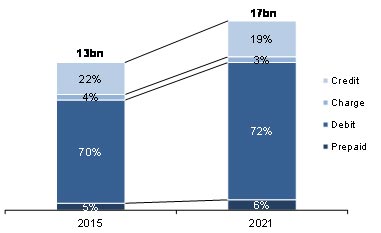
    RBR forecasts that the number of cards worldwide will rise 28% from 13 billion at the end of 2015 to 17 billion by the end of 2021. With projected growth rates of 49% and 35% over this period, MEA and Asia-Pacific will continue to be the fastest expanding regions.

    RBR Senior Associate Chris Herbert, who led the study, commented: “Although the growth rate in the number of cards worldwide is slowing down, there are several large market swhich still have considerable potential. For example, there are comparatively low levels of bank account and card holding in India, Indonesia, Nigeria and Pakistan, and therefore huge numbers of possible new clients who have not yet entered the banking system.”

    Debit cards will contribute the majority of growth

    Debit cards make up 70% of payment cards globally, up from 68% in 2014. As unbanked individuals in emerging markets continue to enter the banking system, it is in the debit sector that we will see most growth, as it is debit cards that are normally issued when a person opens a current account. By 2021, debit cards are forecast to represent 72% of all payment cards.

    Number of Payment Cards Worldwide, by Type
    Source: Global Payment Cards Data and Forecasts to 2021 (RBR)

    Source: Global Payment Cards Data and Forecasts to 2021 (RBR)

    Credit card numbers impacted by regulatory and economic factors

    The number of credit cards worldwide rose by 2% in 2015, but their share of total cards fell by a percentage point to 22% and is expected to fall further, to 19%, by 2021.

    The interchange fee regulation enforced across the EU in December 2015 typically lowered interchange for credit cards more than for debit cards, and RBR has found this is impacting issuance of credit cards in many countries there. In the Netherlands, for example, credit card interchange was a major source of revenue for banks, but some now appear to be discouraging customers from taking out credit cards because the caps have reduced their profitability.

    In countries such as Russia, the fall in the number of credit cards is directly related to economic uncertainty as banks often respond by tightening eligibility requirements and increasing interest rates in such circumstances.

    Chris Herbert added: “Despite varying levels of maturity of the cards markets in different countries, we forecast that debit cards will continue to see faster growth than credit cards, as a result of rising bank account holding and regulatory and economic pressure on the credit card sector.”

    Debit card numbers are growing faster than credit cards – a trend that is set to continue for many years to come, according to strategic research and consulting firm RBR

    Middle East and Africa, and Asia-Pacific will continue as the fastest growing card regions

    RBR’s new study Global Payment Cards Data and Forecasts to 2021 shows that the Middle East and Africa (MEA) and Asia-Pacific were the fastest growing regions for payment cards in 2015, with card numbers up by 13% and 10% respectively. Underlying this double-digit growth are financial inclusion measures,such as digitalisation of salary and government benefit payments, which have yielded positive results.

    RBR forecasts that the number of cards worldwide will rise 28% from 13 billion at the end of 2015 to 17 billion by the end of 2021. With projected growth rates of 49% and 35% over this period, MEA and Asia-Pacific will continue to be the fastest expanding regions.

    RBR Senior Associate Chris Herbert, who led the study, commented: “Although the growth rate in the number of cards worldwide is slowing down, there are several large market swhich still have considerable potential. For example, there are comparatively low levels of bank account and card holding in India, Indonesia, Nigeria and Pakistan, and therefore huge numbers of possible new clients who have not yet entered the banking system.”

    Debit cards will contribute the majority of growth

    Debit cards make up 70% of payment cards globally, up from 68% in 2014. As unbanked individuals in emerging markets continue to enter the banking system, it is in the debit sector that we will see most growth, as it is debit cards that are normally issued when a person opens a current account. By 2021, debit cards are forecast to represent 72% of all payment cards.

    Number of Payment Cards Worldwide, by Type

    Source: Global Payment Cards Data and Forecasts to 2021 (RBR)

    Source: Global Payment Cards Data and Forecasts to 2021 (RBR)

    Credit card numbers impacted by regulatory and economic factors

    The number of credit cards worldwide rose by 2% in 2015, but their share of total cards fell by a percentage point to 22% and is expected to fall further, to 19%, by 2021.

    The interchange fee regulation enforced across the EU in December 2015 typically lowered interchange for credit cards more than for debit cards, and RBR has found this is impacting issuance of credit cards in many countries there. In the Netherlands, for example, credit card interchange was a major source of revenue for banks, but some now appear to be discouraging customers from taking out credit cards because the caps have reduced their profitability.

    In countries such as Russia, the fall in the number of credit cards is directly related to economic uncertainty as banks often respond by tightening eligibility requirements and increasing interest rates in such circumstances.

    Chris Herbert added: “Despite varying levels of maturity of the cards markets in different countries, we forecast that debit cards will continue to see faster growth than credit cards, as a result of rising bank account holding and regulatory and economic pressure on the credit card sector.”

    More from Finance

    Explore more articles in the Finance category

    Image for Commerzbank supervisory board committee met 11 times to discuss UniCredit in 2025
    Commerzbank Supervisory Board Committee Met 11 Times to Discuss UniCredit in 2025
    Image for Swiss air transport caterer Gategroup considers listing
    Swiss Air Transport Caterer Gategroup Considers Listing
    Image for German business sentiment fell less than expected in March, Ifo finds
    German Business Sentiment Fell Less Than Expected in March, Ifo Finds
    Image for On Holding names co-founders as CEOs
    On Holding Names Co-Founders as CEOs
    Image for ECB may need to act on even 'not-too-persistent' inflation surge, Lagarde says
    ECB May Need to Act on Even 'not-Too-Persistent' Inflation Surge, Lagarde Says
    Image for Europe's STOXX 600 gains 1% on prospect of Middle East ceasefire
    Europe's Stoxx 600 Gains 1% on Prospect of Middle East Ceasefire
    Image for Estonia says drone enters from Russia, hits power station, ERR reports
    Estonia Says Drone Enters From Russia, Hits Power Station, Err Reports
    Image for Germany's Aurelius interested in buying Carrefour's Belgian unit, L'Echo reports
    Germany's Aurelius Interested in Buying Carrefour's Belgian Unit, L'Echo Reports
    Image for Germany's EnBW expects profits to be stable at best in 2026
    Germany's EnBW Expects Profits to Be Stable at Best in 2026
    Image for UK, EU and Switzerland set out one-day settlement testing plan
    Uk, EU and Switzerland Set Out One-Day Settlement Testing Plan
    Image for Taiwan wary that China could exploit US distraction over Middle East war
    Taiwan Wary That China Could Exploit US Distraction Over Middle East War
    Image for Russian attacks knock out power for thousands in Ukraine's north
    Russian Attacks Knock Out Power for Thousands in Ukraine's North
    View All Finance Posts
    Previous Finance PostJapan Looks to Argentina to Meet Its Food-Security Needs
    Next Finance PostAccountants Can’t Afford to Ignore Making Tax Digital