Research Reports
Global High Flow Nasal Cannula Market Research, Segmentation, Leading Industry Insights by 2030
Published by mark itwired
Posted on September 2, 2021
10 min readLast updated: February 13, 2026
Add as preferred source on Google
Published by mark itwired
Posted on September 2, 2021
10 min readLast updated: February 13, 2026
Add as preferred source on GoogleMarket research company Future Market Insights’ projections on the high flow nasal cannula market reveal that the market is slated to be valued at ~US$ 18 Bn by 2030. Technological advancements by key market players are also anticipated to burgeon the high-flow nasal cannula market. Moreover, clinical trials for evaluating new application areas shall open up new avenues for the market. According to the Global Burden of Disease Study, 2013, around 300 million people suffered from COPD during that year. This is attributed to growing addiction for smoking, deteriorating air quality and rising pollution across the globe. The prevalence of respiratory disorders will further boost market prospects.
Growing prevalence of respiratory disorders have led to an increase in the uptake of high-flow nasal cannula (HFNC) devices. The Center for Disease Control and Prevention (CDC) acknowledges the high-flow nasal cannula oxygenation therapy as a standard recommended therapy across the United States, especially during the COVID-19 pandemic.
Following this development, healthcare providers are facilitating extensive research on how to better integrate this technology in providing relief for severely infected patients. In the pre-COVID-19 scenario, HFNC was being administered to patients with acute respiratory distress syndrome (ARDS) and acute lung injury (ALI). These conditions were responsible for a majority of respiratory casualties.
Such extensive applications to correct respiratory anomalies is anticipated to sustain the market demand for HFNC treatment solutions and devices throughout the forecast period.
“Rising incidence of respiratory problems is anticipated to steer the high-flow nasal cannula market towards a positive growth trajectory. Moreover, the coronavirus pandemic is anticipated to leverage market prospects, owing to its suitability in oxygen delivery to patients,” opines an FMI analyst.
Get the latest COVID-19 impact insights on the high-flow nasal cannula market by requesting for a report sample here https://www.futuremarketinsights.com/reports/sample/rep-gb-11269
The high flow nasal cannula market is characterized by the presence of numerous players, making the market highly fragmented. The players are capitalizing on new product launches to acquire a market foothold.
For instance, in Jan 2019, ResMed unveiled its MOBI portable oxygen concentrator across the US market to address patients suffering from chronic obstructive pulmonary disease (COPD). Later that year, in May 2019, Fisher & Paykel Healthcare Ltd. launched the Optiflow 3S nasal cannula technology.
Likewise, Teleflex launched the Hudson RCI Comfort Flo Plus Cannula which concentrates on administering oxygen to the upper airway dead space, providing a greater level of comfort.
Component
Medical Application
End User
Region/Country
North America
Latin America
Europe
South Asia
East Asia
Oceania
Middle East & Africa (MEA)
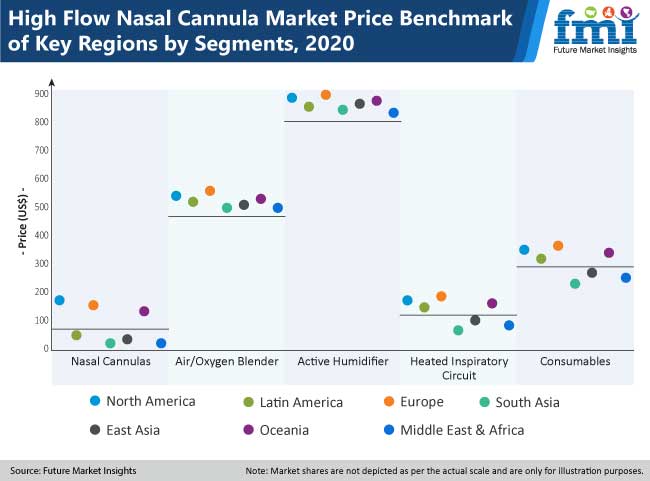
High flow nasal cannula market, a new study from Future Market Insights, states the indications of high flow nasal cannula from 2015 to 2019 and presents demand projections from 2020 from 2030 on the basis of components (air/oxygen blender, active humidifier, nasal cannulas, heated inspiratory circuit, and consumables), application (acute respiratory failure, chronic obstructive pulmonary disease (COPD), bronchiectasis, carbon monoxide toxicity, sleep apnea, acute heart failure, and others), and end user (hospitals, specialty clinics, long-term care centers, ambulatory care centers, and homecare setting) across seven prominent regions.
1.1. Global Market Outlook
1.2. Demand Side Trends
1.3. Supply Side Trends
1.4. Technology Roadmap
1.5. Analysis and Recommendations
2.1. Market Coverage / Taxonomy
2.2. Market Definition / Scope / Limitations
3.1. Key Trends Impacting the Market
3.2. Product Innovation / Development Trends
4.1. Product Adoption / Usage Analysis
4.2. Product USPs / Features
4.3. Promotional Strategies
4.4. State-of-art/Evolution of High Flow Nasal Cannula
4.5. Clinical Developments
4.6. Product Approvals
4.7. Reimbursement Scenario
5.1. Historical Market Volume (Mn Units) Analysis, 2015-2019
5.2. Current and Future Market Volume (Mn Units) Projections, 2020-2030
5.3. Y-o-Y Growth Trend Analysis
6.1. Regional Pricing Analysis By Component
6.2. Pricing Break-up
6.2.1. Manufacturer Level Pricing
6.2.2. Distributor Level Pricing
6.3. Global Average Pricing Analysis Benchmark
The post Global High Flow Nasal Cannula Market Research, Segmentation, Leading Industry Insights by 2030 first appeared on Market Research Blog.
Market research company Future Market Insights’ projections on the high flow nasal cannula market reveal that the market is slated to be valued at ~US$ 18 Bn by 2030. Technological advancements by key market players are also anticipated to burgeon the high-flow nasal cannula market. Moreover, clinical trials for evaluating new application areas shall open up new avenues for the market. According to the Global Burden of Disease Study, 2013, around 300 million people suffered from COPD during that year. This is attributed to growing addiction for smoking, deteriorating air quality and rising pollution across the globe. The prevalence of respiratory disorders will further boost market prospects.
Growing prevalence of respiratory disorders have led to an increase in the uptake of high-flow nasal cannula (HFNC) devices. The Center for Disease Control and Prevention (CDC) acknowledges the high-flow nasal cannula oxygenation therapy as a standard recommended therapy across the United States, especially during the COVID-19 pandemic.
Following this development, healthcare providers are facilitating extensive research on how to better integrate this technology in providing relief for severely infected patients. In the pre-COVID-19 scenario, HFNC was being administered to patients with acute respiratory distress syndrome (ARDS) and acute lung injury (ALI). These conditions were responsible for a majority of respiratory casualties.
Such extensive applications to correct respiratory anomalies is anticipated to sustain the market demand for HFNC treatment solutions and devices throughout the forecast period.
“Rising incidence of respiratory problems is anticipated to steer the high-flow nasal cannula market towards a positive growth trajectory. Moreover, the coronavirus pandemic is anticipated to leverage market prospects, owing to its suitability in oxygen delivery to patients,” opines an FMI analyst.
Get the latest COVID-19 impact insights on the high-flow nasal cannula market by requesting for a report sample here https://www.futuremarketinsights.com/reports/sample/rep-gb-11269
The high flow nasal cannula market is characterized by the presence of numerous players, making the market highly fragmented. The players are capitalizing on new product launches to acquire a market foothold.
For instance, in Jan 2019, ResMed unveiled its MOBI portable oxygen concentrator across the US market to address patients suffering from chronic obstructive pulmonary disease (COPD). Later that year, in May 2019, Fisher & Paykel Healthcare Ltd. launched the Optiflow 3S nasal cannula technology.
Likewise, Teleflex launched the Hudson RCI Comfort Flo Plus Cannula which concentrates on administering oxygen to the upper airway dead space, providing a greater level of comfort.
Component
Medical Application
End User
Region/Country
North America
Latin America
Europe
South Asia
East Asia
Oceania
Middle East & Africa (MEA)
High flow nasal cannula market, a new study from Future Market Insights, states the indications of high flow nasal cannula from 2015 to 2019 and presents demand projections from 2020 from 2030 on the basis of components (air/oxygen blender, active humidifier, nasal cannulas, heated inspiratory circuit, and consumables), application (acute respiratory failure, chronic obstructive pulmonary disease (COPD), bronchiectasis, carbon monoxide toxicity, sleep apnea, acute heart failure, and others), and end user (hospitals, specialty clinics, long-term care centers, ambulatory care centers, and homecare setting) across seven prominent regions.
1.1. Global Market Outlook
1.2. Demand Side Trends
1.3. Supply Side Trends
1.4. Technology Roadmap
1.5. Analysis and Recommendations
2.1. Market Coverage / Taxonomy
2.2. Market Definition / Scope / Limitations
3.1. Key Trends Impacting the Market
3.2. Product Innovation / Development Trends
4.1. Product Adoption / Usage Analysis
4.2. Product USPs / Features
4.3. Promotional Strategies
4.4. State-of-art/Evolution of High Flow Nasal Cannula
4.5. Clinical Developments
4.6. Product Approvals
4.7. Reimbursement Scenario
5.1. Historical Market Volume (Mn Units) Analysis, 2015-2019
5.2. Current and Future Market Volume (Mn Units) Projections, 2020-2030
5.3. Y-o-Y Growth Trend Analysis
6.1. Regional Pricing Analysis By Component
6.2. Pricing Break-up
6.2.1. Manufacturer Level Pricing
6.2.2. Distributor Level Pricing
6.3. Global Average Pricing Analysis Benchmark
The post Global High Flow Nasal Cannula Market Research, Segmentation, Leading Industry Insights by 2030 first appeared on Market Research Blog.
Chronic Obstructive Pulmonary Disease (COPD) is a progressive lung disease characterized by increasing breathlessness, often caused by long-term exposure to harmful substances like tobacco smoke.
Market segmentation is the process of dividing a broad consumer or business market into sub-groups based on shared characteristics, allowing for targeted marketing strategies.
Explore more articles in the Research Reports category