An image depicting a financial advisor explaining green finance products to clients, highlighting the importance of sustainable investments and risk avoidance in the finance sector.
Transesterification Technology Instrumental in Production of Emission-reducing Fuel Additives
Organic carbonates are gaining increased applicability in various chemical and biotechnical processes, owing to their advantageous attributes. Likewise, dimethyl carbonate is being highly publicized for its versatile chemical reactivity in the production of alternate fuel additives and cleaning agents. Manufacturers in the dimethyl carbonate market are grabbing incremental opportunities by increasing the applicability of DMC as a solvent in the synthesis of polymers, flavoring agents, and pesticides, among others. Moreover, DMC is being used as an electrolyte in lithium-ion batteries, owing to its low toxicity and efficient dissolving abilities.
Companies in the dimethyl carbonate market are increasing their research efforts to innovate in new synthesis technologies. As such, the transesterification of propylene carbonate and methanol to produce dimethyl carbonate is emerging as a mature technology. This technique is playing an instrumental role in the production of fuel additives that help to reduce vehicle emissions, thus preventing the risks of health issues among individuals.
Strong expertise with attention to detail makes our market research reports stand apart. Download PDF Brochure –
High Demand for DMC in China for Polycarbonate Production Boosts Dimethyl Carbonate Market Growth
Dimethyl carbonate is becoming an important chemical raw material, owing to its good biodegradability, polarity, and reactivity, which is being channelized in the production of polycarbonates, fuel additives, and cleaning solvents.
Request for Covid-19 Impact Analysis on dimethyl carbonate market:
New synthesis technologies such as the synthesis of dimethyl carbonate from urea and methanol is becoming popular recently. Companies in the dimethyl carbonate market are unlocking revenue opportunities with rapid advancements in polycarbonate production and lithium batteries in China. The high demand for DMC in polycarbonate production and lithium batteries is expected to bolster growth of the global dimethyl carbonate market.
Buy our Premium Research Report on dimethyl carbonate market@
The synthesis of DMC via transesterification of propylene carbonate and methanol holds promising potentials for the production of paints and coatings, owing to its advantages of less waste generation and less equipment corrosion. As such, manufacturers are increasing efforts to develop highly efficient solid catalysts and are increasing focus in new three-phase catalytic distillation technologies. They are innovating in new methods for DMC separation from DMC-methanol azeotrope with low energy consumption.
More Trending Reports by Transparency Market Research –
Green Synthesis of Dimethyl Carbonate Gains Popularity as Cost-efficient Method
Carbon is an abundant element and is one of the key elements in fuels and polymers. This has encouraged companies in the dimethyl carbonate market to convert carbon dioxide (CO2) into useful chemicals such as dimethyl carbonate (DMC), owing to the non-toxic attributes of carbon. This trend is anticipated to grow, since traditional processes such as phosgenation involve drawbacks such as the use of highly toxic and corrosive phosgene gas and the formation of large amounts of inorganic salts. Hence, companies in the dimethyl carbonate market are increasing their R&D efforts to gain efficacy in the green synthesis of DMC.
Manufacturers are adopting methods that involve direct synthesis of dimethyl carbonate from CO2 and methanol in order to gain efficacy in green chemistry. As such, green synthesis of DMC is growing popular as a cost efficient method, since methanol is a less expensive raw material. As such, DMC is being used as a precursor for polycarbonate synthesis.
COVID-19 Crisis Affects Production of Polycarbonates and Lithium Batteries in China
Ongoing developments in the coronavirus (COVID-19) pandemic are negatively impacting the dimethyl carbonate market. The novel virus is disrupting supply chains and affecting the business in China, since Chinese manufacturers are aggressive in polycarbonate and lithium battery production. Due to lockdown situations in most countries that have surging number of COVID-19 patients, manufacturing plants have been temporarily shut down until the infection subsides. As opposed to India, governments have relaxed regulations in orange and green zones. Thus, companies in the India dimethyl carbonate market can re-activate their production activities to minimize the slump in revenue generation.
Manufacturers are adopting contingency plans in order to revive market growth. They are establishing skeleton-size crews to ensure the well-being and safety of workers and employees. Companies are adopting dynamic measures to respond against volatile demands and changing market scenario.
Analysts’ Viewpoint
The COVID-19 outbreak has caused a slowdown in the production of polycarbonates and lithium-ion batteries in China. As such, more than 50% of the DMC in China is being produced via green synthesis of propylene carbonate (PC) and methanol to comply with environmental regulations. Manufacturers are increasing focus in several types of ionic liquids that play an instrumental role in the synthesis of DMC.
Different catalysts are acquiring prominence in DMC production technologies. However, homogenous catalysts are prone to deactivation and are difficult to separate in the process of DMC production. Hence, manufacturers should use heterogeneous catalysts that are easy to separate and hold promising potential in large-scale industrial applications.
Dimethyl Carbonate Market: Overview
Dimethyl carbonate is an organic compound classified as a carbonate ester. It is colorless, transparent, and flammable. Being denser than water, it is slightly soluble in water. Dimethyl carbonate has pleasant odor and relatively mild toxicology. It can be completely dissolved in organic solvents such as ketone, ester, and alcohol. Dimethyl carbonate forms azeotrope with water and it is non-corrosive to metals. It is rapidly replacing toxic reagents, such as phosgene, as a precursor in the production of polycarbonates.
Dimethyl carbonate is primarily used as an intermediate in the manufacture of polycarbonates. Polycarbonates are types of plastics known for their impact resistance, high dielectric strength, and optical transparency. In Asia Pacific, dimethyl carbonate is largely employed in the manufacture of pesticides, followed by pharmaceuticals and intermediate chemicals.
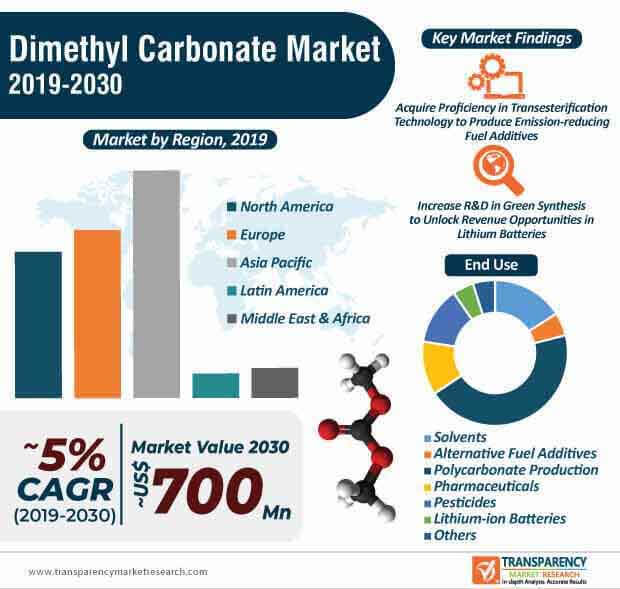
In terms of value, the global dimethyl carbonate market is anticipated to expand at a CAGR of ~5% during the forecast period to reach value of ~US$ 700 Mn by 2030
North America was a prominent region of the global dimethyl carbonate market in 2019. The market in the region is expected to expand at a CAGR of more than 4.5% between 2020 and 2030.
Polycarbonates produced from dimethyl carbonate are non-toxic, unlike those produced from phosgene. The manufacturing process of dimethyl carbonate does not use any chlorinated solvent; therefore, it does not lead to any environmental issues.
The global paints & coatings industry has been expanding significantly, due to high demand for paints and coatings in the building & construction industry in Asia Pacific. Increase in construction activities in Middle East & Africa are also projected to drive the global industry. This, in turn, is likely to fuel the demand for dimethyl carbonate during the forecast period.
Rise in Demand for Industrial-grade Dimethyl Carbonate in Chemical Manufacturing Industry
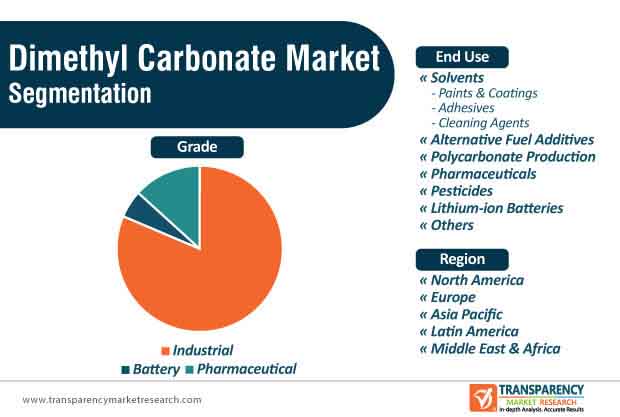
Among grades, industrial was the major segment of the global dimethyl carbonate market in 2019. It accounted for more than 80% of the market share in the year. It is estimated to continue its dominance in the global dimethyl carbonate market between 2020 and 2030. A major application of dimethyl carbonate lies in its usage in the manufacture of solvents such as paints and coatings, adhesives, and cleaning agents as well as alternative fuel additives. Additionally, the battery segment is estimated to witness lucrative opportunities during the forecast period, owing to growth of the global automotive industry.
Rise in Demand for Dimethyl Carbonate in Various End-use Applications
Among end uses, polycarbonate production was the major segment, holding more than 40% share of the global dimethyl carbonate market in 2019. It is estimated to continue its dominance between 2020 and 2030. Consumption of dimethyl carbonate in polycarbonate manufacture in the region is considerably high. Dimethyl carbonate serves as an eco-friendly alternative for phosgene and toxic methylating agents, such as dimethyl sulfate and methyl chloride. Additionally, dimethyl carbonate can replace ethanol in gasoline applications.
Regional Overview of Dimethyl Carbonate Market
In terms of volume, Asia Pacific constituted a major share of the global dimethyl carbonate market in 2019. Demand for dimethyl carbonate in the region is anticipated to increase during the forecast period, due to rapid growth in the usage of polycarbonates in Asia Pacific. The market in Asia Pacific is estimated to continue to expand at a rapid pace during the forecast period, owing to rise in the demand for dimethyl carbonate in various end-use applications such as paints & coatings, adhesives, cleaning agents, pesticides, and lithium-ion batteries in the region.
Dimethyl carbonate is often utilized in the manufacture of antibiotics in the pharmaceutical industry. Ciprofloxacin and carbadox can be manufactured from dimethyl carbonate. Ciprofloxacin is employed to prevent certain infections caused by bacteria. It is also employed to treat or prevent anthrax. Carbadox is an antibacterial agent that is utilized in veterinary medications.
Dimethyl Carbonate Market: Competition Landscape
Manufacturers are focusing on expanding their production capacities for dimethyl carbonate in order to meet the demand for dimethyl carbonate in solvents and pharmaceutical applications
Key players operating in the global dimethyl carbonate market are
UBE Industries
Shandong Haike Chemical Group Co., Ltd.
KOWA American Corporation
Qingdao Aspirit Chemical Co., Ltd.
Shandong Shida Shenghua Chemical Co., Ltd.
Tokyo Chemical Industry Co., Ltd.
Shandong Depu Chemical Industry Science & Technology Co., Ltd.
Dongying City Longxing Chemical Co., Ltd.
Shandong Feiyang Chemical Co., Ltd.
Kindun Chemical Co., Limited
Alfa Aesar
Shandong Wells Chemicals Co. Ltd.
Dongying Hi-tech Spring Chemical Industry Co., Ltd
Transparency Market Research is a global market intelligence company, providing global business information reports and services. Our exclusive blend of quantitative forecasting and trends analysis provides forward-looking insight for thousands of decision makers. Our experienced team of Analysts, Researchers, and Consultants, use proprietary data sources and various tools and techniques to gather, and analyze information.
Our data repository is continuously updated and revised by a team of research experts, so that it always reflects the latest trends and information. With a broad research and analysis capability, Transparency Market Research employs rigorous primary and secondary research techniques in developing distinctive data sets and research material for business reports.
Transesterification Technology Instrumental in Production of Emission-reducing Fuel Additives
Organic carbonates are gaining increased applicability in various chemical and biotechnical processes, owing to their advantageous attributes. Likewise, dimethyl carbonate is being highly publicized for its versatile chemical reactivity in the production of alternate fuel additives and cleaning agents. Manufacturers in the dimethyl carbonate market are grabbing incremental opportunities by increasing the applicability of DMC as a solvent in the synthesis of polymers, flavoring agents, and pesticides, among others. Moreover, DMC is being used as an electrolyte in lithium-ion batteries, owing to its low toxicity and efficient dissolving abilities.
Companies in the dimethyl carbonate market are increasing their research efforts to innovate in new synthesis technologies. As such, the transesterification of propylene carbonate and methanol to produce dimethyl carbonate is emerging as a mature technology. This technique is playing an instrumental role in the production of fuel additives that help to reduce vehicle emissions, thus preventing the risks of health issues among individuals.
Strong expertise with attention to detail makes our market research reports stand apart. Download PDF Brochure –
High Demand for DMC in China for Polycarbonate Production Boosts Dimethyl Carbonate Market Growth
Dimethyl carbonate is becoming an important chemical raw material, owing to its good biodegradability, polarity, and reactivity, which is being channelized in the production of polycarbonates, fuel additives, and cleaning solvents.
Request for Covid-19 Impact Analysis on dimethyl carbonate market:
New synthesis technologies such as the synthesis of dimethyl carbonate from urea and methanol is becoming popular recently. Companies in the dimethyl carbonate market are unlocking revenue opportunities with rapid advancements in polycarbonate production and lithium batteries in China. The high demand for DMC in polycarbonate production and lithium batteries is expected to bolster growth of the global dimethyl carbonate market.
Buy our Premium Research Report on dimethyl carbonate market@
The synthesis of DMC via transesterification of propylene carbonate and methanol holds promising potentials for the production of paints and coatings, owing to its advantages of less waste generation and less equipment corrosion. As such, manufacturers are increasing efforts to develop highly efficient solid catalysts and are increasing focus in new three-phase catalytic distillation technologies. They are innovating in new methods for DMC separation from DMC-methanol azeotrope with low energy consumption.
More Trending Reports by Transparency Market Research –
Green Synthesis of Dimethyl Carbonate Gains Popularity as Cost-efficient Method
Carbon is an abundant element and is one of the key elements in fuels and polymers. This has encouraged companies in the dimethyl carbonate market to convert carbon dioxide (CO2) into useful chemicals such as dimethyl carbonate (DMC), owing to the non-toxic attributes of carbon. This trend is anticipated to grow, since traditional processes such as phosgenation involve drawbacks such as the use of highly toxic and corrosive phosgene gas and the formation of large amounts of inorganic salts. Hence, companies in the dimethyl carbonate market are increasing their R&D efforts to gain efficacy in the green synthesis of DMC.
Manufacturers are adopting methods that involve direct synthesis of dimethyl carbonate from CO2 and methanol in order to gain efficacy in green chemistry. As such, green synthesis of DMC is growing popular as a cost efficient method, since methanol is a less expensive raw material. As such, DMC is being used as a precursor for polycarbonate synthesis.
COVID-19 Crisis Affects Production of Polycarbonates and Lithium Batteries in China
Ongoing developments in the coronavirus (COVID-19) pandemic are negatively impacting the dimethyl carbonate market. The novel virus is disrupting supply chains and affecting the business in China, since Chinese manufacturers are aggressive in polycarbonate and lithium battery production. Due to lockdown situations in most countries that have surging number of COVID-19 patients, manufacturing plants have been temporarily shut down until the infection subsides. As opposed to India, governments have relaxed regulations in orange and green zones. Thus, companies in the India dimethyl carbonate market can re-activate their production activities to minimize the slump in revenue generation.
Manufacturers are adopting contingency plans in order to revive market growth. They are establishing skeleton-size crews to ensure the well-being and safety of workers and employees. Companies are adopting dynamic measures to respond against volatile demands and changing market scenario.
Analysts’ Viewpoint
The COVID-19 outbreak has caused a slowdown in the production of polycarbonates and lithium-ion batteries in China. As such, more than 50% of the DMC in China is being produced via green synthesis of propylene carbonate (PC) and methanol to comply with environmental regulations. Manufacturers are increasing focus in several types of ionic liquids that play an instrumental role in the synthesis of DMC.
Different catalysts are acquiring prominence in DMC production technologies. However, homogenous catalysts are prone to deactivation and are difficult to separate in the process of DMC production. Hence, manufacturers should use heterogeneous catalysts that are easy to separate and hold promising potential in large-scale industrial applications.
Dimethyl Carbonate Market: Overview
Dimethyl carbonate is an organic compound classified as a carbonate ester. It is colorless, transparent, and flammable. Being denser than water, it is slightly soluble in water. Dimethyl carbonate has pleasant odor and relatively mild toxicology. It can be completely dissolved in organic solvents such as ketone, ester, and alcohol. Dimethyl carbonate forms azeotrope with water and it is non-corrosive to metals. It is rapidly replacing toxic reagents, such as phosgene, as a precursor in the production of polycarbonates.
Dimethyl carbonate is primarily used as an intermediate in the manufacture of polycarbonates. Polycarbonates are types of plastics known for their impact resistance, high dielectric strength, and optical transparency. In Asia Pacific, dimethyl carbonate is largely employed in the manufacture of pesticides, followed by pharmaceuticals and intermediate chemicals.
In terms of value, the global dimethyl carbonate market is anticipated to expand at a CAGR of ~5% during the forecast period to reach value of ~US$ 700 Mn by 2030
North America was a prominent region of the global dimethyl carbonate market in 2019. The market in the region is expected to expand at a CAGR of more than 4.5% between 2020 and 2030.
Polycarbonates produced from dimethyl carbonate are non-toxic, unlike those produced from phosgene. The manufacturing process of dimethyl carbonate does not use any chlorinated solvent; therefore, it does not lead to any environmental issues.
The global paints & coatings industry has been expanding significantly, due to high demand for paints and coatings in the building & construction industry in Asia Pacific. Increase in construction activities in Middle East & Africa are also projected to drive the global industry. This, in turn, is likely to fuel the demand for dimethyl carbonate during the forecast period.
Rise in Demand for Industrial-grade Dimethyl Carbonate in Chemical Manufacturing Industry
Among grades, industrial was the major segment of the global dimethyl carbonate market in 2019. It accounted for more than 80% of the market share in the year. It is estimated to continue its dominance in the global dimethyl carbonate market between 2020 and 2030. A major application of dimethyl carbonate lies in its usage in the manufacture of solvents such as paints and coatings, adhesives, and cleaning agents as well as alternative fuel additives. Additionally, the battery segment is estimated to witness lucrative opportunities during the forecast period, owing to growth of the global automotive industry.
Rise in Demand for Dimethyl Carbonate in Various End-use Applications
Among end uses, polycarbonate production was the major segment, holding more than 40% share of the global dimethyl carbonate market in 2019. It is estimated to continue its dominance between 2020 and 2030. Consumption of dimethyl carbonate in polycarbonate manufacture in the region is considerably high. Dimethyl carbonate serves as an eco-friendly alternative for phosgene and toxic methylating agents, such as dimethyl sulfate and methyl chloride. Additionally, dimethyl carbonate can replace ethanol in gasoline applications.
Regional Overview of Dimethyl Carbonate Market
In terms of volume, Asia Pacific constituted a major share of the global dimethyl carbonate market in 2019. Demand for dimethyl carbonate in the region is anticipated to increase during the forecast period, due to rapid growth in the usage of polycarbonates in Asia Pacific. The market in Asia Pacific is estimated to continue to expand at a rapid pace during the forecast period, owing to rise in the demand for dimethyl carbonate in various end-use applications such as paints & coatings, adhesives, cleaning agents, pesticides, and lithium-ion batteries in the region.
Dimethyl carbonate is often utilized in the manufacture of antibiotics in the pharmaceutical industry. Ciprofloxacin and carbadox can be manufactured from dimethyl carbonate. Ciprofloxacin is employed to prevent certain infections caused by bacteria. It is also employed to treat or prevent anthrax. Carbadox is an antibacterial agent that is utilized in veterinary medications.
Dimethyl Carbonate Market: Competition Landscape
Manufacturers are focusing on expanding their production capacities for dimethyl carbonate in order to meet the demand for dimethyl carbonate in solvents and pharmaceutical applications
Key players operating in the global dimethyl carbonate market are
UBE Industries
Shandong Haike Chemical Group Co., Ltd.
KOWA American Corporation
Qingdao Aspirit Chemical Co., Ltd.
Shandong Shida Shenghua Chemical Co., Ltd.
Tokyo Chemical Industry Co., Ltd.
Shandong Depu Chemical Industry Science & Technology Co., Ltd.
Dongying City Longxing Chemical Co., Ltd.
Shandong Feiyang Chemical Co., Ltd.
Kindun Chemical Co., Limited
Alfa Aesar
Shandong Wells Chemicals Co. Ltd.
Dongying Hi-tech Spring Chemical Industry Co., Ltd
Transparency Market Research is a global market intelligence company, providing global business information reports and services. Our exclusive blend of quantitative forecasting and trends analysis provides forward-looking insight for thousands of decision makers. Our experienced team of Analysts, Researchers, and Consultants, use proprietary data sources and various tools and techniques to gather, and analyze information.
Our data repository is continuously updated and revised by a team of research experts, so that it always reflects the latest trends and information. With a broad research and analysis capability, Transparency Market Research employs rigorous primary and secondary research techniques in developing distinctive data sets and research material for business reports.
Frequently Asked Questions about Global Dimethyl Carbonate Market is anticipated to expand at a CAGR of ~5% during the forecast period
1What is dimethyl carbonate?
Dimethyl carbonate (DMC) is an organic compound used as a solvent and in the production of fuel additives, cleaning agents, and lithium-ion batteries due to its low toxicity and biodegradability.
2What is transesterification?
Transesterification is a chemical process that converts fats or oils into biodiesel and glycerol, often used in producing dimethyl carbonate from propylene carbonate and methanol.
Fuel additives are substances added to fuels to enhance their performance, improve combustion efficiency, and reduce emissions, contributing to cleaner fuel alternatives.
4What is biodegradability?
Biodegradability refers to the ability of a substance to be broken down naturally by microorganisms, reducing environmental impact and pollution.