
Search
00
GBAF Logo
trophy
Top StoriesInterviewsBusinessFinanceBankingTechnologyInvestingTradingVideosAwardsMagazinesHeadlinesTrends

Subscribe to our newsletter

Get the latest news and updates from our team.

Global Banking & Finance Review®

Global Banking & Finance Review® - Subscribe to our newsletter

Company

    GBAF Logo
    • About Us
    • Advertising and Sponsorship
    • Profile & Readership
    • Contact Us
    • Latest News
    • Privacy & Cookies Policies
    • Terms of Use
    • Advertising Terms
    • Issue 81
    • Issue 80
    • Issue 79
    • Issue 78
    • Issue 77
    • Issue 76
    • Issue 75
    • Issue 74
    • Issue 73
    • Issue 72
    • Issue 71
    • Issue 70
    • View All
    • About the Awards
    • Awards Timetable
    • Awards Winners
    • Submit Nominations
    • Testimonials
    • Media Room
    • FAQ
    • Asset Management Awards
    • Brand of the Year Awards
    • Business Awards
    • Cash Management Banking Awards
    • Banking Technology Awards
    • CEO Awards
    • Customer Service Awards
    • CSR Awards
    • Deal of the Year Awards
    • Corporate Governance Awards
    • Corporate Banking Awards
    • Digital Transformation Awards
    • Fintech Awards
    • Education & Training Awards
    • ESG & Sustainability Awards
    • ESG Awards
    • Forex Banking Awards
    • Innovation Awards
    • Insurance & Takaful Awards
    • Investment Banking Awards
    • Investor Relations Awards
    • Leadership Awards
    • Islamic Banking Awards
    • Real Estate Awards
    • Project Finance Awards
    • Process & Product Awards
    • Telecommunication Awards
    • HR & Recruitment Awards
    • Trade Finance Awards
    • The Next 100 Global Awards
    • Wealth Management Awards
    • Travel Awards
    • Years of Excellence Awards
    • Publishing Principles
    • Ownership & Funding
    • Corrections Policy
    • Editorial Code of Ethics
    • Diversity & Inclusion Policy
    • Fact Checking Policy
    Original content: Global Banking and Finance Review - https://www.globalbankingandfinance.com

    A global financial intelligence and recognition platform delivering authoritative insights, data-driven analysis, and institutional benchmarking across Banking, Capital Markets, Investment, Technology, and Financial Infrastructure.

    Copyright © 2010-2026 - All Rights Reserved. | Sitemap | Tags

    Editorial & Advertiser disclosure

    Global Banking & Finance Review® is an online platform offering news, analysis, and opinion on the latest trends, developments, and innovations in the banking and finance industry worldwide. The platform covers a diverse range of topics, including banking, insurance, investment, wealth management, fintech, and regulatory issues. The website publishes news, press releases, opinion and advertorials on various financial organizations, products and services which are commissioned from various Companies, Organizations, PR agencies, Bloggers etc. These commissioned articles are commercial in nature. This is not to be considered as financial advice and should be considered only for information purposes. It does not reflect the views or opinion of our website and is not to be considered an endorsement or a recommendation. We cannot guarantee the accuracy or applicability of any information provided with respect to your individual or personal circumstances. Please seek Professional advice from a qualified professional before making any financial decisions. We link to various third-party websites, affiliate sales networks, and to our advertising partners websites. When you view or click on certain links available on our articles, our partners may compensate us for displaying the content to you or make a purchase or fill a form. This will not incur any additional charges to you. To make things simpler for you to identity or distinguish advertised or sponsored articles or links, you may consider all articles or links hosted on our site as a commercial article placement. We will not be responsible for any loss you may suffer as a result of any omission or inaccuracy on the website.

    1. Home
    2. >Business
    3. >Giving people something to believe in
    Business

    Giving People Something to Believe In

    Published by Jessica Weisman-Pitts

    Posted on June 27, 2022

    5 min read

    Last updated: February 6, 2026

    Add as preferred source on Google
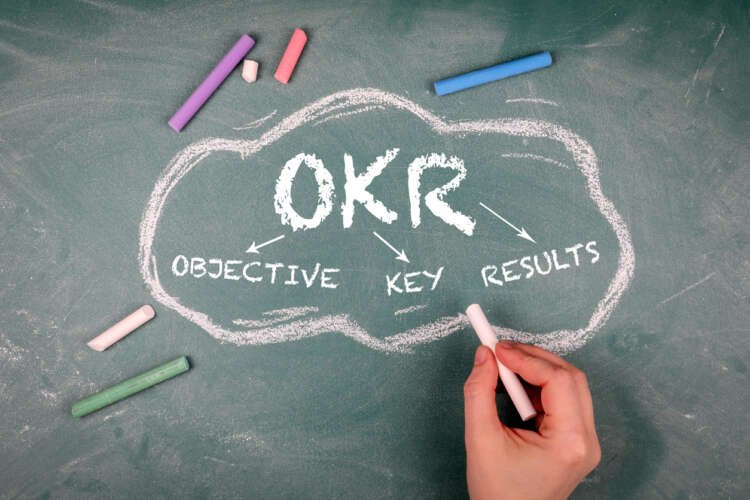
    An illustration of Objectives and Key Results (OKRs) on a green chalkboard, representing the importance of purpose and leadership in driving business transformation and employee motivation.
    Drawing of OKRs on a green chalkboard symbolizing business purpose and leadership - Global Banking & Finance Review
    Why waste money on news and opinion when you can access them for free?

    Take advantage of our newsletter subscription and stay informed on the go!

    Subscribe

    Tags:managementinnovationEmployee engagement

    By Des Kennedy, Executive OKR Coach, at AuxinOKR

    “OKRs are not a silver bullet. They’re not going to be a substitute for a strong cultute or for stronger leadership, but when those fundamentals are in place, they can take you to the mountain top” – John Doerr.

    Business leaders who embrace Objectives and Key Results (OKRs) do so because they seek transformational change. But it’s important to remember that the framework itself is not a silver bullet.

    Introducing and embedding OKRs takes time, commitment and buy-in at all levels. And even when you’ve mastered the skills required, you may still find you are not achieving the outcomes you’d aimed for.

    That’s because, although OKRs is a powerful tool, it’s ultimately your people that make change happen. So, understanding what drives and connects them is key to OKRs success.

    Businesses are human systems. And, like all systems, the better organised and interconnected they are the better they perform.

    So, what makes people want to get behind a common goal and embrace a different way of working? At AuxinOKR we believe the answer starts with purpose. Or, to put it another way, a person’s ability to answer these two simple questions:

    1. Why am I doing this?
    2. Why are we doing this?

    Belief in a common purpose motivates people to alter their behaviour both individually and collectively. When this behavioural change leads to positive outcomes their belief gets stronger and motivation increases.

    OKRs enable this process to gather and maintain momentum. It’s worth exploring each element in detail to see how they relate to each other.

    Purpose

    More people today want to work for employers with a clear purpose. Businesses and organisations that aren’t just there to make money for a single stakeholder or achieve growth at all costs but that have a set of deeply held values that they, as employees, can subscribe to and believe in. While increasingly customers and other stakeholders of a business expect it to do more than offer products and services.

    Consultancy firm EY defines companies with purpose as those that “create value for a broad set of stakeholders, including society and the environment and that have an aspirational reason for being that is grounded in humanity and that inspires a clear call to action.”

    Research shows that 75% of executives of purposeful companies recognise that purpose drives value over the short and longer term. Including: building customer loyalty; preserving brand reputation; delivering innovative products and services; as well as attracting and retaining top talent.

    Beliefs

    It is widely recognised that our belief system drives our behaviour. Educational psychologist Dr Bobby Hoffman proposes that human behaviour is based on a set of five tacit self-beliefs that in aggregate determine what we do, how we do it and how we see our accomplishments. These self-beliefs are a set of guiding principles. Operating on a subconscious level these five self-beliefs are:

    • Control
    • Competency
    • Value
    • Goal-orientation
    • Epistemology

    Motivation

    Motivation at work falls into two categories. Extrinsic motivation is driven by the prospect of external rewards such as a pay rise, bonuses or recognition for a job well done. While intrinsic motivation comes from inside and speaks to a positive emotional response, like a feeling of enjoyment and fulfilment for example.

    There are many reasons why we, as individuals, turn up for work everyday. These include: enjoying our role; the challenge it presents; the culture of the organisation we work for; the people we work with; the opportunities it provides to further our career; and the money we receive at the end of the month.

    Conventional wisdom states that those who are more intrinsically motivated make better employees. In his best-selling book Drive author Dan Pink sets out a model for helping employees become more intrinsically motivated. Stating that rewards alone do little to improve a person’s engagement with tasks and that the ‘carrot and stick’ approach of old is no longer effective in the modern workplace.

    Self-determination theory suggests that people are motivated by three innate needs:

    • Autonomy — people need to feel in control of their own behaviour and goals.
    • Competence — people need to master the skills required for success.
    • Connection — people need to feel a sense of belonging and attachment to others.

    Behaviour

    Effective business leaders realised long ago that the ‘command and control’ approach of the past is simply not sustainable. Recognising instead the importance of clarity, connection and consideration in every person-to-person interaction. A leader’s role is to guide and encourage individuals towards certain positive behaviours like:

    • Championing company values
    • Commitment, cooperation and collaboration
    • Welcoming new ideas
    • Supporting, trusting and respecting one another
    • Communicating clearly and often

    OKRs as a catalyst

    When looking at purpose, beliefs, motivation and behaviour in this way the common themes that run throughout each become apparent. But if a business is to achieve transformational change, it needs defined goals and a clear plan to achieve them as well to measure progress. And this is where Objectives and Key Results come in.

    When combined with a clear purpose OKRs act as a catalyst increasing conductivity between beliefs, motivation and behaviour.

    OKRs actively encourage autonomy, competence and connection (self-determination) amongst teams while providing demonstrable proof that behavioural change delivers positive outcomes.

    When your employees believe they have a positive effect on outcomes at work, they become more motivated and engaged. While the conversations, feedback and recognition OKRs promote, support and encourage them as they learn and grow.

    As the habits and skills required become second nature so OKRs help build a high-performing team. A team with clearly defined goals and committed actions. With true transparency and accountability. A team that is willing and able to communicate clearly and celebrate each other’s successes.

    More info at: www.auxinokr.com

    Frequently Asked Questions about Giving people something to believe in

    1What are OKRs?

    OKRs, or Objectives and Key Results, are a goal-setting framework used by organizations to define measurable goals and track their outcomes.

    2What is employee engagement?

    Employee engagement refers to the level of enthusiasm and commitment an employee has towards their work and the organization.

    3What is intrinsic motivation?

    Intrinsic motivation is the internal drive to perform an activity for its own sake, due to personal satisfaction or fulfillment.

    4What is extrinsic motivation?

    Extrinsic motivation involves performing a task to earn a reward or avoid punishment, such as bonuses or recognition.

    5What is transformational leadership?

    Transformational leadership is a leadership style that inspires and motivates employees to innovate and create change that will help grow and shape the future success of the company.

    More from Business

    Explore more articles in the Business category

    Image for Submit Your Entry for Years of Excellence Awards 2026
    Submit Your Entry for Years of Excellence Awards 2026
    Image for Nominations Open for Travel & Hospitality Awards 2026
    Nominations Open for Travel & Hospitality Awards 2026
    Image for Submit Your Entry Today for Telecom Awards 2026
    Submit Your Entry Today for Telecom Awards 2026
    Image for Submit Your Entries for The Next 100 Global Awards 2026
    Submit Your Entries for the Next 100 Global Awards 2026
    Image for Submit Your Entry: Public Sector & Governance Excellence Awards 2026
    Submit Your Entry: Public Sector & Governance Excellence Awards 2026
    Image for Nominations Invited for Real Estate Development Awards 2026
    Nominations Invited for Real Estate Development Awards 2026
    Image for Submit Your Entry: Process & Product Awards 2026
    Submit Your Entry: Process & Product Awards 2026
    Image for Call for Entries: HR & Recruitment Awards 2026
    Call for Entries: HR & Recruitment Awards 2026
    Image for Submit Your Nominations Today for Education & Training Awards 2026
    Submit Your Nominations Today for Education & Training Awards 2026
    Image for Join the Corporate Governance Awards 2026: Showcase Your Organisation’s Leadership
    Join the Corporate Governance Awards 2026: Showcase Your Organisation’s Leadership
    Image for Submit Your Entry Today for Business Awards 2026
    Submit Your Entry Today for Business Awards 2026
    Image for Decentralized Masters’ ‘family culture’ building trust instead of hierarchy
    Decentralized Masters’ ‘family Culture’ Building Trust Instead of Hierarchy
    View All Business Posts
    Previous Business PostMaking Information Work for the Customer – the Key Role of Knowledge Management
    Next Business PostBetter SMEs for a Better World







