Search
00
GBAF Logo
trophy
Top StoriesInterviewsBusinessFinanceBankingTechnologyInvestingTradingVideosAwardsMagazinesHeadlinesTrends

Subscribe to our newsletter

Get the latest news and updates from our team.

Global Banking & Finance Review®

Global Banking & Finance Review® - Subscribe to our newsletter

Company

    GBAF Logo
    • About Us
    • Profile
    • Privacy & Cookie Policy
    • Terms of Use
    • Contact Us
    • Advertising
    • Submit Post
    • Latest News
    • Research Reports
    • Press Release
    • Awards▾
      • About the Awards
      • Awards TimeTable
      • Submit Nominations
      • Testimonials
      • Media Room
      • Award Winners
      • FAQ
    • Magazines▾
      • Global Banking & Finance Review Magazine Issue 79
      • Global Banking & Finance Review Magazine Issue 78
      • Global Banking & Finance Review Magazine Issue 77
      • Global Banking & Finance Review Magazine Issue 76
      • Global Banking & Finance Review Magazine Issue 75
      • Global Banking & Finance Review Magazine Issue 73
      • Global Banking & Finance Review Magazine Issue 71
      • Global Banking & Finance Review Magazine Issue 70
      • Global Banking & Finance Review Magazine Issue 69
      • Global Banking & Finance Review Magazine Issue 66
    Top StoriesInterviewsBusinessFinanceBankingTechnologyInvestingTradingVideosAwardsMagazinesHeadlinesTrends

    Global Banking & Finance Review® is a leading financial portal and online magazine offering News, Analysis, Opinion, Reviews, Interviews & Videos from the world of Banking, Finance, Business, Trading, Technology, Investing, Brokerage, Foreign Exchange, Tax & Legal, Islamic Finance, Asset & Wealth Management.
    Copyright © 2010-2026 GBAF Publications Ltd - All Rights Reserved. | Sitemap | Tags | Developed By eCorpIT

    Editorial & Advertiser disclosure

    Global Banking & Finance Review® is an online platform offering news, analysis, and opinion on the latest trends, developments, and innovations in the banking and finance industry worldwide. The platform covers a diverse range of topics, including banking, insurance, investment, wealth management, fintech, and regulatory issues. The website publishes news, press releases, opinion and advertorials on various financial organizations, products and services which are commissioned from various Companies, Organizations, PR agencies, Bloggers etc. These commissioned articles are commercial in nature. This is not to be considered as financial advice and should be considered only for information purposes. It does not reflect the views or opinion of our website and is not to be considered an endorsement or a recommendation. We cannot guarantee the accuracy or applicability of any information provided with respect to your individual or personal circumstances. Please seek Professional advice from a qualified professional before making any financial decisions. We link to various third-party websites, affiliate sales networks, and to our advertising partners websites. When you view or click on certain links available on our articles, our partners may compensate us for displaying the content to you or make a purchase or fill a form. This will not incur any additional charges to you. To make things simpler for you to identity or distinguish advertised or sponsored articles or links, you may consider all articles or links hosted on our site as a commercial article placement. We will not be responsible for any loss you may suffer as a result of any omission or inaccuracy on the website.

    Home > Finance > German economic growth to remain muted in near term – IMF
    Finance

    German economic growth to remain muted in near term – IMF

    Published by Jessica Weisman-Pitts

    Posted on May 16, 2023

    3 min read

    Last updated: February 1, 2026

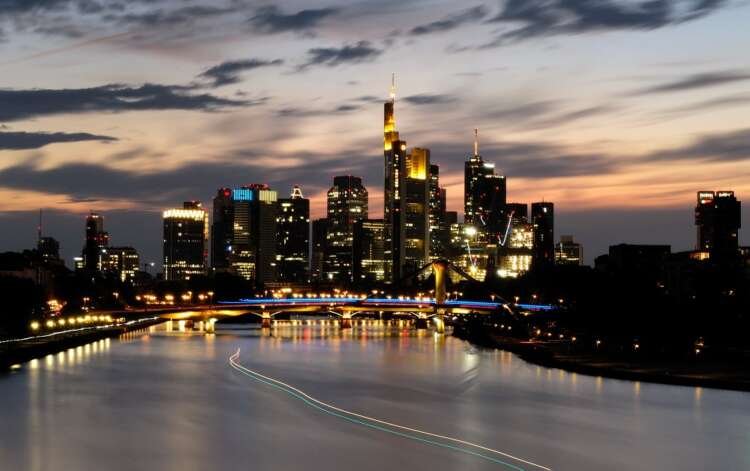
    The image captures the skyline of Frankfurt at sunset, representing Germany's economic landscape. As the IMF predicts muted growth, this iconic city symbolizes the financial challenges ahead.
    Frankfurt skyline at sunset, symbolizing Germany's economic outlook - Global Banking & Finance Review
    Why waste money on news and opinion when you can access them for free?

    Take advantage of our newsletter subscription and stay informed on the go!

    Subscribe

    Tags:GDPeconomic growthfinancial stabilitycore inflation

    Quick Summary

    BERLIN (Reuters) -The German economy has shown resilience over the last year thanks to a strong policy response and a mild winter, but economic growth will remain muted in the near term, the International Monetary Fund (IMF) said on Tuesday.

    BERLIN (Reuters) -The German economy has shown resilience over the last year thanks to a strong policy response and a mild winter, but economic growth will remain muted in the near term, the International Monetary Fund (IMF) said on Tuesday.

    Tighter financial conditions and the energy price shock have begun to weigh on near-term growth, the IMF warned in its country report for Germany.

    It forecast growth in Germany’s gross domestic product (GDP) to stay near zero in 2023, before gradually strengthening to between 1% and 2% in the period of 2024 to 2026.

    Over the longer term, average GDP growth is expected to fall back below 1% as the population ages and with no significant accelerations in productivity or labour supply foreseen.

    Although headline inflation is falling steadily, core inflation is proving stickier, according to the report. “A top priority in the near term is thus to support disinflation with a moderate tightening of the fiscal stance in 2023,” it said.

    “The IMF has clearly confirmed the finance ministry’s fiscal policy strategy: financial restraint and supply-side measures,” Finance Minister Christian Lindner said.

    Over the medium term, Germany may need to create more fiscal room for investment in its future, the IMF said. It expects Germany’s deficit to narrow to around 0.5% of GDP by 2027 as energy relief measures are phased out.

    The debt brake, anchored in the German constitution, limits the budget deficit to 0.35% of GDP. The German parliament suspended the debt brake between 2020 and 2022 to allow for extra spending in response to the COVID-19 pandemic and the effects of the war in Ukraine.

    Germany created multiple extrabudgetary funds totalling about 9% of GDP during those years. This spending does count towards the general government deficit as measured under EU statistical standards.

    “Germany should consider adjusting the debt-brake rule to better align it with EU fiscal rules and lessen reliance on extrabudgetary funds,” the IMF said.

    However, the German finance ministry said a relaxation of the debt brake was not an option.

    “The debt brake has not only proved its worth nationally, it is also a guarantor of confidence in the stability of German public finances,” Lindner said.

    He said the argument that the debt brake was circumvented with extrabudgetary funds during the crises was not the intention of the finance ministry.

    “Both the special program for the armed forces and the price brakes are clearly earmarked,” he said.

    The organization suggests increasing the annual deficit limit by 1 percentage point of GDP, to be more “realistic” regarding the country’s medium-term spending needs.

    The IMF warned that uncertainty is high and risks to the baseline forecasts are tilted downward.

    (Reporting by Maria Martinez; Editing by Rachel More and Christina Fincher)

    Frequently Asked Questions about German economic growth to remain muted in near term – IMF

    1What is GDP?

    Gross Domestic Product (GDP) is the total monetary value of all goods and services produced within a country's borders in a specific time period, used as an economic indicator.

    2What is economic growth?

    Economic growth refers to the increase in the production of goods and services in an economy over a period of time, typically measured as the percentage increase in GDP.

    3What is core inflation?

    Core inflation is a measure of the long-term trend in the price level, excluding items that face volatile price movement, such as food and energy prices.

    4What is financial stability?

    Financial stability refers to a condition where the financial system operates effectively, with institutions able to withstand economic shocks without significant disruption.

    More from Finance

    Explore more articles in the Finance category

    Image for Rugby-Ford shines as England overwhelm dismal Wales
    Rugby-Ford shines as England overwhelm dismal Wales
    Image for Greenland foreign minister says US talks are positive but the outcome remains uncertain
    Greenland foreign minister says US talks are positive but the outcome remains uncertain
    Image for Hungary's opposition Tisza promises wealth tax, euro adoption in election programme
    Hungary's opposition Tisza promises wealth tax, euro adoption in election programme
    Image for Farmers report 'catastrophic damage to crops as Storm Marta hits Spain and Portugal
    Farmers report 'catastrophic damage to crops as Storm Marta hits Spain and Portugal
    Image for If US attacks, Iran says it will strike US bases in the region
    If US attacks, Iran says it will strike US bases in the region
    Image for Olympics-Biathlon-Winter Games bring tourism boost to biathlon hotbed of northern Italy
    Olympics-Biathlon-Winter Games bring tourism boost to biathlon hotbed of northern Italy
    Image for Analysis-Bitcoin loses Trump-era gains as crypto market volatility signals uncertainty
    Analysis-Bitcoin loses Trump-era gains as crypto market volatility signals uncertainty
    Image for NatWest closes in on $3.4 billion takeover of wealth manager Evelyn, Sky News reports
    NatWest closes in on $3.4 billion takeover of wealth manager Evelyn, Sky News reports
    Image for Stellantis-backed ACC drops plans for Italian, German gigafactories, union says
    Stellantis-backed ACC drops plans for Italian, German gigafactories, union says
    Image for US pushes Russia and Ukraine to end war by summer, Zelenskiy says
    US pushes Russia and Ukraine to end war by summer, Zelenskiy says
    Image for Russia launches massive attack on Ukraine's energy system, Zelenskiy says
    Russia launches massive attack on Ukraine's energy system, Zelenskiy says
    Image for Russia launched 400 drones, 40 missiles to hit Ukraine's energy sector, Zelenskiy says
    Russia launched 400 drones, 40 missiles to hit Ukraine's energy sector, Zelenskiy says
    View All Finance Posts
    Previous Finance PostCredit Monitoring: How to Keep Track of Your Credit Score and Report
    Next Finance PostHaunted by a ghost broker: Why the insurance industry needs to redouble its efforts to protect consumers