Search
00
GBAF Logo
trophy
Top StoriesInterviewsBusinessFinanceBankingTechnologyInvestingTradingVideosAwardsMagazinesHeadlinesTrends

Subscribe to our newsletter

Get the latest news and updates from our team.

Global Banking and Finance Review

Global Banking & Finance Review

Company

    GBAF Logo
    • About Us
    • Profile
    • Privacy & Cookie Policy
    • Terms of Use
    • Contact Us
    • Advertising
    • Submit Post
    • Latest News
    • Research Reports
    • Press Release
    • Awards▾
      • About the Awards
      • Awards TimeTable
      • Submit Nominations
      • Testimonials
      • Media Room
      • Award Winners
      • FAQ
    • Magazines▾
      • Global Banking & Finance Review Magazine Issue 79
      • Global Banking & Finance Review Magazine Issue 78
      • Global Banking & Finance Review Magazine Issue 77
      • Global Banking & Finance Review Magazine Issue 76
      • Global Banking & Finance Review Magazine Issue 75
      • Global Banking & Finance Review Magazine Issue 73
      • Global Banking & Finance Review Magazine Issue 71
      • Global Banking & Finance Review Magazine Issue 70
      • Global Banking & Finance Review Magazine Issue 69
      • Global Banking & Finance Review Magazine Issue 66
    Top StoriesInterviewsBusinessFinanceBankingTechnologyInvestingTradingVideosAwardsMagazinesHeadlinesTrends

    Global Banking & Finance Review® is a leading financial portal and online magazine offering News, Analysis, Opinion, Reviews, Interviews & Videos from the world of Banking, Finance, Business, Trading, Technology, Investing, Brokerage, Foreign Exchange, Tax & Legal, Islamic Finance, Asset & Wealth Management.
    Copyright © 2010-2025 GBAF Publications Ltd - All Rights Reserved.

    ;
    Editorial & Advertiser disclosure

    Global Banking and Finance Review is an online platform offering news, analysis, and opinion on the latest trends, developments, and innovations in the banking and finance industry worldwide. The platform covers a diverse range of topics, including banking, insurance, investment, wealth management, fintech, and regulatory issues. The website publishes news, press releases, opinion and advertorials on various financial organizations, products and services which are commissioned from various Companies, Organizations, PR agencies, Bloggers etc. These commissioned articles are commercial in nature. This is not to be considered as financial advice and should be considered only for information purposes. It does not reflect the views or opinion of our website and is not to be considered an endorsement or a recommendation. We cannot guarantee the accuracy or applicability of any information provided with respect to your individual or personal circumstances. Please seek Professional advice from a qualified professional before making any financial decisions. We link to various third-party websites, affiliate sales networks, and to our advertising partners websites. When you view or click on certain links available on our articles, our partners may compensate us for displaying the content to you or make a purchase or fill a form. This will not incur any additional charges to you. To make things simpler for you to identity or distinguish advertised or sponsored articles or links, you may consider all articles or links hosted on our site as a commercial article placement. We will not be responsible for any loss you may suffer as a result of any omission or inaccuracy on the website.

    Home > Trading > Exclusive-Under U.S. sanctions, Iran and Venezuela strike oil export deal – sources
    Trading

    Exclusive-Under U.S. sanctions, Iran and Venezuela strike oil export deal – sources

    Exclusive-Under U.S. sanctions, Iran and Venezuela strike oil export deal – sources

    Published by maria gbaf

    Posted on September 27, 2021

    Featured image for article about Trading

    By Deisy Buitrago, Marianna Parraga and Matt Spetalnick

    CARACAS/HOUSTON/WASHINGTON (Reuters) – Venezuela has agreed to a key contract to swap its heavy oil for Iranian condensate that it can use to improve the quality of its tar-like crude, with the first cargoes due this week, five people close to the deal said.

    As the South American country seeks to boost its flagging oil exports in the face of U.S. sanctions, according to the sources, the deal between state-run firms Petroleos de Venezuela (PDVSA) and National Iranian Oil Company (NIOC) deepens the cooperation between two of Washington’s foes.

    One of the people said the swap agreement is planned to last for six months in its first phase, but could be extended. Reuters could not immediately determine other details of the mwpact.

    The oil ministries of Venezuela and Iran, and state-run PDVSA and NIOC did not reply to requests for comment.

    The deal could be a breach of U.S. sanctions on both nations, according to a Treasury Department email to Reuters which cited U.S. government orders that establish the punitive measures.

    U.S. sanctions programs not only forbid Americans from doing business with the oil sectors of Iran and Venezuela, but also threaten to impose “secondary sanctions” against any non-U.S. person or entity that carries out transactions with either countries’ oil companies.

    Secondary sanctions can carry a range of penalties against those targeted, including cutting off access to the U.S. financial system, fines or the freezing of U.S. assets.

    Any “transactions with NIOC by non-U.S. persons are generally subject to secondary sanctions,” the Treasury Department said in response to a question about the deal. It also said it “retains authority to impose sanctions on any person that is determined to operate in the oil sector of the Venezuelan economy,” but did not specifically address whether the current deal is a sanctions breach.

    U.S. sanctions are often applied at the discretion of the administration in power. Former U.S. President Donald Trump’s government seized Iranian fuel cargoes https://www.reuters.com/article/us-usa-iran-cargo-idUSKCN25A2AH at sea bound for Venezuela for alleged sanction busting last year, but his successor Joe Biden has made no similar moves.

    In Washington, a source familiar with the matter said the swap arrangement between Venezuela and Iran has been on the radar screens of U.S. government officials as a likely sanctions violation in recent months and they want to see how far it will go in practical terms.

    U.S. officials are concerned, the source said, that Iranian diluent shipments could help provide President Nicolas Maduro with more of a financial lifeline as he negotiates with the Venezuelan opposition towards elections.

    Sanctions on both nations have crimped their oil sales in recent years, spurring NIOC to support Venezuela – including through shipping services and fuel swaps – in allocating exports to Asia.

    In a meeting at the U.N. General Assembly in New York on Wednesday, the foreign ministers of Venezuela and Iran publicly stated their commitment to stronger bilateral trade, despite U.S. attempts to block it.

    Trump’s tightening of sanctions contributed last year to a 38% fall in Venezuela’s oil exports – the backbone of its economy – to their lowest level in 77 years and curtailed sources of fuel imports, worsening gasoline shortages in the nation of some 30 million people.

    A U.S. Treasury spokesperson said the department was “concerned” about reports of oil deals between Venezuela and Iran, but had not verified details.

    “We will continue to enforce both our Iran and Venezuela-related sanctions,” the spokesperson said. Treasury “has demonstrated its willingness” to blacklist entities who support Iranian attempts to evade U.S. sanctions and who “further enable their destabilizing behavior around the world,” the official added.

    The swap contract would provide PDVSA with a steady supply of condensate, which it needs to dilute output of extra heavy oil from the Orinoco Belt, its largest producing region, the people said. The bituminous crude requires mixing before it can be transported and exported.

    In return, Iran will receive shipments of Venezuelan heavy oil that it can market in Asia, said the people, who declined to be identified as they were not authorized to speak publicly.

    CARGOES THIS WEEK

    PDVSA has boosted oil swaps to minimize cash payments since the U.S. Treasury Department in 2019 blocked the company from using U.S. dollars. Washington has also sanctioned foreign companies for receiving or shipping Venezuelan oil.

    Since last year, PDVSA has imported two cargoes of Iranian condensate in one-off swap deals to meet specific needs for diluents, and it has also exchanged Venezuelan jet fuel for Iranian gasoline.

    The new contract would help PDVSA secure a source of diluents, stabilizing exports of the Orinoco’s crude blends, while allowing its own lighter oil to be refined in Venezuela to produce badly needed motor fuel, three of the people said.

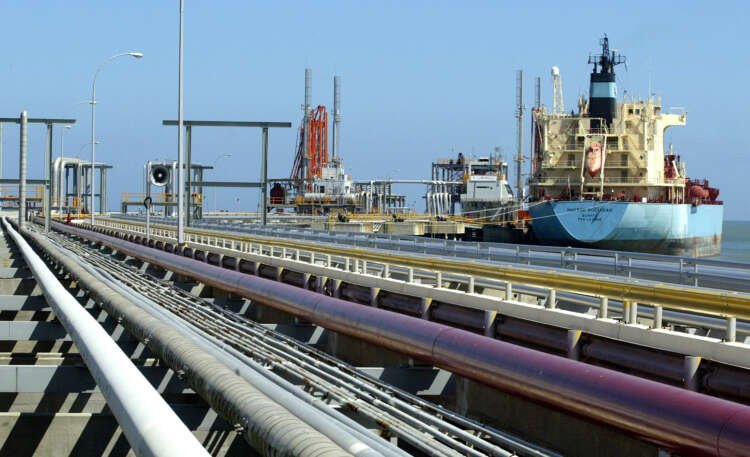
    The first 1.9 million barrel cargo of Venezuela’s Merey heavy crude under the new swap set sail earlier this week from PDVSA’s Jose port on the very large crude carrier (VLCC) Felicity, owned and operated by National Iranian Tanker Co (NITC), according to the three people and monitoring service TankerTrackers.com.

    NITC, a unit of NIOC, did not reply to a request for comment.

    The vessel was not included in PDVSA’s monthly port schedules for September, which lists planned imports and exports. However, TankerTrackers.com identified it while at Jose this month.

    The Venezuelan crude shipment is a partial payment for a cargo of 2 million barrels of Iranian condensate that arrived in Venezuela on Thursday, according to the three sources and one of PDVSA’s port schedules.

    LITTLE ENFORCEMENT

    Last year, the previous Trump administration seized over 1 million barrels of Iranian fuel bound for Venezuela and blacklisted five tanker captains, as part of a “maximum pressure” strategy, but the United States has not interdicted recent Iranian supplies to Venezuela.

    The U.S. State Department declined to comment on the deal. A Treasury spokesperson did not respond to a Reuters question on how concerned the government might be that Iran-Venezuela deals would allow PDVSA to step up exports.

    U.S. government officials have insisted they do not plan to ease sanctions on Venezuela unless Maduro takes definitive steps toward free and fair elections.

    Trump’s curbs on established companies doing business with PDVSA prompted the socialist-ruled nation to turn to swaps with Iran and other countries, while trading with a series of little-known customers.

    PDVSA’s new customers and swaps have allowed it to keep exports stable around 650,000 barrels per day (bpd) this year, after they zigzagged in 2020.

    However, a worsening shortage of diluents has recently limited oil exports, placing the Orinoco Belt production in an “emergency”, according to PDVSA documents from August and September related to its output status that were reviewed by Reuters.

    PDVSA plans to mix the Iranian condensate with extra heavy oil to produce diluted crude oil, a grade demanded by Asian refiners that it has struggled to export since late 2019 when suppliers halted diluent shipments due to sanctions, the three sources said.

    (Reporting by Marianna Parraga in Houston, Deisy Buitrago in Caracas and Matt Spetalnick in Washington; additional reporting by Bozorgmehr Sharafedin in London; Editing by Daniel Flynn, Christopher Cushing and Alistair Bell)

    By Deisy Buitrago, Marianna Parraga and Matt Spetalnick

    CARACAS/HOUSTON/WASHINGTON (Reuters) – Venezuela has agreed to a key contract to swap its heavy oil for Iranian condensate that it can use to improve the quality of its tar-like crude, with the first cargoes due this week, five people close to the deal said.

    As the South American country seeks to boost its flagging oil exports in the face of U.S. sanctions, according to the sources, the deal between state-run firms Petroleos de Venezuela (PDVSA) and National Iranian Oil Company (NIOC) deepens the cooperation between two of Washington’s foes.

    One of the people said the swap agreement is planned to last for six months in its first phase, but could be extended. Reuters could not immediately determine other details of the mwpact.

    The oil ministries of Venezuela and Iran, and state-run PDVSA and NIOC did not reply to requests for comment.

    The deal could be a breach of U.S. sanctions on both nations, according to a Treasury Department email to Reuters which cited U.S. government orders that establish the punitive measures.

    U.S. sanctions programs not only forbid Americans from doing business with the oil sectors of Iran and Venezuela, but also threaten to impose “secondary sanctions” against any non-U.S. person or entity that carries out transactions with either countries’ oil companies.

    Secondary sanctions can carry a range of penalties against those targeted, including cutting off access to the U.S. financial system, fines or the freezing of U.S. assets.

    Any “transactions with NIOC by non-U.S. persons are generally subject to secondary sanctions,” the Treasury Department said in response to a question about the deal. It also said it “retains authority to impose sanctions on any person that is determined to operate in the oil sector of the Venezuelan economy,” but did not specifically address whether the current deal is a sanctions breach.

    U.S. sanctions are often applied at the discretion of the administration in power. Former U.S. President Donald Trump’s government seized Iranian fuel cargoes https://www.reuters.com/article/us-usa-iran-cargo-idUSKCN25A2AH at sea bound for Venezuela for alleged sanction busting last year, but his successor Joe Biden has made no similar moves.

    In Washington, a source familiar with the matter said the swap arrangement between Venezuela and Iran has been on the radar screens of U.S. government officials as a likely sanctions violation in recent months and they want to see how far it will go in practical terms.

    U.S. officials are concerned, the source said, that Iranian diluent shipments could help provide President Nicolas Maduro with more of a financial lifeline as he negotiates with the Venezuelan opposition towards elections.

    Sanctions on both nations have crimped their oil sales in recent years, spurring NIOC to support Venezuela – including through shipping services and fuel swaps – in allocating exports to Asia.

    In a meeting at the U.N. General Assembly in New York on Wednesday, the foreign ministers of Venezuela and Iran publicly stated their commitment to stronger bilateral trade, despite U.S. attempts to block it.

    Trump’s tightening of sanctions contributed last year to a 38% fall in Venezuela’s oil exports – the backbone of its economy – to their lowest level in 77 years and curtailed sources of fuel imports, worsening gasoline shortages in the nation of some 30 million people.

    A U.S. Treasury spokesperson said the department was “concerned” about reports of oil deals between Venezuela and Iran, but had not verified details.

    “We will continue to enforce both our Iran and Venezuela-related sanctions,” the spokesperson said. Treasury “has demonstrated its willingness” to blacklist entities who support Iranian attempts to evade U.S. sanctions and who “further enable their destabilizing behavior around the world,” the official added.

    The swap contract would provide PDVSA with a steady supply of condensate, which it needs to dilute output of extra heavy oil from the Orinoco Belt, its largest producing region, the people said. The bituminous crude requires mixing before it can be transported and exported.

    In return, Iran will receive shipments of Venezuelan heavy oil that it can market in Asia, said the people, who declined to be identified as they were not authorized to speak publicly.

    CARGOES THIS WEEK

    PDVSA has boosted oil swaps to minimize cash payments since the U.S. Treasury Department in 2019 blocked the company from using U.S. dollars. Washington has also sanctioned foreign companies for receiving or shipping Venezuelan oil.

    Since last year, PDVSA has imported two cargoes of Iranian condensate in one-off swap deals to meet specific needs for diluents, and it has also exchanged Venezuelan jet fuel for Iranian gasoline.

    The new contract would help PDVSA secure a source of diluents, stabilizing exports of the Orinoco’s crude blends, while allowing its own lighter oil to be refined in Venezuela to produce badly needed motor fuel, three of the people said.

    The first 1.9 million barrel cargo of Venezuela’s Merey heavy crude under the new swap set sail earlier this week from PDVSA’s Jose port on the very large crude carrier (VLCC) Felicity, owned and operated by National Iranian Tanker Co (NITC), according to the three people and monitoring service TankerTrackers.com.

    NITC, a unit of NIOC, did not reply to a request for comment.

    The vessel was not included in PDVSA’s monthly port schedules for September, which lists planned imports and exports. However, TankerTrackers.com identified it while at Jose this month.

    The Venezuelan crude shipment is a partial payment for a cargo of 2 million barrels of Iranian condensate that arrived in Venezuela on Thursday, according to the three sources and one of PDVSA’s port schedules.

    LITTLE ENFORCEMENT

    Last year, the previous Trump administration seized over 1 million barrels of Iranian fuel bound for Venezuela and blacklisted five tanker captains, as part of a “maximum pressure” strategy, but the United States has not interdicted recent Iranian supplies to Venezuela.

    The U.S. State Department declined to comment on the deal. A Treasury spokesperson did not respond to a Reuters question on how concerned the government might be that Iran-Venezuela deals would allow PDVSA to step up exports.

    U.S. government officials have insisted they do not plan to ease sanctions on Venezuela unless Maduro takes definitive steps toward free and fair elections.

    Trump’s curbs on established companies doing business with PDVSA prompted the socialist-ruled nation to turn to swaps with Iran and other countries, while trading with a series of little-known customers.

    PDVSA’s new customers and swaps have allowed it to keep exports stable around 650,000 barrels per day (bpd) this year, after they zigzagged in 2020.

    However, a worsening shortage of diluents has recently limited oil exports, placing the Orinoco Belt production in an “emergency”, according to PDVSA documents from August and September related to its output status that were reviewed by Reuters.

    PDVSA plans to mix the Iranian condensate with extra heavy oil to produce diluted crude oil, a grade demanded by Asian refiners that it has struggled to export since late 2019 when suppliers halted diluent shipments due to sanctions, the three sources said.

    (Reporting by Marianna Parraga in Houston, Deisy Buitrago in Caracas and Matt Spetalnick in Washington; additional reporting by Bozorgmehr Sharafedin in London; Editing by Daniel Flynn, Christopher Cushing and Alistair Bell)

    Related Posts
    What Is a Liquidity Provider – And Why Modern Brokers Can’t Function Without One
    What Is a Liquidity Provider – And Why Modern Brokers Can’t Function Without One
    OneFunded: Prop Firm Overview and Program Structure
    OneFunded: Prop Firm Overview and Program Structure
    What if You Can Actually Chat with Your Crypto Wallet?
    What if You Can Actually Chat with Your Crypto Wallet?
    The Growing Importance of Choosing the Right Crypto Broker in 2025
    The Growing Importance of Choosing the Right Crypto Broker in 2025
    The Rise of Algorithmic Trading Among Retail Investors in the UK
    The Rise of Algorithmic Trading Among Retail Investors in the UK
    Forex Trading for the 9-to-5er: A Realistic Path to a Second Income
    Forex Trading for the 9-to-5er: A Realistic Path to a Second Income
    Quality Matters: ZiNRai’s Focus on Empowering Traders with Precision and Purpose
    Quality Matters: ZiNRai’s Focus on Empowering Traders with Precision and Purpose
    MiCA Regulations and the Legal Requirements for Crypto Presales and Token Offerings in the European Union
    MiCA Regulations and the Legal Requirements for Crypto Presales and Token Offerings in the European Union
    Top Ways Forex Traders Benefit From Peer-to-Peer Learning
    Top Ways Forex Traders Benefit From Peer-to-Peer Learning
    Why High Leverage Remains Attractive to Forex Traders Worldwide
    Why High Leverage Remains Attractive to Forex Traders Worldwide
    XDC Network’s ETP Listing Signals the Maturing Convergence of Blockchain and Trade Finance
    XDC Network’s ETP Listing Signals the Maturing Convergence of Blockchain and Trade Finance
    Inside the Perp DEX Landscape: How Platforms Like Grvt and Hyperliquid Are Shaping Their Long-Term Vision
    Inside the Perp DEX Landscape: How Platforms Like Grvt and Hyperliquid Are Shaping Their Long-Term Vision

    Why waste money on news and opinions when you can access them for free?

    Take advantage of our newsletter subscription and stay informed on the go!

    Subscribe

    Previous Trading PostChinese crackdown on bitcoin another blow to Cathie Wood’s ARK ETF
    Next Trading PostExclusive-Conoco offers to sell some secondary U.S. oil acreage -document

    More from Trading

    Explore more articles in the Trading category

    Blending Theory and Practice: Building Stronger Forex Strategies

    Blending Theory and Practice: Building Stronger Forex Strategies

    Strategies for Professional CFD Traders: Tools and Company Support

    Strategies for Professional CFD Traders: Tools and Company Support

    Trust as the Cornerstone of Capital Markets

    Trust as the Cornerstone of Capital Markets

    UK Investors Reassess Trading Venues as Liquidity Shifts

    UK Investors Reassess Trading Venues as Liquidity Shifts

    Bitcoin Price Live: What Factors Influence Its Value?

    Bitcoin Price Live: What Factors Influence Its Value?

    Offshore Forex Brokers vs. U.S.-Regulated Brokers: A Risk Assessment

    Offshore Forex Brokers vs. U.S.-Regulated Brokers: A Risk Assessment

    The Broker Expo, Its Role in the Small Business World, and Everest Business Funding’s Role as Sponsor

    The Broker Expo, Its Role in the Small Business World, and Everest Business Funding’s Role as Sponsor

    Finding Your Edge with a Crypto-First Prop Firm

    Finding Your Edge with a Crypto-First Prop Firm

    Evaluating the Most Reliable Tools for Tracking Real-Time Cryptocurrency Prices

    Evaluating the Most Reliable Tools for Tracking Real-Time Cryptocurrency Prices

    MT5 vs MT4: Why More Brokers Are Moving to MetaTrader 5

    MT5 vs MT4: Why More Brokers Are Moving to MetaTrader 5

    From Central Banks to Retail Traders: Who Drives the Forex Market?

    From Central Banks to Retail Traders: Who Drives the Forex Market?

    Building a Winning Forex Portfolio: Tools and Resources You Can’t Ignore

    Building a Winning Forex Portfolio: Tools and Resources You Can’t Ignore

    View All Trading Posts