Trading
Confident Day Trading for Beginners: The WR Trading Approach Explained
Published by Barnali Pal Sinha
Posted on April 2, 2026
6 min readLast updated: April 2, 2026
Add as preferred source on Google
Published by Barnali Pal Sinha
Posted on April 2, 2026
6 min readLast updated: April 2, 2026
Add as preferred source on GoogleThe WR Trading approach offers beginners a structured day‑trading path using high risk‑reward setups, anchored VWAP and M1 chart signals, with mentorship to build confidence. It emphasizes disciplined, few‑hours‑a‑day routines.
Most people who try day trading for the first time describe the same experience. They open a platform, watch a few tutorials, and then sit in front of a chart wondering what they are actually supposed to do next. The market moves, they hesitate, they take a trade based on a gut feeling, and the result is rarely what they expected. A few weeks in, the account is smaller and the confidence is gone.
This is not a story about lacking intelligence or discipline. It is a story about starting without a framework built for where you actually are, not where you hope to be. The WR Trading approach was designed with this exact gap in mind. Here is how it works in practice, and why the structure behind it matters as much as the strategy itself.
Why Fewer Markets Can Make You a Better Trader
One of the first mistakes beginners make is trying to follow too many things at once. Dozens of currency pairs, hundreds of stocks, and multiple indices all moving at the same time create the illusion that opportunity is everywhere. That illusion leads directly to overtrading.
WRTrading.com addresses this by concentrating on a small number of high-liquidity markets, primarily EUR/USD and the S&P 500. These are not arbitrary choices. EUR/USD is the most traded currency pair in the world, with tight spreads and predictable session-based behavior. Both markets are traded through CFDs and Futures, keeping the product selection as focused as the strategy itself.
The S&P 500 offers consistent volume and readable structure during US market hours. By studying fewer instruments deeply rather than scanning broadly, beginners build genuine pattern recognition instead of chasing noise.
For anyone new to building a day trading strategy, this constraint is not a limitation. It is protection against one of the most reliable ways beginners burn through capital before they ever find their footing.
What a High Risk-Reward Ratio Actually Changes for You
Most beginners assume that being profitable requires winning most of their trades. That assumption drives them to overtrade, to chase losses, and to close winning positions too early out of fear. The math, however, tells a different story.
WR Trading centers its methodology around high risk-reward ratio (RRR) setups, specifically targeting ratios of 1:5, 1:7, and in some cases 1:10. In practice, this means that for every dollar risked, the target return is five, seven, or ten dollars. At a 1:5 ratio, a trader who wins just 3 out of 10 trades, a 30% hit rate, still comes out ahead over a meaningful sample size.
Understanding high risk-reward ratio trading changes how you approach every setup. You stop looking for certainty before entering and start looking for the right conditions, where the potential reward is large enough to justify the risk even if it only works out a fraction of the time. WR Trading builds this principle into the methodology from the very beginning, which means beginners are developing the right habits before bad ones get a chance to form.
Reading the 1-Minute Chart Without the Guesswork
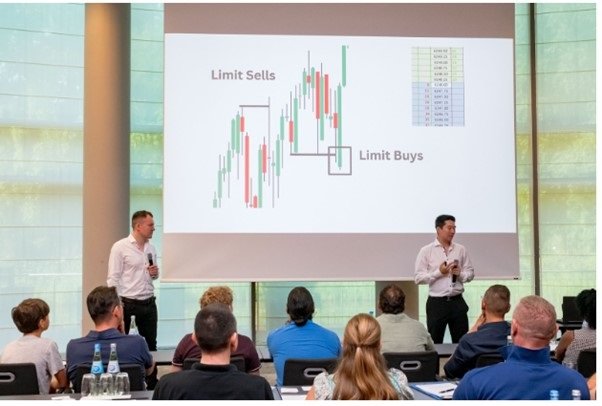
Technical analysis can be as simple or as complicated as you make it. Beginners tend to make it complicated, layering indicator on top of indicator until the chart tells them nothing useful. WR Trading takes the opposite approach.
The core focus is on the 1-minute chart, using wick-based price action and the anchored VWAP as the only indicator to identify entries. A wick on a candlestick shows a price level that was tested and rejected within that candle's window. When those rejections appear at clear structural levels, they become a repeatable signal rather than a judgment call.
For beginners who have felt like they were guessing on every entry, having something specific to look for, rather than a feeling to act on, is what makes trading confidence something that can actually be built over time rather than hoped for.
Knowing When to Stay Out Is Half the Strategy
No framework for trading confidence is complete without addressing patience. Most unnecessary losses beginners take do not come from picking the wrong entry. They come from trading when the conditions simply are not there.
WR Trading teaches explicitly that not every session produces a valid setup, and that choosing not to trade is a real and correct decision. This matters more than it sounds. When beginners feel pressure to be active, they start forcing trades that do not meet their criteria, and one impulsive trade can erase several disciplined ones.
This principle pairs naturally with the time commitment WR Trading recommends: roughly one to two hours of active trading per day. That boundary creates a workable rhythm. You assess the market during the best hours for your chosen instruments, apply your rules, and step away. That is a structure a person can maintain. Sitting in front of a screen all day hoping something happens is not.
Building Skill in Layers, Not All at Once
Andre Witzel, the founder of WR Trading, and co-founder JT Rong have both been open about losing money early in their careers because they learned in the wrong order, jumping into complex strategies before the fundamentals were solid. That shared experience directly shaped how the program is structured.
WR Trading is organized across three levels: Important Basics, Profitable Strategy, and Advanced Methods. What makes this meaningful for beginners is that the first level includes a demo trading phase, meaning you practice the methodology on a simulated account before any real capital is involved. You learn chart reading, strategy application, and your own behavioral patterns without real losses distorting your judgment before you are ready.
This mirrors how skill development actually works. You practice before you perform live. The ongoing live webinars, Discord community, and the option for personal trading coaching at higher levels exist because passive video study cannot provide the feedback loop that trading mentorship does. Those conversations, about specific trades, specific mistakes, and specific adjustments, are where real learning tends to happen.
One honest caveat worth stating clearly: no program removes risk from trading. Consistency takes months to develop, losses are part of the process, and there are no shortcuts that work at scale. Day trading carries real financial risk and is not appropriate for everyone. What structured personalized trading education changes is not whether you will face losses, but whether you have the tools to learn from them rather than keep repeating them.
A Starting Point That Actually Makes Sense
If you have tried trading and walked away feeling like you were missing something fundamental, you probably were. Not intelligence, not effort, but a method built around how beginners actually learn and where they most commonly go wrong.
WR Trading offers beginners a concrete place to start: focused markets, a clear risk-reward framework, a readable entry method on the 1-minute chart, and a structured progression that builds real trading confidence before real money is at stake.
A structured day‑trading method using high risk‑reward setups (1:5 to 1:10), anchored VWAP and M1 chart signals, taught via mentorship.
Typically 1–3 hours per day, or 1–2 hours a few times per week, depending on your schedule.
Yes. It starts with foundational basics, demo-to-live progression, and structured support to build confidence.
Primarily highly liquid markets like the S&P 500 and EUR/USD, to reduce distraction and improve pattern recognition.
Explore more articles in the Trading category