Search
00
GBAF Logo
trophy
Top StoriesInterviewsBusinessFinanceBankingTechnologyInvestingTradingVideosAwardsMagazinesHeadlinesTrends

Subscribe to our newsletter

Get the latest news and updates from our team.

Global Banking & Finance Review®

Global Banking & Finance Review® - Subscribe to our newsletter

Company

    GBAF Logo
    • About Us
    • Profile
    • Privacy & Cookie Policy
    • Terms of Use
    • Contact Us
    • Advertising
    • Submit Post
    • Latest News
    • Research Reports
    • Press Release
    • Awards▾
      • About the Awards
      • Awards TimeTable
      • Submit Nominations
      • Testimonials
      • Media Room
      • Award Winners
      • FAQ
    • Magazines▾
      • Global Banking & Finance Review Magazine Issue 79
      • Global Banking & Finance Review Magazine Issue 78
      • Global Banking & Finance Review Magazine Issue 77
      • Global Banking & Finance Review Magazine Issue 76
      • Global Banking & Finance Review Magazine Issue 75
      • Global Banking & Finance Review Magazine Issue 73
      • Global Banking & Finance Review Magazine Issue 71
      • Global Banking & Finance Review Magazine Issue 70
      • Global Banking & Finance Review Magazine Issue 69
      • Global Banking & Finance Review Magazine Issue 66
    Top StoriesInterviewsBusinessFinanceBankingTechnologyInvestingTradingVideosAwardsMagazinesHeadlinesTrends

    Global Banking & Finance Review® is a leading financial portal and online magazine offering News, Analysis, Opinion, Reviews, Interviews & Videos from the world of Banking, Finance, Business, Trading, Technology, Investing, Brokerage, Foreign Exchange, Tax & Legal, Islamic Finance, Asset & Wealth Management.
    Copyright © 2010-2026 GBAF Publications Ltd - All Rights Reserved. | Sitemap | Tags | Developed By eCorpIT

    Editorial & Advertiser disclosure

    Global Banking & Finance Review® is an online platform offering news, analysis, and opinion on the latest trends, developments, and innovations in the banking and finance industry worldwide. The platform covers a diverse range of topics, including banking, insurance, investment, wealth management, fintech, and regulatory issues. The website publishes news, press releases, opinion and advertorials on various financial organizations, products and services which are commissioned from various Companies, Organizations, PR agencies, Bloggers etc. These commissioned articles are commercial in nature. This is not to be considered as financial advice and should be considered only for information purposes. It does not reflect the views or opinion of our website and is not to be considered an endorsement or a recommendation. We cannot guarantee the accuracy or applicability of any information provided with respect to your individual or personal circumstances. Please seek Professional advice from a qualified professional before making any financial decisions. We link to various third-party websites, affiliate sales networks, and to our advertising partners websites. When you view or click on certain links available on our articles, our partners may compensate us for displaying the content to you or make a purchase or fill a form. This will not incur any additional charges to you. To make things simpler for you to identity or distinguish advertised or sponsored articles or links, you may consider all articles or links hosted on our site as a commercial article placement. We will not be responsible for any loss you may suffer as a result of any omission or inaccuracy on the website.

    Home > Research Reports > Central Banking Systems Market Projected to Achieve a 7.2% CAGR from 2024 to 2031
    Research Reports

    Central Banking Systems Market Projected to Achieve a 7.2% CAGR from 2024 to 2031

    Published by Wanda Rich

    Posted on July 16, 2024

    9 min read

    Last updated: January 30, 2026

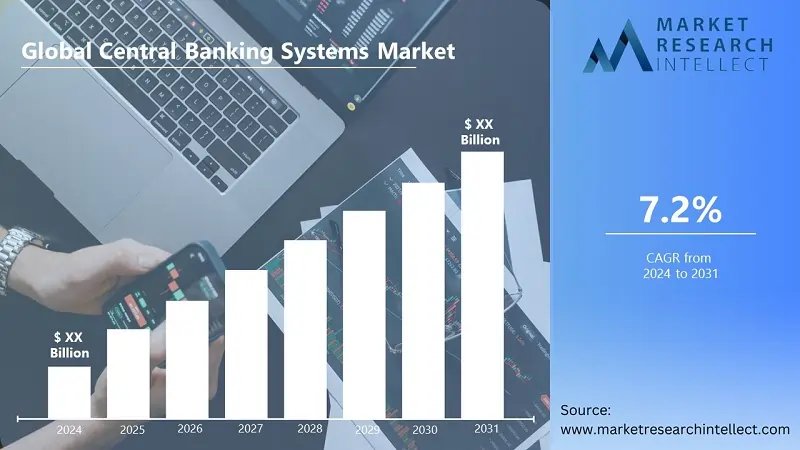
    This image depicts a graph showcasing the projected 7.2% CAGR growth of the central banking systems market from 2024 to 2031, reflecting key trends in banking and finance.
    Graph illustrating the projected growth of central banking systems market - Global Banking & Finance Review
    Why waste money on news and opinion when you can access them for free?

    Take advantage of our newsletter subscription and stay informed on the go!

    Subscribe

    Tags:blockchainfinancial stabilitymonetary policy

    Table of Contents

    • Central Banking Systems Market Drivers
    • Central Banking Systems Market Restraints
    • Key Players
    • Central Banking Systems Market Segmentations
    • Banking Financial Services and Insurance (BFSI)
    • About Us: Market Research Intellect
    • For inquiries, Contact us at:

    The Central Banking Systems Market size is expected to grow at a Compound Annual Growth Rate (CAGR) of around 7.2% from 2024 to 2031. This translates to a significant rise in market size by 2031 compared to 2023. It’s important to note that this is an estimated CAGR and may differ slightly depending on the source.

    Central banking systems play a pivotal role in the financial stability and economic health of countries worldwide. These institutions, typically state-owned or government-sanctioned entities, serve as the primary monetary authority, tasked with overseeing the monetary policy and regulation of the banking sector within their jurisdictions. The primary functions of central banks include the issuance of currency, management of foreign reserves, acting as a lender of last resort, and ensuring the stability of the financial system. They are instrumental in setting interest rates, controlling inflation, and fostering economic growth.

    The core objective of central banks is to maintain price stability, which involves keeping inflation under control. They achieve this through various monetary policy tools, including open market operations, setting reserve requirements for commercial banks, and altering the discount rate. By buying or selling government securities in the open market, central banks influence the money supply and liquidity in the economy. Adjusting reserve requirements impacts the amount of money that banks can lend, while changes to the discount rate affect the cost of borrowing for commercial banks.

    Another critical function of central banks is to act as a lender of last resort. In times of financial crisis or banking sector instability, central banks provide emergency funding to commercial banks facing liquidity shortages. This function is vital for maintaining confidence in the banking system and preventing bank runs, where customers withdraw their deposits en masse due to fears of insolvency.

    Central banks also manage a country’s foreign exchange reserves, which are used to influence exchange rates and maintain the stability of the national currency. By intervening in the foreign exchange market, central banks can prevent excessive volatility and ensure that the exchange rate remains within a desirable range. This is particularly important for countries with fixed or pegged exchange rate regimes.

    In addition to their monetary policy functions, central banks play a regulatory role. They oversee and regulate commercial banks and other financial institutions to ensure their soundness and compliance with relevant laws and regulations. This includes conducting regular inspections, enforcing capital adequacy requirements, and monitoring risk management practices. Through their regulatory activities, central banks aim to promote the stability and integrity of the financial system.

    The structure and governance of central banks vary across countries. In many cases, central banks operate independently from the government to shield monetary policy decisions from political influence. This independence is crucial for maintaining the credibility of the central bank and ensuring that monetary policy is guided by economic considerations rather than short-term political interests.

    Central Banking Systems Market Drivers

    1. Economic Stability: Central banks strive to ensure economic stability by controlling inflation and managing interest rates, which fosters sustainable economic growth.
    2. Technological Advancements: The integration of advanced technologies such as AI and blockchain in central banking systems enhances efficiency and security in financial transactions.
    3. Globalization: Increasing globalization necessitates robust central banking systems to manage cross-border financial flows and exchange rate stability.
    4. Regulatory Reforms: Ongoing regulatory reforms aimed at strengthening the financial system drive the adoption and modernization of central banking systems.
    5. Monetary Policy Implementation: Effective implementation of monetary policies by central banks is critical for controlling inflation and fostering economic growth.
    6. Crisis Management: Central banks play a vital role in managing financial crises by providing liquidity to banks and maintaining confidence in the financial system.
    7. Digital Currencies: The emergence of central bank digital currencies (CBDCs) is driving innovation and modernization in central banking systems.
    8. Risk Management: Enhanced risk management practices in central banks help mitigate financial risks and maintain stability in the banking sector.
    9. Financial Inclusion: Central banks promote financial inclusion by ensuring that financial services are accessible to all segments of the population.
    10. Public Confidence: Maintaining public confidence in the financial system is a key driver for central banks, ensuring trust and stability in the banking sector.

    Central Banking Systems Market Restraints

    1. Political Interference: Political interference in central banking decisions can undermine the effectiveness of monetary policies and compromise economic stability.
    2. Technological Risks: The adoption of advanced technologies introduces new risks, such as cybersecurity threats, which can compromise central banking operations.
    3. Economic Uncertainty: Economic uncertainty, such as recessions or global financial crises, can limit the effectiveness of central banking measures.
    4. Regulatory Challenges: Constantly evolving regulatory requirements pose challenges for central banks in terms of compliance and enforcement.
    5. Operational Costs: High operational costs associated with implementing and maintaining advanced central banking systems can be a significant restraint.
    6. Market Volatility: Market volatility, particularly in foreign exchange and capital markets, can complicate central banks’ efforts to maintain economic stability.
    7. Public Trust Issues: Loss of public trust due to perceived inefficacies or corruption within central banks can undermine their credibility and effectiveness.
    8. Global Economic Shifts: Shifts in the global economic landscape, such as trade wars or geopolitical tensions, can impact central banking operations and policies.
    9. Technological Disruption: Rapid technological changes can render existing central banking systems obsolete, necessitating continuous upgrades and adaptations.
    10. Resource Constraints: Limited financial and human resources can hinder the ability of central banks to implement and sustain effective monetary policies.

    Key Players

    • Federal Reserve System (United States)
    • European Central Bank (ECB)
    • Bank of Japan (BOJ)
    • People’s Bank of China (PBOC)
    • Bank of England (BOE)
    • Swiss National Bank (SNB)
    • Reserve Bank of India (RBI)
    • Central Bank of Brazil (BCB)
    • Bank of Canada (BOC)
    • Reserve Bank of Australia (RBA)

    Central Banking Systems Market Segmentations

    By Function:

    • Monetary Policy Implementation
    • Currency Issuance
    • Foreign Exchange Management
    • Financial Regulation and Supervision
    • Financial Stability

    By Technology:

    • Traditional Banking Systems
    • Digital Banking Systems
    • Blockchain Technology
    • Artificial Intelligence

    By Service:

    • Retail Banking
    • Wholesale Banking
    • International Banking
    • Investment Banking

    By End-User:

    • Government
    • Commercial Banks
    • Financial Institutions
    • General Public

    Banking Financial Services and Insurance (BFSI)

    The Banking Financial Services and Insurance (BFSI) sector encompasses a wide range of financial services, including banking, insurance, and investment services. It is a critical component of the global economy, providing the financial infrastructure necessary for economic growth and stability. The BFSI sector includes commercial banks, investment banks, insurance companies, asset management firms, and other financial institutions. These entities offer a variety of services, such as deposit-taking, lending, investment management, insurance underwriting, and risk management.

    The banking segment within the BFSI sector is responsible for providing essential financial services to individuals, businesses, and governments. Commercial banks offer a range of products, including savings accounts, checking accounts, loans, mortgages, and credit cards. Investment banks, on the other hand, specialize in capital market activities, such as underwriting, mergers and acquisitions, and trading of securities. Central banks, as part of the banking segment, play a crucial role in regulating the monetary system and ensuring financial stability.

    Insurance companies within the BFSI sector provide risk management solutions by offering various types of insurance policies, including life insurance, health insurance, property and casualty insurance, and liability insurance. These companies help individuals and businesses protect themselves against financial losses resulting from unforeseen events, such as accidents, natural disasters, and illnesses. By pooling and managing risk, insurance companies contribute to the stability and resilience of the economy.

    The investment services segment of the BFSI sector includes asset management firms, mutual funds, hedge funds, and private equity firms. These entities manage investment portfolios on behalf of clients, ranging from individual investors to large institutional investors. They provide expertise in portfolio management, asset allocation, and investment strategy, helping clients achieve their financial goals. The growth of the investment services segment has been driven by increasing global wealth, rising demand for retirement savings products, and the development of sophisticated investment vehicles.

    Technological advancements have significantly transformed the BFSI sector, leading to the rise of digital banking, fintech, and insurtech. Digital banking platforms offer convenient and accessible financial services through online and mobile channels, reducing the need for physical branch visits. Fintech companies leverage innovative technologies, such as artificial intelligence, blockchain, and big data analytics, to deliver personalized financial solutions and improve customer experiences. Insurtech firms use digital tools to streamline insurance processes, enhance underwriting accuracy, and offer new insurance products tailored to customer needs.

    The BFSI sector faces several challenges, including regulatory compliance, cybersecurity threats, and economic volatility. Regulatory bodies impose stringent requirements to ensure the stability and integrity of the financial system. Compliance with these regulations can be complex and costly for financial institutions. Cybersecurity threats pose significant risks to the BFSI sector, as financial institutions are prime targets for cyberattacks. Protecting sensitive customer data and maintaining robust cybersecurity measures are critical for safeguarding trust and confidence in the sector. Economic volatility, such as fluctuations in interest rates, exchange rates, and asset prices, can impact the profitability and stability of financial institutions.

    Despite these challenges, the BFSI sector continues to grow and evolve, driven by increasing financial inclusion, technological advancements, and global economic development. The sector plays a vital role in facilitating economic activities, providing financial services, and managing risks. As the global economy becomes more interconnected, the importance of a resilient and efficient BFSI sector cannot be overstated. Central banking systems, as an integral part of the BFSI sector, contribute significantly to maintaining economic stability and fostering sustainable growth. Through effective monetary policy, regulation, and innovation, central banks ensure that the financial system remains robust and capable of supporting the diverse needs of the economy.

    About Us: Market Research Intellect

    Market Research Intellect is a leading Global Research and Consulting firm servicing over 5000+ global clients. We provide advanced analytical research solutions while offering information-enriched research studies. We also offer insights into strategic and growth analyses and data necessary to achieve corporate goals and critical revenue decisions.

    Our 250 Analysts and SMEs offer a high level of expertise in data collection and governance using industrial techniques to collect and analyze data on more than 25,000 high-impact and niche markets. Our analysts are trained to combine modern data collection techniques, superior research methodology, expertise, and years of collective experience to produce informative and accurate research.

    Our research spans a multitude of industries including Energy, Technology, Manufacturing and Construction, Chemicals and Materials, Food and Beverages, etc. Having serviced many Fortune 2000 organizations, we bring a rich and reliable experience that covers all kinds of research needs.

    For inquiries, Contact us at:

    Mr. Edwyne Fernandes

    Market Research Intellect

    APAC: +61 485 860 968

    EU: +44 788 886 6344

    US: +1 743 222 5439

    Frequently Asked Questions about Central Banking Systems Market Projected to Achieve a 7.2% CAGR from 2024 to 2031

    1What is a central bank?

    A central bank is a financial institution that manages a country's currency, money supply, and interest rates. It also oversees the banking system and implements monetary policy to ensure economic stability.

    2What is monetary policy?

    Monetary policy refers to the actions taken by a central bank to control the money supply and interest rates to achieve macroeconomic goals such as controlling inflation, consumption, growth, and liquidity.

    3What is inflation?

    Inflation is the rate at which the general level of prices for goods and services rises, eroding purchasing power. Central banks aim to control inflation through monetary policy.

    4What is financial stability?

    Financial stability refers to a condition where the financial system operates effectively, with institutions able to withstand shocks and continue to provide essential services.

    5What are digital currencies?

    Digital currencies are forms of currency that exist only in digital form, including cryptocurrencies like Bitcoin and central bank digital currencies (CBDCs) that are issued by central banks.

    More from Research Reports

    Explore more articles in the Research Reports category

    Image for Workflow Automation Market Outlook 2025: Business Expansion, Market Trends, and Future Predictions
    Workflow Automation Market Outlook 2025: Business Expansion, Market Trends, and Future Predictions
    Image for Smart Contracts Market 2032 Industry Overview, Evolution Growth Rate and Future Forecasts 2025-2032
    Smart Contracts Market 2032 Industry Overview, Evolution Growth Rate and Future Forecasts 2025-2032
    Image for Predictive Maintenance Market 2025-2032: Industry Outlook, Trends Analysis, New Opportunities, and Prospects
    Predictive Maintenance Market 2025-2032: Industry Outlook, Trends Analysis, New Opportunities, and Prospects
    Image for Oilseed Market to Expand at a CAGR of 5.3% by 2032 – Growth Drivers & Forecast Analysis
    Oilseed Market to Expand at a CAGR of 5.3% by 2032 – Growth Drivers & Forecast Analysis
    Image for Offshore Decommissioning Market Predicted to Reach USD 12.27 Billion by 2032, Growing at a CAGR of 6.3% | Coherent Market Insights
    Offshore Decommissioning Market Predicted to Reach USD 12.27 Billion by 2032, Growing at a CAGR of 6.3% | Coherent Market Insights
    Image for Flea And Tick Products Market Anticipated to flourish at a CAGR of 9.32% from 2025 to 2032
    Flea And Tick Products Market Anticipated to flourish at a CAGR of 9.32% from 2025 to 2032
    Image for Customer Data Platform Market Growth Probability, Key Vendors and Future Scenario Up To 2032
    Customer Data Platform Market Growth Probability, Key Vendors and Future Scenario Up To 2032
    Image for Carbon Dioxide Utilization Market to Hit $14.38 Bn by 2032 with a CAGR of 13.6% According to Coherent Market Insights
    Carbon Dioxide Utilization Market to Hit $14.38 Bn by 2032 with a CAGR of 13.6% According to Coherent Market Insights
    Image for Beauty Supplements Market Anticipated to flourish at a CAGR of 5.55% from 2025 to 2032, reaching USD 4,591 Million by 2032
    Beauty Supplements Market Anticipated to flourish at a CAGR of 5.55% from 2025 to 2032, reaching USD 4,591 Million by 2032
    Image for AI Governance Market Size & Forecast 2025-2032 : Emerging Business Opportunities and Growth Prospects
    AI Governance Market Size & Forecast 2025-2032 : Emerging Business Opportunities and Growth Prospects
    Image for Wireline Services Market to Reach USD 47.13 Billion by 2032 with a 7.0% CAGR According to Coherent Market Insights
    Wireline Services Market to Reach USD 47.13 Billion by 2032 with a 7.0% CAGR According to Coherent Market Insights
    Image for U.S. Hospitality Staffing Market to be Worth USD 258.72 Billion by 2032: Coherent Market Insights
    U.S. Hospitality Staffing Market to be Worth USD 258.72 Billion by 2032: Coherent Market Insights
    View All Research Reports Posts
    Previous Research Reports PostCordyceps Militaris Market Set for Robust Growth: Projected CAGR of 5%-8% from 2024 to 2031, Market Value to Reach Up to USD 171.38 Million
    Next Research Reports PostAutomotive Adhesion Promoter Market to Surge with a 12.8% CAGR, Projected to Reach USD 1.8 Billion by 2031