
Search
00
GBAF Logo
trophy
Top StoriesInterviewsBusinessFinanceBankingTechnologyInvestingTradingVideosAwardsMagazinesHeadlinesTrends

Subscribe to our newsletter

Get the latest news and updates from our team.

Global Banking & Finance Review®

Global Banking & Finance Review® - Subscribe to our newsletter

Company

    GBAF Logo
    • About Us
    • Advertising and Sponsorship
    • Profile & Readership
    • Contact Us
    • Latest News
    • Privacy & Cookies Policies
    • Terms of Use
    • Advertising Terms
    • Issue 81
    • Issue 80
    • Issue 79
    • Issue 78
    • Issue 77
    • Issue 76
    • Issue 75
    • Issue 74
    • Issue 73
    • Issue 72
    • Issue 71
    • Issue 70
    • View All
    • About the Awards
    • Awards Timetable
    • Awards Winners
    • Submit Nominations
    • Testimonials
    • Media Room
    • FAQ
    • Asset Management Awards
    • Brand of the Year Awards
    • Business Awards
    • Cash Management Banking Awards
    • Banking Technology Awards
    • CEO Awards
    • Customer Service Awards
    • CSR Awards
    • Deal of the Year Awards
    • Corporate Governance Awards
    • Corporate Banking Awards
    • Digital Transformation Awards
    • Fintech Awards
    • Education & Training Awards
    • ESG & Sustainability Awards
    • ESG Awards
    • Forex Banking Awards
    • Innovation Awards
    • Insurance & Takaful Awards
    • Investment Banking Awards
    • Investor Relations Awards
    • Leadership Awards
    • Islamic Banking Awards
    • Real Estate Awards
    • Project Finance Awards
    • Process & Product Awards
    • Telecommunication Awards
    • HR & Recruitment Awards
    • Trade Finance Awards
    • The Next 100 Global Awards
    • Wealth Management Awards
    • Travel Awards
    • Years of Excellence Awards
    • Publishing Principles
    • Ownership & Funding
    • Corrections Policy
    • Editorial Code of Ethics
    • Diversity & Inclusion Policy
    • Fact Checking Policy
    Original content: Global Banking and Finance Review - https://www.globalbankingandfinance.com

    A global financial intelligence and recognition platform delivering authoritative insights, data-driven analysis, and institutional benchmarking across Banking, Capital Markets, Investment, Technology, and Financial Infrastructure.

    Copyright © 2010-2026 - All Rights Reserved. | Sitemap | Tags

    Editorial & Advertiser disclosure

    Global Banking & Finance Review® is an online platform offering news, analysis, and opinion on the latest trends, developments, and innovations in the banking and finance industry worldwide. The platform covers a diverse range of topics, including banking, insurance, investment, wealth management, fintech, and regulatory issues. The website publishes news, press releases, opinion and advertorials on various financial organizations, products and services which are commissioned from various Companies, Organizations, PR agencies, Bloggers etc. These commissioned articles are commercial in nature. This is not to be considered as financial advice and should be considered only for information purposes. It does not reflect the views or opinion of our website and is not to be considered an endorsement or a recommendation. We cannot guarantee the accuracy or applicability of any information provided with respect to your individual or personal circumstances. Please seek Professional advice from a qualified professional before making any financial decisions. We link to various third-party websites, affiliate sales networks, and to our advertising partners websites. When you view or click on certain links available on our articles, our partners may compensate us for displaying the content to you or make a purchase or fill a form. This will not incur any additional charges to you. To make things simpler for you to identity or distinguish advertised or sponsored articles or links, you may consider all articles or links hosted on our site as a commercial article placement. We will not be responsible for any loss you may suffer as a result of any omission or inaccuracy on the website.

    1. Home
    2. >Finance
    3. >Cashless societies and the need for trusted timestamping in the digital economy
    Finance

    Cashless Societies and the Need for Trusted Timestamping in the Digital Economy

    Published by Jessica Weisman-Pitts

    Posted on February 21, 2022

    5 min read

    Last updated: February 8, 2026

    Add as preferred source on Google
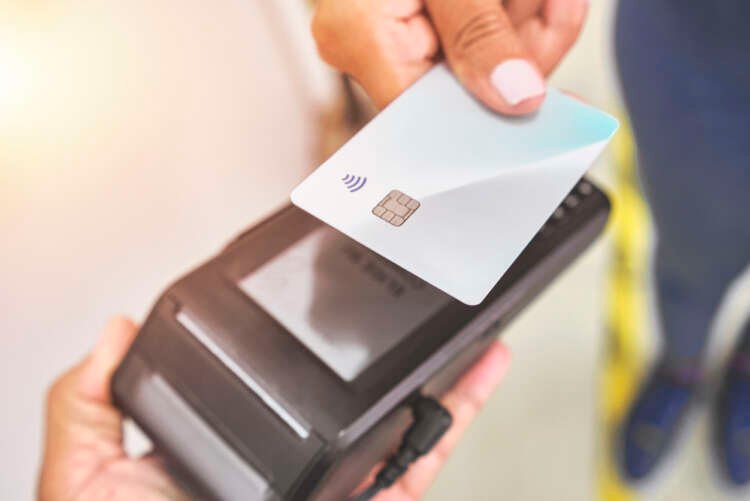
    Close-up of a customer making a contactless payment, illustrating the transition to cashless transactions in today's digital economy, emphasizing security and timestamping in finance.
    Customer using contactless payment method in a cashless transaction - Global Banking & Finance Review
    Why waste money on news and opinion when you can access them for free?

    Take advantage of our newsletter subscription and stay informed on the go!

    Subscribe

    Tags:innovationpaymentsfinancial servicestechnologyDigital transformation

    Richard Hoptroff

    Cashless – the new normal in the digital economy?

    Every day the prospect of a cashless society draws closer, with only one in six UK payments now being made in cash, and 13.7 million people living a “cashless life” last year, nearly double the level of 7.4 million in 2019. Compared to half of all transactions a decade ago, five out of six payments now contain no notes or coins. A rising number of businesses are going through digital transformation and refusing to accept cash, with many opting to become card-only in the last year – Ikea said on its website that it will not accept cash payments in its UK locations “for the time being”. Nando’s, a restaurant chain, has gone cashless; Itsu, a Japanese food chain, says it is card-only in stores, and BrewDog, a craft beer company, is among the hospitality firms that have chosen to only accept card payments.

    The cashless phenomenon is symptomatic of a wider cultural shift towards digital transformation. Over the last few centuries technology has increased the global reach and average speed of human life pace. Financial transactions have become increasingly fast and convenient, which in turn spurred economic growth. Our reliance on the convenience brought about by all things digital is growing every day, and at an exponential rate. However, digital transformation does not always lead to extra security.

    Convenient ≠ Safe

    Going through digital transformation and becoming cashless is convenient – it eliminates the middleman, helps avoid corruption and is effective in fighting organised crime. Nevertheless, the convenience has a flip side – digital vulnerability. Indeed, a cashless society calls for a fundamental agreement on when digital transactions took place. A way to ensure that such agreement is in place is by having accurate time synchronisation and traceable timestamping. Timing is also a necessary component of the financial services, banking, forex trading and fintech businesses– regulations such as the Second Markets in Financial Instruments Directive (MIFID II) in the EU, and Consolidated Audit Trail (CAT) in the US legally require time synchronisation and timestamping to be accurate and reliable.

    This increasing popularity of living cashless coupled with the intensifying level of demand for accurate time synchronisation and trusted timestamping has exposed the essential need for a systemic solution for when things go wrong, a failsafe backup system to correct any misalignments. If a financial service, bank, forex trading or a fintech business were to lose its satellite connectivity, digital payment systems would begin to fail and a cashless society would begin to crumble. Indeed, few people realise how dependent we are on the satellites that play a role in our everyday lives.

    While GNSS signals are widely available and free, they are subject to interference and are becoming more vulnerable to assault. Satellites in a 20-kilometre medium-earth orbit broadcast one-way signals in the 1.2-1.6 GHz waveband. This implies that they can be easily disturbed, either deliberately or inadvertently. The most common causes of GNSS disruption are unintentional interference, jamming and spoofing. Unintentional interference occurs when radio waves are generated by equipment ranging from microwave ovens to faulty antennas, drowning out weak GNSS signals. Intentional interference (‘jamming’) is becoming more prevalent, most notably when commercial drivers jam their on-board monitoring systems to obscure their tracks. Spoofing is a more advanced kind of interference in which fake GNSS signals are created to fool GNSS receivers into thinking they are in another location. As drone technology becomes more prevalent, they will increasingly be used as a defence against unwanted drone incursions. Originally developed by state actors as a defensive strategy, they are now available at low cost and will increasingly be used in defence.

    Accurate time synchronisation and trusted timestamping is the answer

    The big question is this – How does one build satellite resilience to ensure that a cashless society can function well in the digital economy and in the future? This is where accurate time synchronisation and traceable timestamping come in. These timing solutions work by linking grandmaster clocks to multiple primary UTC sources in a timing hub, which means that connectivity providers can syndicate highly accurate time to servers in any data centre in the world over Internet Protocol via low-latency fibre cables. Time synchronisation software then adjusts the server clock to match the time feed, measures the internal latency and creates traceable and trusted timestamps logs, which are stored in the cloud.

    Timing providers have developed systems built on a network of mutually robust cloud timing hubs, each of which is made up of three nanosecond-accurate grandmaster clocks linked to three distinct sources. The hubs compare the various timing sources on a regular basis to guarantee that accurate time synchronisation and traceable timestamps are always maintained. Thus, network delivered traceable timestamping solutions are bound to become even more relevant as we move towards digital transformation and a completely cashless life. Building network resilience by investing into these solutions will be the key for all businesses even beyond financial service, bank, forex trading or a fintech business looking to go cash-free.

    Frequently Asked Questions about Cashless societies and the need for trusted timestamping in the digital economy

    1What is a cashless society?

    A cashless society is an economic state where financial transactions are conducted electronically rather than with physical cash. This includes the use of credit cards, mobile payments, and digital currencies.

    2What is digital transformation?

    Digital transformation refers to the integration of digital technology into all areas of a business, fundamentally changing how it operates and delivers value to customers.

    3What is timestamping in finance?

    Timestamping in finance is the process of recording the exact time a transaction occurs. This is crucial for compliance and auditing purposes, ensuring accurate transaction records.

    4What is time synchronization?

    Time synchronization is the process of aligning the time across different systems and devices to ensure that all transactions and data logs are accurately timed.

    5What is digital vulnerability?

    Digital vulnerability refers to the risks associated with online transactions and digital systems, including potential data breaches, fraud, and cyberattacks.

    More from Finance

    Explore more articles in the Finance category

    Image for UK's Headlam warns of revenue drop as Middle East war pushes costs higher
    UK's Headlam Warns of Revenue Drop as Middle East War Pushes Costs Higher
    Image for Hedge fund founder Odey gives evidence in fight against financial industry ban
    Hedge Fund Founder Odey Gives Evidence in Fight Against Financial Industry Ban
    Image for UK's RS Group forecasts annual profit marginally ahead of market view
    UK's Rs Group Forecasts Annual Profit Marginally Ahead of Market View
    Image for Spanish gambling group Codere to go on sale for $2.3 billion, Expansion reports
    Spanish Gambling Group Codere to Go on Sale for $2.3 Billion, Expansion Reports
    Image for UK's ASOS posts 50% profit surge on cost-focussed revamp
    UK's Asos Posts 50% Profit Surge on Cost-Focussed Revamp
    Image for UK inflation holds at 3.0% in February
    UK Inflation Holds at 3.0% in February
    Image for Fastweb + Vodafone terminates agreement with INWIT
    Fastweb + Vodafone Terminates Agreement With Inwit
    Image for Asia looks to COVID-era playbook to tackle fuel crisis
    Asia Looks to COVID-era Playbook to Tackle Fuel Crisis
    Image for Analysis-Western powers were unable to secure shipping in the Red Sea. Hormuz will be harder
    Analysis-Western Powers Were Unable to Secure Shipping in the Red Sea. Hormuz Will Be Harder
    Image for Air Liquide executive: will allocate helium volume from other places in the world
    Air Liquide Executive: Will Allocate Helium Volume From Other Places in the World
    Image for Blaze at Russia's Baltic Sea port of Ust-Luga after major Ukrainian drone attack
    Blaze at Russia's Baltic Sea Port of Ust-Luga After Major Ukrainian Drone Attack
    Image for Morning Bid: Deal, or no deal?
    Morning Bid: Deal, or No Deal?
    View All Finance Posts
    Previous Finance PostThe Most Profitable Auto Insurance Companies and Why
    Next Finance PostAir France-KLM Ready to Move Swiftly With Capital Increase, Les Echos Reports

