Automotive Die Casting Lubricants Market to Reach $118.4M by 2031
As per a recent market study by Future Market Insights (FMI), the global automotive die casting lubricants market is projected to reach US$ 118.4 Mn in 2021, expanding at a 4.1% CAGR over the assessment period.
Increasing sales of automobile across the globe driven by growing urban population is elevating the demand for automotive die casting lubricants over the forecast period. In addition to this, rising trend of sustainability and focus on energy efficiency measures is expected to foster sales of automotive die casting lubricants.
Stringent regulations regarding carbon emissions is resulting in high demand for fuel efficient and lightweight vehicles. Materials such as aluminum, magnesium, zinc, and other non-ferrous materials are gaining significance in the automotive industry to produce lightweight vehicles. These factors are anticipated to bode well for the automotive die casting lubricants market.
However, lightweight materials with good mechanical strength are comparatively more expensive than conventional materials. High cost associated with these materials will impact the profit margins and hinder sales of automotive die casting lubricants in the forthcoming years.
FMI’s in-depth regional analysis projects the U.S. to dominate the North American die casting lubricants market, owing to the presence of key market players and robust automotive sector. Expanding at a 3.5% CAGR, the U.S. is anticipated to capture 91.0% of the North American die casting lubricants market share.
“Government-led initiatives encouraging the production and sales of electric vehicles, coupled with increasing research and development efforts to develop sustainable automotive die casting lubricant materials will continue augmenting market growth through 2031,” says the FMI analyst.
Key Takeaways from Automotive Die Casting Lubricants Market Study
- Based on lubricant type, die casting lubricants will dominate the segment, holding 94% of the total revenue generated.
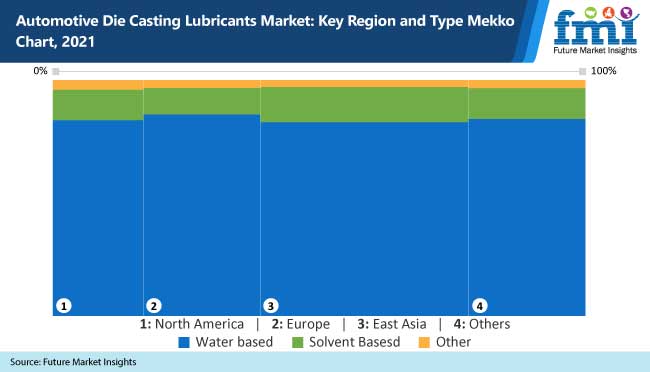
- Sales of water-based lubricants is projected to grow at a 4.3% CAGR.
- Aluminum will emerge as the most-preferred material type, accounting for 75% of the total market share.
- The U.S. will continue dominating the North American automotive die casting lubricants market, growing at a 3.5% CAGR.
- China will emerge as an attractive automotive die casting lubricants market, reaching a valuation of US$ 31.5 Mn in 2021.
- Germany will continue witnessing high demand for automotive die casting lubricants, accounting for 28% of the European market share.
For Information On The Research Approach Used In The Report, Ask Analyst @ https://www.futuremarketinsights.com/ask-question/rep-gb-13948
Automotive Die Casting Lubricants Market: Participant Insights
Henkel AG & Co. KGaA, Chem-Trend LP, Quaker Houghton Inc., Moresco Corp., The Hill, and Griffith Company, Geiger + Co. Schmierstoff-Chemie GmbH, Ultraseal India Pvt. Ltd, CHEMTOOL INCORPORATED, Condat SA, Hardcastle Petrofer Pvt. Ltd, Sunocs LLC, J&S Chemical Corporation, Lubgraf Synoils Pvt. Ltd., Aoki Science Institute Co., Ltd, Falcon Industrial Inc, Lafrance Manufacturing, Marbo Italia spa, Sunrise Chemtech Pvt. Ltd, Acme Refining LLC are some of the leading players operating in the global automotive die casting lubricants market.
As per FMI, top 5 players comprise Henkel AG & Co. KGaA, Quaker Houghton Inc., Moresco Corp., Condat SA, and Chemtool Incorporated, accounting for approximately 50-60% of the total market share.
About Chemicals & Materials division of FMI
The Chemicals & Materials division at FMI offers distinct and pin-point analysis about the chemicals & materials industry. Coverage of the chemicals and materials market extends from commodity, bulk, specialty and petrochemicals to advanced materials, composites, and nanotechnology. The team also puts special emphasis on ‘green alternatives’, recycling and renewable technology developments, and supply-demand trade assessment. Our research studies are widely referred by chemical manufacturers, research institutions, channel partners, and government bodies for developing – ‘The Way Forward’.
The post Automotive Die Casting Lubricants Market to Reach US$ 118.4 Mn, Globally, by 2031 at 4.1% CAGR: Future Market Insights appeared first on Market Research Blog.