Search
00
GBAF Logo
trophy
Top StoriesInterviewsBusinessFinanceBankingTechnologyInvestingTradingVideosAwardsMagazinesHeadlinesTrends

Subscribe to our newsletter

Get the latest news and updates from our team.

Global Banking & Finance Review®

Global Banking & Finance Review® - Subscribe to our newsletter

Company

    GBAF Logo
    • About Us
    • Profile
    • Privacy & Cookie Policy
    • Terms of Use
    • Contact Us
    • Advertising
    • Submit Post
    • Latest News
    • Research Reports
    • Press Release
    • Awards▾
      • About the Awards
      • Awards TimeTable
      • Submit Nominations
      • Testimonials
      • Media Room
      • Award Winners
      • FAQ
    • Magazines▾
      • Global Banking & Finance Review Magazine Issue 79
      • Global Banking & Finance Review Magazine Issue 78
      • Global Banking & Finance Review Magazine Issue 77
      • Global Banking & Finance Review Magazine Issue 76
      • Global Banking & Finance Review Magazine Issue 75
      • Global Banking & Finance Review Magazine Issue 73
      • Global Banking & Finance Review Magazine Issue 71
      • Global Banking & Finance Review Magazine Issue 70
      • Global Banking & Finance Review Magazine Issue 69
      • Global Banking & Finance Review Magazine Issue 66
    Top StoriesInterviewsBusinessFinanceBankingTechnologyInvestingTradingVideosAwardsMagazinesHeadlinesTrends

    Global Banking & Finance Review® is a leading financial portal and online magazine offering News, Analysis, Opinion, Reviews, Interviews & Videos from the world of Banking, Finance, Business, Trading, Technology, Investing, Brokerage, Foreign Exchange, Tax & Legal, Islamic Finance, Asset & Wealth Management.
    Copyright © 2010-2026 GBAF Publications Ltd - All Rights Reserved. | Sitemap | Tags | Developed By eCorpIT

    Editorial & Advertiser disclosure

    Global Banking & Finance Review® is an online platform offering news, analysis, and opinion on the latest trends, developments, and innovations in the banking and finance industry worldwide. The platform covers a diverse range of topics, including banking, insurance, investment, wealth management, fintech, and regulatory issues. The website publishes news, press releases, opinion and advertorials on various financial organizations, products and services which are commissioned from various Companies, Organizations, PR agencies, Bloggers etc. These commissioned articles are commercial in nature. This is not to be considered as financial advice and should be considered only for information purposes. It does not reflect the views or opinion of our website and is not to be considered an endorsement or a recommendation. We cannot guarantee the accuracy or applicability of any information provided with respect to your individual or personal circumstances. Please seek Professional advice from a qualified professional before making any financial decisions. We link to various third-party websites, affiliate sales networks, and to our advertising partners websites. When you view or click on certain links available on our articles, our partners may compensate us for displaying the content to you or make a purchase or fill a form. This will not incur any additional charges to you. To make things simpler for you to identity or distinguish advertised or sponsored articles or links, you may consider all articles or links hosted on our site as a commercial article placement. We will not be responsible for any loss you may suffer as a result of any omission or inaccuracy on the website.

    Home > Business > As COVID-19 fuels youth unemployment, Nigeria doles out jobs
    Business

    As COVID-19 fuels youth unemployment, Nigeria doles out jobs

    Published by linker 5

    Posted on January 27, 2021

    5 min read

    Last updated: January 21, 2026

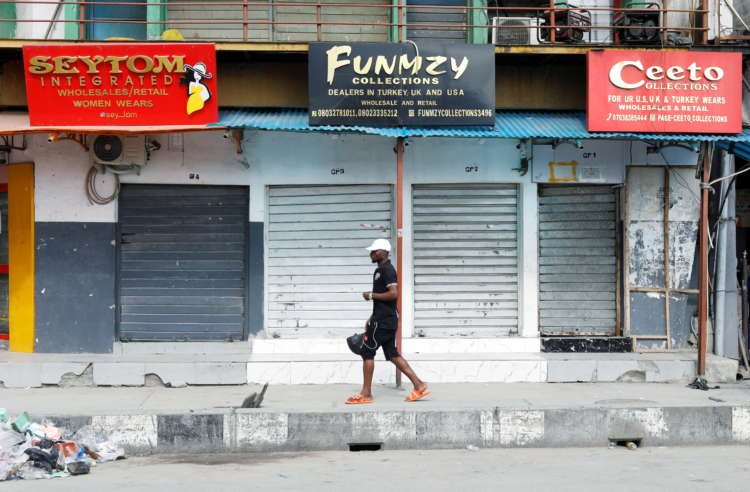
    A man walks past shops remaining closed in Lagos
    Why waste money on news and opinion when you can access them for free?

    Take advantage of our newsletter subscription and stay informed on the go!

    Subscribe

    By Adaobi Tricia Nwaubani

    ABUJA (Thomson Reuters Foundation) – From hotels and schools to the navy and police force, Nigerian graduate Ene Adejo has looked for a job just about everywhere since she finished her studies eight years ago, but she is still unemployed.

    “Sometimes they tell me the course I studied doesn’t relate to the job I’m applying for … Sometimes they tell me I don’t have experience,” Adejo, 34, who studied adult education and business studies, said from her home in the capital, Abuja.

    The COVID-19 pandemic has fueled youth unemployment in Africa’s largest economy, which has risen for five consecutive years to about 14%, prompting the government to launch a huge public works scheme to create jobs.

    About 750,000 young unemployed people will be offered three-month placements with a monthly salary of 20,000 naira ($51) under the Special Public Works (SPW) programme.

    While Adejo is not keen on the low-skilled jobs on offer, such as traffic control and road maintenance, she plans to apply anyway.

    “I just don’t like being idle,” she said.

    Nearly 14 million young people are out of work in Nigeria, which has one of the world’s largest youth populations, with more than a third of its 200 million people aged 24 or under, according to United Nations’ data.

    While such numbers help explain government concern to tackle youth unemployment, critics say the SPW programme fails to address structural problems in the country, where oil wealth has enriched a small elite but failed to create employment.

    “It’s a laudable idea but it’s like a drop in the ocean. It isn’t going to solve any problem. It’s just a short-term measure,” said Abiodun Folawewo, a professor of economics at the University of Ibadan in southwestern Nigeria.

    Governments should not be providing jobs, he said, rather fostering the right conditions for businesses to thrive, in turn increasing labour demand.

    “Once those things are in place, then jobs will be created. It is because those things are lacking that the government is doing this.”

    FIGHTING POVERTY

    Even proponents of state-led job creation initiatives have expressed scepticism about the SPW, which was launched by President Muhammadu Buhari earlier this month.

    Obadiah Mailafia, a former deputy central bank governor who has called for some sort of mass employment scheme, said investment in major infrastructure projects was the key to providing long-term, highly skilled employment.

    “I don’t find this particularly inspiring because public works schemes are far more than just casual works placements,” he said.

    “Public works systems are about building railways networks, highways, mass housing, and getting lots of youth employed in those projects,” Mailafia, who ran for president against Buhari in a 2019 election, told the Thomson Reuters Foundation.

    But Labour Minister of State Festus Keyamo said the jobs scheme was an emergency measure aimed at helping as many people as possible in tandem with longer-term economic stimulus and infrastructure efforts.

    “In the now, while government is doing that, how will they survive?” said Keyamo, who is leading the programme.

    “While government is creating an enabling environment, the government sees a way to even lift a few people, give a few people something in the immediate. Government’s approach to fighting poverty is multifaceted,” he said.

    He added that the government was considering extending the scheme beyond three months, making it an annual affair, or turning it into an agricultural programme.

    ‘I JUST KEEP APPLYING’

    Keyamo said the scheme targets the lowest socioeconomic class with little education, but that will do little to help the millions of well-educated young Nigerians classed as underemployed – working part-time or under-using their skills.

    Nigeria’s rate of youth underemployment is 28.6%, according to the Nigerian Bureau of Statistics.

    Nancy Otokina, who has a masters in business administration, has worked for less than two years in total since she graduated from university in 2009. Even going back to study for her masters failed to get her a lasting job.

    “I thought it would improve my prospects. That was actually my main aim of doing it,” said Otokina, 35, who has a five-year-old son.

    She has held off having another child in the hope she can find a job first.

    “I just keep applying and applying,” she said.

    Besides questioning the short-term focus of the SPW programme, some critics including Mailafia and Folawewo said they feared the government would use it as a means of rewarding supporters of the ruling All Progressives Congress (APC) party.

    Keyamo rejected such criticism, saying stringent measures have been put in place to make the selection process transparent and free from political bias.

    While Adejo waits to see what will come of her application, she has been helping out with administrative work at her church on a voluntary basis – trying to make ends meet by reselling household goods on social media.

    She said she remained hopeful that her job search would bear fruit eventually: “I still expect that I’ll get a good job. My dream is to join the military or the police.”

    (Reporting by Adaobi Tricia Nwaubani; Editing by Helen Popper; Please credit the Thomson Reuters Foundation, the charitable arm of Thomson Reuters, that covers the lives of people around the world who struggle to live freely or fairly. Visit http://news.trust.org)

    More from Business

    Explore more articles in the Business category

    Image for Empire Lending helps SMEs secure capital faster, without bank delays
    Empire Lending helps SMEs secure capital faster, without bank delays
    Image for Why Leen Kawas is Prioritizing Strategic Leadership at Propel Bio Partners
    Why Leen Kawas is Prioritizing Strategic Leadership at Propel Bio Partners
    Image for How Commercial Lending Software Platforms Are Structured and Utilized
    How Commercial Lending Software Platforms Are Structured and Utilized
    Image for Oil Traders vs. Tech Startups: Surprising Lessons from Two High-Stakes Worlds | Said Addi
    Oil Traders vs. Tech Startups: Surprising Lessons from Two High-Stakes Worlds | Said Addi
    Image for Why More Mortgage Brokers Are Choosing to Join a Network
    Why More Mortgage Brokers Are Choosing to Join a Network
    Image for From Recession Survivor to Industry Pioneer: Ed Lewis's Data Revolution
    From Recession Survivor to Industry Pioneer: Ed Lewis's Data Revolution
    Image for From Optometry to Soul Vision: The Doctor Helping Entrepreneurs Lead With Purpose
    From Optometry to Soul Vision: The Doctor Helping Entrepreneurs Lead With Purpose
    Image for Global Rankings Revealed: Top PMO Certifications Worldwide
    Global Rankings Revealed: Top PMO Certifications Worldwide
    Image for World Premiere of Midnight in the War Room to be Hosted at Black Hat Vegas
    World Premiere of Midnight in the War Room to be Hosted at Black Hat Vegas
    Image for Role of Personal Accident Cover in 2-Wheeler Insurance for Owners and Riders
    Role of Personal Accident Cover in 2-Wheeler Insurance for Owners and Riders
    Image for The Young Rich Lister Who Also Teaches: How Aaron Sansoni Built a Brand Around Execution
    The Young Rich Lister Who Also Teaches: How Aaron Sansoni Built a Brand Around Execution
    Image for Q3 2025 Priority Leadership: Tom Priore and Tim O'Leary Balance Near-Term Challenges with Long-Term Strategic Wins
    Q3 2025 Priority Leadership: Tom Priore and Tim O'Leary Balance Near-Term Challenges with Long-Term Strategic Wins
    View All Business Posts
    Previous Business PostWho needs to sit next to a trader? Asset managers embrace outsourcing
    Next Business PostMore carats and sparkle: How LVMH plans to change Tiffany