Search
00
GBAF Logo
trophy
Top StoriesInterviewsBusinessFinanceBankingTechnologyInvestingTradingVideosAwardsMagazinesHeadlinesTrends

Subscribe to our newsletter

Get the latest news and updates from our team.

Global Banking & Finance Review®

Global Banking & Finance Review® - Subscribe to our newsletter

Company

    GBAF Logo
    • About Us
    • Profile
    • Privacy & Cookie Policy
    • Terms of Use
    • Contact Us
    • Advertising
    • Submit Post
    • Latest News
    • Research Reports
    • Press Release
    • Awards▾
      • About the Awards
      • Awards TimeTable
      • Submit Nominations
      • Testimonials
      • Media Room
      • Award Winners
      • FAQ
    • Magazines▾
      • Global Banking & Finance Review Magazine Issue 79
      • Global Banking & Finance Review Magazine Issue 78
      • Global Banking & Finance Review Magazine Issue 77
      • Global Banking & Finance Review Magazine Issue 76
      • Global Banking & Finance Review Magazine Issue 75
      • Global Banking & Finance Review Magazine Issue 73
      • Global Banking & Finance Review Magazine Issue 71
      • Global Banking & Finance Review Magazine Issue 70
      • Global Banking & Finance Review Magazine Issue 69
      • Global Banking & Finance Review Magazine Issue 66
    Top StoriesInterviewsBusinessFinanceBankingTechnologyInvestingTradingVideosAwardsMagazinesHeadlinesTrends

    Global Banking & Finance Review® is a leading financial portal and online magazine offering News, Analysis, Opinion, Reviews, Interviews & Videos from the world of Banking, Finance, Business, Trading, Technology, Investing, Brokerage, Foreign Exchange, Tax & Legal, Islamic Finance, Asset & Wealth Management.
    Copyright © 2010-2026 GBAF Publications Ltd - All Rights Reserved. | Sitemap | Tags | Developed By eCorpIT

    Editorial & Advertiser disclosure

    Global Banking & Finance Review® is an online platform offering news, analysis, and opinion on the latest trends, developments, and innovations in the banking and finance industry worldwide. The platform covers a diverse range of topics, including banking, insurance, investment, wealth management, fintech, and regulatory issues. The website publishes news, press releases, opinion and advertorials on various financial organizations, products and services which are commissioned from various Companies, Organizations, PR agencies, Bloggers etc. These commissioned articles are commercial in nature. This is not to be considered as financial advice and should be considered only for information purposes. It does not reflect the views or opinion of our website and is not to be considered an endorsement or a recommendation. We cannot guarantee the accuracy or applicability of any information provided with respect to your individual or personal circumstances. Please seek Professional advice from a qualified professional before making any financial decisions. We link to various third-party websites, affiliate sales networks, and to our advertising partners websites. When you view or click on certain links available on our articles, our partners may compensate us for displaying the content to you or make a purchase or fill a form. This will not incur any additional charges to you. To make things simpler for you to identity or distinguish advertised or sponsored articles or links, you may consider all articles or links hosted on our site as a commercial article placement. We will not be responsible for any loss you may suffer as a result of any omission or inaccuracy on the website.

    Home > Investing > Analysis-After jumbo Fed rate cut, market hopes ride on US soft landing
    Investing

    Analysis-After jumbo Fed rate cut, market hopes ride on US soft landing

    Published by Uma Rajagopal

    Posted on September 19, 2024

    5 min read

    Last updated: January 29, 2026

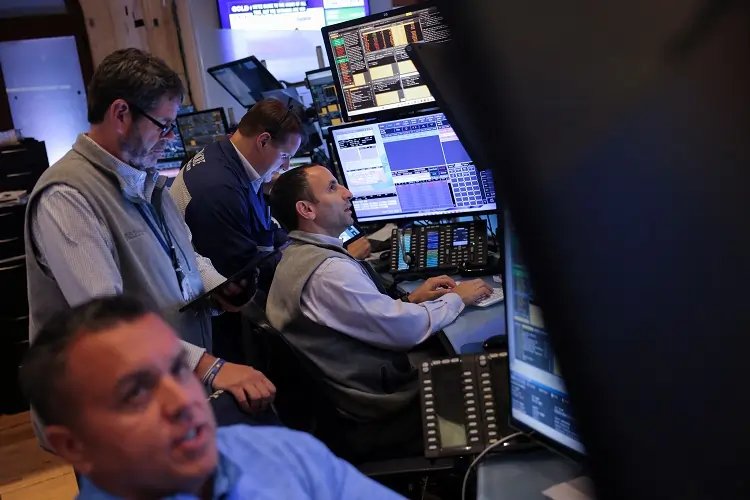
    This image illustrates the market's reaction to the Federal Reserve's recent 50 basis point rate cut, highlighting investor sentiment and economic forecasts related to soft landing scenarios in U.S. markets.
    Federal Reserve meeting highlights with charts and market data - Global Banking & Finance Review
    Why waste money on news and opinion when you can access them for free?

    Take advantage of our newsletter subscription and stay informed on the go!

    Subscribe

    Tags:interest rateseconomic growthfinancial marketsmonetary policy

    By Lewis Krauskopf and Davide Barbuscia

    NEW YORK (Reuters) – One of the most consequential Federal Reserve meetings in recent history has put investors’ focus squarely on one question: whether the central bank has kicked off its rate cutting cycle in time to keep the economy from slowing too rapidly.

    The Fed delivered a 50 basis point rate cut on Wednesday – lowering borrowing costs for the first time in more than four years – and assured investors the jumbo-sized reduction was a measure to safeguard a resilient economy, rather than an emergency response to recent weakness in the labor market. Bets on the size of the rate cut swung in the days before the meeting and were near an even split on Wednesday morning.

    The degree to which Powell’s outlook pans out is likely to be a key factor in the trajectory of stocks and bonds for the remainder of 2024.

    Prospects of a “soft landing,” where the Fed brings down inflation without pushing the economy into recession, have lifted stocks and bonds this year, though signs of a softening labor market have fueled worries that the Fed may be too late in acting to shore up growth.

    “Right now, it looks as if the market is going to pause to digest what was to many a surprise,” said Eric Beyrich, co-CIO of investment advisory firm Sound Income Strategies. “There will still be people thinking, ‘wow, If the Fed cuts big like that, what do they see that we’re not seeing that suggests the economy will get worse?’”

    Market reaction on Wednesday was relatively subdued as stocks, Treasuries and the dollar retraced initial, post-decision rallies. The S&P 500 ended down 0.3%, after rising as much as 1% during the session. The index is up nearly 18% this year and stands near a record high.

    In comments following the decision, Powell called the move a “recalibration” to account for the sharp decline in inflation since last year and said the central bank wanted to stay ahead of any potential weakening in the jobs market.

    Some investors were skeptical of that sunny view.

    “Despite what Chair Powell is saying in the press conference, a 50 basis point move does indicate that there is concern that they are behind the curve,” said Josh Emanuel, chief investment officer at Wilshire.

    Emanuel said he was already overweight bonds coming into the meeting, favoring investment-grade credit over riskier high-yield bonds ahead of an expected deterioration in the economy.

    Many others, however, believed the rate cuts were a positive development for the market and would buoy the economy.

    “I think that this dramatically increases the odds of the Fed being able to stick the landing, which ultimately will be bullish for risk assets,” said Jeff Schulze, head of economic and market strategy at ClearBridge Investments.

    Indeed, stocks have performed well following rate cuts – as long as the economy stayed out of recession. The S&P 500 has posted an average 14% gain in the six months following the first reduction of a rate-cutting cycle, when the Fed cut in a non-recessionary period, data from Evercore ISI going back to 1970 showed. That compares to a 4% decline in that period after the initial cut when the economy is in a recession.

    Rick Rieder, chief investment officer for global fixed income at BlackRock, said investors may have overreacted to recent labor markets reports that had come in weaker than expected. Other data, such as gross domestic product growth estimates, continued to show a resilient economy.

    “I think the markets got ahead of themselves again in terms of interpreting that data was very soft,” he said. “Chair Powell said it’s a solid economy, and it is.”

    LONG-TERM ADJUSTMENTS

    Fed officials updated their views on interest rates from their latest June projections, but while they now anticipate deeper cuts, those rate forecasts remained above market expectations of a more accommodative central bank.

    The Fed said it expects the Fed funds rate – currently in the 4.75% to 5% range – at 3.4% by the end of next year, while rates traders are betting on about 2.9%. Also, the Fed’s endpoint for rate cuts reflected a slight upgrade, to 2.9% from 2.8%.

    The outlook gap may have sparked a reversal in Treasury markets, sparking a selloff in longer-term Treasuries on Wednesday. The benchmark 10-year Treasury yield, which moves inversely to bond prices, stands at around 3.73 after touching its lowest level since mid-2023 earlier this week.

    “In terms of the pace at which cuts were priced in, I think this is a right reaction,” said John Madziyire, head of U.S. Treasuries and TIPS at Vanguard, who was betting on long-term yields moving higher.

    Others were looking even further out, with some pointing to the outcome of the U.S. presidential election as potentially complicating the path for rate cuts going forward.

    “If trade wars were to ensue under a Trump presidency, that could be negative for fixed income,” said Andrzej Skiba, head of U.S. fixed income for RBC Global Asset Management. “That would be inflationary and limit the Fed’s ability to cut rates”

    (Reporting by Lewis Krauskopf and Davide Barbuscia; Additional reporting by Suzanne McGee; Editing by Ira Iosebashvili and Muralikumar Anantharaman)

    Frequently Asked Questions about Analysis-After jumbo Fed rate cut, market hopes ride on US soft landing

    1What is a rate cut?

    A rate cut refers to a reduction in the interest rate set by a central bank, aimed at stimulating economic activity by making borrowing cheaper.

    2What is inflation?

    Inflation is the rate at which the general level of prices for goods and services rises, eroding purchasing power.

    3What is a soft landing?

    A soft landing is an economic term referring to a scenario where an economy slows down without entering a recession, often managed by central bank policies.

    4What is the Federal Reserve?

    The Federal Reserve, often referred to as the Fed, is the central banking system of the United States, responsible for setting monetary policy.

    More from Investing

    Explore more articles in the Investing category

    Image for Understanding the Factors Shaping Bitcoin’s Current Market Conditions
    Understanding the Factors Shaping Bitcoin’s Current Market Conditions
    Image for Understanding Investment Management Consulting Services in the U.S. Market
    Understanding Investment Management Consulting Services in the U.S. Market
    Image for The Role of DST Sponsors and Service Providers in Delaware Statutory Trusts
    The Role of DST Sponsors and Service Providers in Delaware Statutory Trusts
    Image for Understanding Self-Directed IRA Structures and Platform Models
    Understanding Self-Directed IRA Structures and Platform Models
    Image for 1031 Exchanges and Delaware Statutory Trusts: What Investors Need to Know
    1031 Exchanges and Delaware Statutory Trusts: What Investors Need to Know
    Image for Excellence in Innovation – Strategic Investment & Economic Transformation Egypt 2025
    Excellence in Innovation – Strategic Investment & Economic Transformation Egypt 2025
    Image for What Is the Average Pension Pot in the UK? (By Age)
    What Is the Average Pension Pot in the UK? (By Age)
    Image for From Money Printing to Market Surge: The Macro Forces Driving Crypto in 2026
    From Money Printing to Market Surge: The Macro Forces Driving Crypto in 2026
    Image for  Millennials Aren’t Ignoring Retirement. They’re Rebuilding It.
    Millennials Aren’t Ignoring Retirement. They’re Rebuilding It.
    Image for BridgeWise Launches FixedWise, the First AI Solution Bringing Granular Bond Intelligence to the European Market
    BridgeWise Launches FixedWise, the First AI Solution Bringing Granular Bond Intelligence to the European Market
    Image for Why Financial Advisors Are Rethinking Gold Allocations
    Why Financial Advisors Are Rethinking Gold Allocations
    Image for From Opaque to Investable: Yaniv Bertele's Blueprint for Transparent Alternatives
    From Opaque to Investable: Yaniv Bertele's Blueprint for Transparent Alternatives
    View All Investing Posts
    Previous Investing PostHow Does Jewellery Investment Impact Financial Portfolios?
    Next Investing PostLondon stocks drop after inflation data, focus shifts to Fed