Over the years, I have had numerous conversations with friends and family about the stock market, investment strategies, and the current landscape of opportunities. Many have asked about the rationale behind our fund's strategy, particularly our exposure to Chinese equities, and how we approach deci...
How investors should approach the stock market – insights and case studies from our investment strategy
Over the years, I have had numerous conversations with friends and family about the stock market, investment strategies, and the current landscape of opportunities. Many have asked about the rationale behind our fund's strategy, particularly our exposure to Chinese equities, and how we approach decision-making in such a complicated environment. These discussions have made me realize the importance of educating investors on how to think about the market—focusing on fundamentals, research, and a disciplined approach to investing.
The purpose of this letter is to share insights on how we evaluate investment opportunities, both within our fund and as a general investment principle. I’ve included case studies and real-world examples to illustrate how we apply these principles, with a special focus on China, which we believe is an undervalued market with strong upside potential. Through this, I hope to provide guidance on how investors can make decisions based on data and facts rather than emotion or sentiment.
The investment philosophy
At Alaamry Global Capital, our strategy is simple: we invest in exceptional companies trading below their intrinsic value. We target businesses with:
Competitive advantages
Strong and capable management
Prudent capital allocation
Shareholder-friendly practices
We prioritize investing in companies with founder-led management teams. Some 85% of our portfolio comprises companies where, on average, 30% of outstanding shares are held by insiders.
By purchasing such companies at discounted prices, we create a margin of safety that protects against potential downside risks while maximizing long-term returns.
These opportunities often arise during periods of economic uncertainty, industry challenges, or company-specific issues. Negative market sentiment and short-term panic drive stock prices below fair value, offering attractive entry points for long-term investors.
As Benjamin Graham wisely observed:
“Markets are a voting machine in the short term but a weighing machine in the long term”.
In today’s technology-driven world, average holding periods for stocks have dramatically declined from eight years in the 1950s to under six months. This short-term focus allows us to capitalize on undervalued stocks, holding them through recovery for superior long-term returns.
Why focus on China?
China, the world’s second-largest economy, offers an unparalleled investment opportunity. Despite achieving the “Chinese Miracle” with an average annual growth rate of 10% over three decades, its stock market remains significantly discounted.
The Hang Seng Index is at a steep drawn-down level
The Hang Seng Index, which peaked at 31,000 in 2021, has dropped 53% to lows of 14,687. This decline surpasses the 25% covid-19 crash and is comparable to the 57% drawdown during the Global Financial Crisis (GFC).
To put this into perspective, a similar performance in the S&P 500 would place it at around 1,928 points—three times cheaper than its current level of over 6,000. Such a decline would erase a decade of gains, much like the Hang Seng’s drop wiped out 15 years of returns.
Currently, the Hang Seng trades at roughly one-third the valuation of the S&P 500, presenting a compelling opportunity.
As Baron Rothschild famously said:
"The time to buy is when there's blood in the streets."
Price-to-earnings ratio points to great valuations
Historically, the US market has experienced prolonged periods of flat or negative returns:
Post-dot-com bubble (2000–2013): The S&P 500 took 13 years to recover to previous highs.
1969–1981: A stagnant period influenced by the 1974 oil embargo, the effects of which lasted 11 years.
Market recoveries after such downturns have been robust:
2013 to present: The S&P 500 climbed from 2,060 to over 6,000 (+291%).
1990 to 2000: The index rose from 720 to 2,770 (+385%).
The US market’s current price-to-earnings (PE) ratio is at 27, nearing dot-com bubble levels and nearly double its historical mean of 15.8. The Hang Seng Index PE is at 10, significantly below its 20-year average of 15.19.
The last time the US market PE ratio reached a level similar to the 10 of the Hang Seng was during the 2008 GFC. Since then, the S&P has delivered an impressive 878% return, or 15.6% annually (excluding dividends).
China’s stock market offers attractive valuations compared to the US. The low Hang Seng Index PE ratio signals the potential for a strong rebound. If the index reverts to its 20-year average, it could rise to 30,000,a 50% upside. A return to its historic high P/E of 21.2 would push the index above 40,000, offering a potential 100% upside.
As Warren Buffett wisely stated:
“Be fearful when others are greedy and greedy when others are fearful”
The Buffett Indicator points to an undervaluation of the Chinese market
Warren Buffett’s preferred valuation metric, the Buffett Indicator, compares total stock market capitalization to GDP.
US Indicator: 2.09x GDP, higher than the 1.5x peak during the dot-com bubble and four times higher than the 0.5x low during the GFC.
China ratio: 0.60x GDP.
This signals significant overvaluation in the US and makes China nearly 3.5 times cheaper
Case study: Microsoft’s lost decade – low historical returns lay the foundation for high future returns
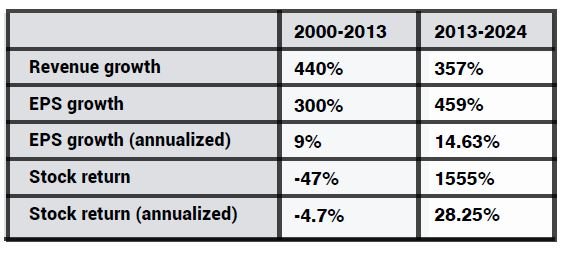
Microsoft’s “lost decade” (2000–2010) offers valuable insights to investors. During this period, despite strong fundamentals, the stock delivered zero returns for a decade due to valuation contraction:
Price to earnings (PE) dropped from 70x to 8x.
Price-to-sales (PS) ratio fell from 28x to 2.27x.
From 2013 to 2024, Microsoft’s fundamentals kept improving, leading to significant rerating:
Revenue/share grew 3.5x; EPS grew 8x.
P/E expanded from 12x to 34.4x.
Stock price rose from $27 (2013) to $420 (2024).
Total return: 1,555%, or 28.3% annualized.
Here is a comparison of Microsoft’s share-price returns with the growth in its fundamentals over those two periods.
Microsoft's fundamentals were strong in both periods, but stock returns varied due to valuation differences. This raises the question: Why do investors avoid low-valuation markets but flock to overvalued ones?
The takeaways from this case study:
Value, price, and fundamentals all matter in the long run.
Short-term price fluctuations mostly reflect the near-term sentiment of investors.
Low historical returns lay the foundation for high future returns.
Investors are generally irrational and guided by herd mentality. They are most comfortable buying with the crowd at market highs rather than being prescient but one of the few at market lows.
Warren Buffett’s quote is worth mentioning here:
“Price is what you pay, value is what you get”
The Magnificent Seven: the US market is more concentrated and expensive
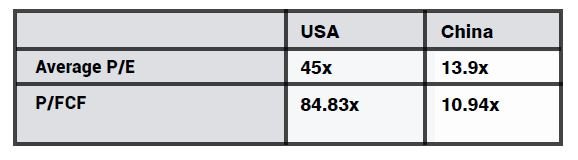
The contrast between the US and Chinese Magnificent Seven is stark.
US stocks are approximately 5.50 times more expensive than their Chinese counterparts. Like Microsoft’s post-lost decade recovery, China’s large caps could experience similar rerating.
Insider behavior can give the game away
Currently, insiders in US companies are happy to sell their stock knowing the shares are at all-time peak valuations. At the current S&P 500 level of 6,000, US insiders are selling stock in record volume.
This reinforces our belief that the China market is where the opportunity lies. If insiders do not have confidence in their own companies in the US, why should we put our money in their companies?
Fundamentals of our China portfolio
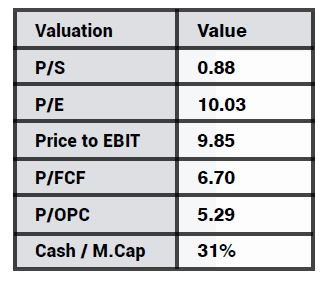
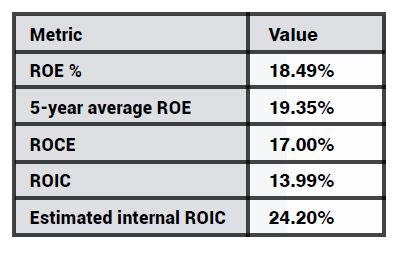
Our China-based portfolio demonstrates compelling valuation and fundamentals:
Valuation
Profitability metrics
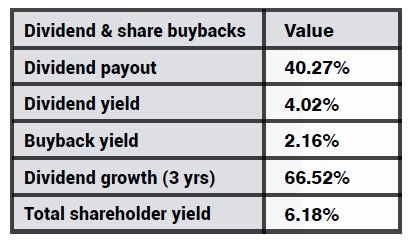
Capital returns
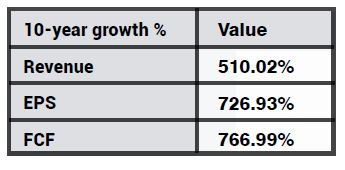
Fundamental performance of our companies
Conclusion
During a business trip to China, I met the CEO of a portfolio company who had grown his business into a multibillion-dollar enterprise with a 38-fold increase in free cash flow over a decade and a 10-year average ROE of 21.32%. Despite this success, his stock had dropped 60% from 2021 highs, leaving him puzzled and unhappy.
I assured him that short-term market irrationality doesn’t negate strong fundamentals. I recounted how some of the stocks I owned had a drawdown of over 90% but they turned around eventually to become 10-baggers. I also reassured him that, as the CEO, he is best suited to determine his company's health. Soon after, I noticed from the public filings that he began personally buying back shares, demonstrating confidence in his company and alignment of interest with shareholders, traits I admire deeply.
Our investment mission
We focus on amazing, founder-led companies with strong insider ownership and high returns on capital. These businesses are available at single-digit valuations—70% cheaper than their US counterparts.
If a company is twice as good as average but priced at half the average, in a way I would consider it a four-times better investment opportunity.
However, not every good company is a good investment & vice versa. At Alaamry Global Capital, we balance valuation and quality to achieve long-term returns. Instead of listing what we do, here’s what we avoid:
Short-term investing (day trading or predicting the next quarter’s results).
Shorting or speculative price action.
Predicting the economy or chasing fads.
Investing in companies with questionable management integrity & disregard for shareholders' interests.
Investing in loss-making companies without proven track records.
While many fund managers avoid markets like China due to weak Market sentiment, we embrace long-term opportunities and invest our own capital, aligning fully with our investors' interests.
We focus on studying businesses minutely, investing only when they meet our stringent criteria. A guiding question we ask is: Would we own this business if the stock market was closed for the next 10 years? This long-term perspective helps us ignore short-term price fluctuations.
My investment journey began over 15 years ago, shaped by experiences like the 2011 Japan tsunami, when strong companies traded at discounts unrelated to their fundamentals. This reinforced my belief in value investing. It’s a philosophy I continue to apply successfully today, hoping to benefit both my community and the Kingdom of Saudi Arabia.
Warren Buffett boasted during the GFC: “Buy American, I am”. Like him, I now say, “Buy China, I am.”
I hope this letter provides valuable insights into our philosophy. Just as I have learned from others’ writings, I aspire for my reflections to help strengthen your investment perspective by encouraging you to read and learn continuously.
Post script: For more details on the reflections shared in this note, please ask us for our Annual Shareholder Letter for 2024 by clicking here or through our website.