Search
00
GBAF Logo
trophy
Top StoriesInterviewsBusinessFinanceBankingTechnologyInvestingTradingVideosAwardsMagazinesHeadlinesTrends

Subscribe to our newsletter

Get the latest news and updates from our team.

Global Banking & Finance Review®

Global Banking & Finance Review® - Subscribe to our newsletter

Company

    GBAF Logo
    • About Us
    • Profile
    • Privacy & Cookie Policy
    • Terms of Use
    • Contact Us
    • Advertising
    • Submit Post
    • Latest News
    • Research Reports
    • Press Release
    • Awards▾
      • About the Awards
      • Awards TimeTable
      • Submit Nominations
      • Testimonials
      • Media Room
      • Award Winners
      • FAQ
    • Magazines▾
      • Global Banking & Finance Review Magazine Issue 79
      • Global Banking & Finance Review Magazine Issue 78
      • Global Banking & Finance Review Magazine Issue 77
      • Global Banking & Finance Review Magazine Issue 76
      • Global Banking & Finance Review Magazine Issue 75
      • Global Banking & Finance Review Magazine Issue 73
      • Global Banking & Finance Review Magazine Issue 71
      • Global Banking & Finance Review Magazine Issue 70
      • Global Banking & Finance Review Magazine Issue 69
      • Global Banking & Finance Review Magazine Issue 66
    Top StoriesInterviewsBusinessFinanceBankingTechnologyInvestingTradingVideosAwardsMagazinesHeadlinesTrends

    Global Banking & Finance Review® is a leading financial portal and online magazine offering News, Analysis, Opinion, Reviews, Interviews & Videos from the world of Banking, Finance, Business, Trading, Technology, Investing, Brokerage, Foreign Exchange, Tax & Legal, Islamic Finance, Asset & Wealth Management.
    Copyright © 2010-2026 GBAF Publications Ltd - All Rights Reserved. | Sitemap | Tags | Developed By eCorpIT

    Editorial & Advertiser disclosure

    Global Banking & Finance Review® is an online platform offering news, analysis, and opinion on the latest trends, developments, and innovations in the banking and finance industry worldwide. The platform covers a diverse range of topics, including banking, insurance, investment, wealth management, fintech, and regulatory issues. The website publishes news, press releases, opinion and advertorials on various financial organizations, products and services which are commissioned from various Companies, Organizations, PR agencies, Bloggers etc. These commissioned articles are commercial in nature. This is not to be considered as financial advice and should be considered only for information purposes. It does not reflect the views or opinion of our website and is not to be considered an endorsement or a recommendation. We cannot guarantee the accuracy or applicability of any information provided with respect to your individual or personal circumstances. Please seek Professional advice from a qualified professional before making any financial decisions. We link to various third-party websites, affiliate sales networks, and to our advertising partners websites. When you view or click on certain links available on our articles, our partners may compensate us for displaying the content to you or make a purchase or fill a form. This will not incur any additional charges to you. To make things simpler for you to identity or distinguish advertised or sponsored articles or links, you may consider all articles or links hosted on our site as a commercial article placement. We will not be responsible for any loss you may suffer as a result of any omission or inaccuracy on the website.

    Home > Banking > After the ‘bazooka’, Bank of Japan dismantles the work of its radical chief
    Banking

    After the ‘bazooka’, Bank of Japan dismantles the work of its radical chief

    Published by maria gbaf

    Posted on September 13, 2021

    16 min read

    Last updated: January 21, 2026

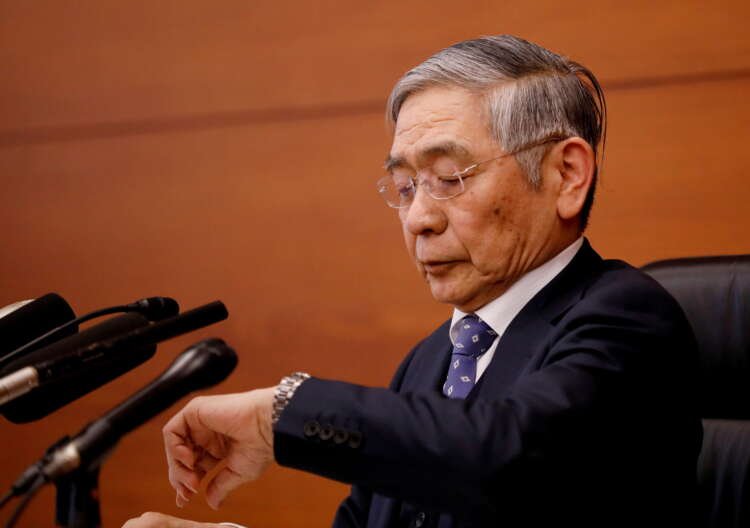
    This image shows the Bank of Japan headquarters, symbolizing the recent shifts in monetary policy under Governor Haruhiko Kuroda. The article discusses the BOJ's transition from radical stimulus measures to more traditional economic strategies.
    Bank of Japan headquarters reflecting on economic policy changes - Global Banking & Finance Review
    Why waste money on news and opinion when you can access them for free?

    Take advantage of our newsletter subscription and stay informed on the go!

    Subscribe

    By Leika Kihara

    TOKYO (Reuters) – After years of shock-and-awe stimulus, the Bank of Japan is quietly rolling back radical policies introduced by its bold chief Haruhiko Kuroda and pioneering controversial new measures that blur the lines between central banking and politics.

    The unwinding of Japan’s complex policy is driven by Deputy Governor Masayoshi Amamiya, insiders say, a career central banker considered the top contender https://www.reuters.com/investigates/special-report/boj-kuroda-economy to replace Governor Kuroda whose term ends in 2023.

    Amamiya and his top lieutenant Shinichi Uchida have worked behind the scenes to make Kuroda’s complicated policy framework–a product of years of unsuccessful attempts to revive stagnant consumer prices–more manageable, and eventually return Japan to more normal interest rate settings, even as the economy struggles with the pandemic.

    The BOJ’s dwindling monetary options mean the two ambitious technocrats are instead pushing the bank into schemes bordering on industrial policy, such as those designed to encourage bank sector consolidation and green finance.

    The most decisive and latest swing in policy direction, though not formally communicated, came in the BOJ’s March meeting when it announced it would no longer commit to a fixed programme of risky asset purchases, an inconspicuous sign it was slowing its monetary support.

    “With the March move, the BOJ laid the groundwork for an eventual policy normalisation,” said a close associate of Kuroda with knowledge on the central bank‘s policy deliberations.

    This account of events around the March meeting is based on interviews with more than two dozen incumbent and former central bank and government officials, ruling and opposition lawmakers and academics with direct or indirect knowledge of monetary policy decisions. The BOJ declined to comment for the story and declined a request by Reuters for interviews with Amamiya and Uchida.

    “The current stimulus can’t stay forever and must be rolled back at some point,” said a former BOJ policymaker who was involved in the March decision. “That’s always in the mind of career central bankers.”

    Officially, the change in March was aimed at extending the lifespan of stimulus policies championed by Kuroda, the man once seen as a bold visionary who could shock the economy out of deflation with his “bazooka” asset-buying programme.

    However, insiders say there was another motive: to pave the way for an eventual retreat from these very policies.

    While that intention was hidden from markets, it would mark a symbolic end to Kuroda’s bold experiment based on the text-book theory that forceful monetary action and communication can influence public price expectations and drive inflation higher.

    “It’s as if the BOJ is trying to prove itself by doing something new all the time,” said former BOJ deputy governor Hirohide Yamaguchi. “What’s become clear is that the BOJ can’t affect and mould public mindset like jelly.”

    Prime Minister Yoshihide Suga’s decision to step down this month could make questions around BOJ communication, ultra-loose policy and Kuroda’s eventual successor hot issues for Japan’s next leader.

    Once seen as a symbol of decisive monetary easing, Kuroda appears to be taking a back seat with recent BOJ forecasts predicting inflation will miss the bank‘s elusive 2% target well beyond his term ending in 2023.

    He has also acknowledged the need to address the strains ultra-low interest rates have on financial institutions.

    Only half of his six speeches so far this year were about monetary policy, in contrast to his first year as governor in 2013, when all but two of his 15 speeches focused on monetary policy.

    With his emphatic advocacy for 2% inflation fading, Kuroda is writing a memoir touching on topics ranging from encounters with various overseas policymakers, to pizza he ate during a business trip to Naples, according to his associates.

    “He probably enjoys reading books on philosophy more than chairing board meetings,” one said jokingly of the bookish governor.

    UNSCRAMBLING EGGS

    The planning for an eventual exit from Kuroda-era stimulus remains closely held and has not been part of the bank‘s official communication.

    But a gradual retreat has been under way since 2016, when the BOJ replaced a pledge to pump money at a set pace with a policy controlling interest rates.

    A fan of classical music known as “Mr. BOJ” for drafting numerous monetary easing schemes, Amamiya has since early last year been orchestrating a more concerted rollback of the very stimulus he helped Kuroda create.

    Details would be worked out by Uchida, who, like Amamiya, has been groomed to move up the BOJ ranks armed with “a wealth of ideas and an extremely sharp mind,” say people who have worked with or under him.

    The challenge was to mitigate the rising cost of prolonged easing to financial institutions, without giving markets the impression the BOJ was headed for a sharp exit from easy policy.

    Amamiya gave the go-ahead to a controversial scheme unveiled in November, under which the BOJ pays 0.1% interest to regional lenders that boost profits or consolidate.

    It was a nod to complaints from regional banks the BOJ’s negative rate policy was narrowing already thin margins, and reflected concern among policymakers that chronically low rates could destabilise the banking sector.

    “It’s essentially a scheme to compensate regional banks for the blow from negative rates,” one source said.

    By mid-2020, the bureaucrats were also debating ways to address what has been their biggest headache: the BOJ’s huge holdings of exchange-traded funds (ETF) that exposed its balance sheet to potential losses from market swings.

    For years, the government relied on the BOJ to set a price floor for Japan’s stock market, discouraging central bankers from ditching a pledge to purchase ETFs at a set pace.

    But as stocks kept rising, the political mood shifted. Lawmakers began to complain about the distortion the BOJ’s huge presence was causing in the share market.

    Last year, an opportunity arose: after ramping up buying to ease market turbulence caused by the pandemic, the BOJ began to scale back purchases and found markets taking the tapering in stride.

    That convinced BOJ officials the bank could terminate buying without upending markets, as long as it gave assurances that it would still intervene in times of crisis.

    “The BOJ made an absolutely right decision by starting with an ETF taper in heading toward an exit from easy policy,” said former trade minister and opposition heavyweight Banri Kaieda, who was once a vocal proponent of aggressive monetary easing.

    BLURRED LINES

    The next step would be to raise interest rates–the first hike since 2007–and mop up excess cash from the market.

    The March move laid the groundwork for that step. But a rate hike could take years due to subdued inflation and will likely be left to Kuroda’s successor, sources say.

    “If the BOJ is lucky, the debate (on raising rates) could begin from around 2023,” former BOJ executive Eiji Maeda told Reuters.

    “But this won’t be policy normalisation. It will merely be a shift away from an extraordinary stimulus towards a more sustainable monetary easing,” said Maeda, who was involved in the drafting of the current stimulus.

    Selling the BOJ’s huge ETF holdings will be even tougher. While bureaucrats have internally brainstormed ideas, there is no consensus on when and how this could be done, sources say.

    To be sure, policymakers both inside and outside the BOJ say stimulus of some kind is still needed to support the struggling economy, and that is unlikely to change when Suga steps down.

    That would leave the central bank in a holding pattern, even as its global peers eye exits from crisis-mode stimulus, and force the BOJ to use unconventional initiatives outside the monetary toolbox to juice the economy.

    Those include a scheme unveiled in July, which offers cheap funds to banks that lend to activities aimed at battling climate change.

    That plan meshes with Suga’s pledge to make Japan carbon-neutral by 2050, a sign the BOJ is controversially aligning its policy with government priorities.

    Such a proposal is typical of Amamiya, who knows which way the political wind is blowing and can adapt flexibly to shifts in popular opinion, say people who have worked with him.

    “We ought to avoid intervening in asset allocation as much as possible. But there’s no simple, ever-lasting line you can draw on what’s acceptable or not,” Amamiya said in July.

    “As economies become more sophisticated…the requirements of economic policy become more complex and difficult too.”

    Such forays into quasi-government policy highlight the BOJ’s current lack of conventional policy ammunition and take it into uncharted waters politically.

    Miyako Suda, a former BOJ board member, said many of the bank‘s new programmes leave it with less autonomy over when to withdraw stimulus than they have with conventional policy tools.

    “It’s no longer a decision the BOJ alone can make,” she said. “When the government and the BOJ are working side by side heading for the same direction, things go fine – the problem is when the two part ways.”

    (Reporting by Leika Kihara; Additional reporting by Tetsushi Kajimoto, Takaya Yamaguchi, Kaori Kaneko, Kentaro Sugiyama and Takahiko Wada; Editing by Sam Holmes)

    By Leika Kihara

    TOKYO (Reuters) – After years of shock-and-awe stimulus, the Bank of Japan is quietly rolling back radical policies introduced by its bold chief Haruhiko Kuroda and pioneering controversial new measures that blur the lines between central banking and politics.

    The unwinding of Japan’s complex policy is driven by Deputy Governor Masayoshi Amamiya, insiders say, a career central banker considered the top contender https://www.reuters.com/investigates/special-report/boj-kuroda-economy to replace Governor Kuroda whose term ends in 2023.

    Amamiya and his top lieutenant Shinichi Uchida have worked behind the scenes to make Kuroda’s complicated policy framework–a product of years of unsuccessful attempts to revive stagnant consumer prices–more manageable, and eventually return Japan to more normal interest rate settings, even as the economy struggles with the pandemic.

    The BOJ’s dwindling monetary options mean the two ambitious technocrats are instead pushing the bank into schemes bordering on industrial policy, such as those designed to encourage bank sector consolidation and green finance.

    The most decisive and latest swing in policy direction, though not formally communicated, came in the BOJ’s March meeting when it announced it would no longer commit to a fixed programme of risky asset purchases, an inconspicuous sign it was slowing its monetary support.

    “With the March move, the BOJ laid the groundwork for an eventual policy normalisation,” said a close associate of Kuroda with knowledge on the central bank‘s policy deliberations.

    This account of events around the March meeting is based on interviews with more than two dozen incumbent and former central bank and government officials, ruling and opposition lawmakers and academics with direct or indirect knowledge of monetary policy decisions. The BOJ declined to comment for the story and declined a request by Reuters for interviews with Amamiya and Uchida.

    “The current stimulus can’t stay forever and must be rolled back at some point,” said a former BOJ policymaker who was involved in the March decision. “That’s always in the mind of career central bankers.”

    Officially, the change in March was aimed at extending the lifespan of stimulus policies championed by Kuroda, the man once seen as a bold visionary who could shock the economy out of deflation with his “bazooka” asset-buying programme.

    However, insiders say there was another motive: to pave the way for an eventual retreat from these very policies.

    While that intention was hidden from markets, it would mark a symbolic end to Kuroda’s bold experiment based on the text-book theory that forceful monetary action and communication can influence public price expectations and drive inflation higher.

    “It’s as if the BOJ is trying to prove itself by doing something new all the time,” said former BOJ deputy governor Hirohide Yamaguchi. “What’s become clear is that the BOJ can’t affect and mould public mindset like jelly.”

    Prime Minister Yoshihide Suga’s decision to step down this month could make questions around BOJ communication, ultra-loose policy and Kuroda’s eventual successor hot issues for Japan’s next leader.

    Once seen as a symbol of decisive monetary easing, Kuroda appears to be taking a back seat with recent BOJ forecasts predicting inflation will miss the bank‘s elusive 2% target well beyond his term ending in 2023.

    He has also acknowledged the need to address the strains ultra-low interest rates have on financial institutions.

    Only half of his six speeches so far this year were about monetary policy, in contrast to his first year as governor in 2013, when all but two of his 15 speeches focused on monetary policy.

    With his emphatic advocacy for 2% inflation fading, Kuroda is writing a memoir touching on topics ranging from encounters with various overseas policymakers, to pizza he ate during a business trip to Naples, according to his associates.

    “He probably enjoys reading books on philosophy more than chairing board meetings,” one said jokingly of the bookish governor.

    UNSCRAMBLING EGGS

    The planning for an eventual exit from Kuroda-era stimulus remains closely held and has not been part of the bank‘s official communication.

    But a gradual retreat has been under way since 2016, when the BOJ replaced a pledge to pump money at a set pace with a policy controlling interest rates.

    A fan of classical music known as “Mr. BOJ” for drafting numerous monetary easing schemes, Amamiya has since early last year been orchestrating a more concerted rollback of the very stimulus he helped Kuroda create.

    Details would be worked out by Uchida, who, like Amamiya, has been groomed to move up the BOJ ranks armed with “a wealth of ideas and an extremely sharp mind,” say people who have worked with or under him.

    The challenge was to mitigate the rising cost of prolonged easing to financial institutions, without giving markets the impression the BOJ was headed for a sharp exit from easy policy.

    Amamiya gave the go-ahead to a controversial scheme unveiled in November, under which the BOJ pays 0.1% interest to regional lenders that boost profits or consolidate.

    It was a nod to complaints from regional banks the BOJ’s negative rate policy was narrowing already thin margins, and reflected concern among policymakers that chronically low rates could destabilise the banking sector.

    “It’s essentially a scheme to compensate regional banks for the blow from negative rates,” one source said.

    By mid-2020, the bureaucrats were also debating ways to address what has been their biggest headache: the BOJ’s huge holdings of exchange-traded funds (ETF) that exposed its balance sheet to potential losses from market swings.

    For years, the government relied on the BOJ to set a price floor for Japan’s stock market, discouraging central bankers from ditching a pledge to purchase ETFs at a set pace.

    But as stocks kept rising, the political mood shifted. Lawmakers began to complain about the distortion the BOJ’s huge presence was causing in the share market.

    Last year, an opportunity arose: after ramping up buying to ease market turbulence caused by the pandemic, the BOJ began to scale back purchases and found markets taking the tapering in stride.

    That convinced BOJ officials the bank could terminate buying without upending markets, as long as it gave assurances that it would still intervene in times of crisis.

    “The BOJ made an absolutely right decision by starting with an ETF taper in heading toward an exit from easy policy,” said former trade minister and opposition heavyweight Banri Kaieda, who was once a vocal proponent of aggressive monetary easing.

    BLURRED LINES

    The next step would be to raise interest rates–the first hike since 2007–and mop up excess cash from the market.

    The March move laid the groundwork for that step. But a rate hike could take years due to subdued inflation and will likely be left to Kuroda’s successor, sources say.

    “If the BOJ is lucky, the debate (on raising rates) could begin from around 2023,” former BOJ executive Eiji Maeda told Reuters.

    “But this won’t be policy normalisation. It will merely be a shift away from an extraordinary stimulus towards a more sustainable monetary easing,” said Maeda, who was involved in the drafting of the current stimulus.

    Selling the BOJ’s huge ETF holdings will be even tougher. While bureaucrats have internally brainstormed ideas, there is no consensus on when and how this could be done, sources say.

    To be sure, policymakers both inside and outside the BOJ say stimulus of some kind is still needed to support the struggling economy, and that is unlikely to change when Suga steps down.

    That would leave the central bank in a holding pattern, even as its global peers eye exits from crisis-mode stimulus, and force the BOJ to use unconventional initiatives outside the monetary toolbox to juice the economy.

    Those include a scheme unveiled in July, which offers cheap funds to banks that lend to activities aimed at battling climate change.

    That plan meshes with Suga’s pledge to make Japan carbon-neutral by 2050, a sign the BOJ is controversially aligning its policy with government priorities.

    Such a proposal is typical of Amamiya, who knows which way the political wind is blowing and can adapt flexibly to shifts in popular opinion, say people who have worked with him.

    “We ought to avoid intervening in asset allocation as much as possible. But there’s no simple, ever-lasting line you can draw on what’s acceptable or not,” Amamiya said in July.

    “As economies become more sophisticated…the requirements of economic policy become more complex and difficult too.”

    Such forays into quasi-government policy highlight the BOJ’s current lack of conventional policy ammunition and take it into uncharted waters politically.

    Miyako Suda, a former BOJ board member, said many of the bank‘s new programmes leave it with less autonomy over when to withdraw stimulus than they have with conventional policy tools.

    “It’s no longer a decision the BOJ alone can make,” she said. “When the government and the BOJ are working side by side heading for the same direction, things go fine – the problem is when the two part ways.”

    (Reporting by Leika Kihara; Additional reporting by Tetsushi Kajimoto, Takaya Yamaguchi, Kaori Kaneko, Kentaro Sugiyama and Takahiko Wada; Editing by Sam Holmes)

    More from Banking

    Explore more articles in the Banking category

    Image for Latin Securities Named Winner of Two Prestigious 2026 Global Banking & Finance Awards
    Latin Securities Named Winner of Two Prestigious 2026 Global Banking & Finance Awards
    Image for Pix at five years: how Brazil built one of the world’s most advanced public payments infrastructures - and why other countries are paying attention
    Pix at five years: how Brazil built one of the world’s most advanced public payments infrastructures - and why other countries are paying attention
    Image for Idle Stablecoins Are Becoming a Systemic Efficiency Problem — and Banks Should Pay Attention
    Idle Stablecoins Are Becoming a Systemic Efficiency Problem — and Banks Should Pay Attention
    Image for Banking Without Boundaries: A More Practical Approach to Global Banking
    Banking Without Boundaries: A More Practical Approach to Global Banking
    Image for Lessons From the Ring and the Deal Table: How Boxing Shapes Steven Nigro’s Approach to Banking and Life
    Lessons From the Ring and the Deal Table: How Boxing Shapes Steven Nigro’s Approach to Banking and Life
    Image for The Key to Unlocking ROI from GenAI
    The Key to Unlocking ROI from GenAI
    Image for The Changing Landscape of Small Business Lending: What Traditional Finance Models Miss
    The Changing Landscape of Small Business Lending: What Traditional Finance Models Miss
    Image for VestoFX.net Expands Education-Oriented Content as Focus on Risk Awareness Grows in CFD Trading
    VestoFX.net Expands Education-Oriented Content as Focus on Risk Awareness Grows in CFD Trading
    Image for The Hybrid Banking Model That Digital-Only Providers Cannot Match
    The Hybrid Banking Model That Digital-Only Providers Cannot Match
    Image for INTERPOLITAN MONEY ANNOUNCES RECORD GROWTH ACROSS 2025
    INTERPOLITAN MONEY ANNOUNCES RECORD GROWTH ACROSS 2025
    Image for Alter Bank Wins Two Prestigious Awards in the 2025 Global Banking & Finance Awards®
    Alter Bank Wins Two Prestigious Awards in the 2025 Global Banking & Finance Awards®
    Image for CIBC wins two Global Banking and Finance Awards for student banking
    CIBC wins two Global Banking and Finance Awards for student banking
    View All Banking Posts
    Previous Banking PostBanks expect London to remain a top financial centre, says survey
    Next Banking PostLloyd’s of London likely exposed to 10% of Ida losses, chairman says