Pharmaceutical and biotechnological companies are the leading end users in the bioengineered protein drugs market, as these companies constantly strive to increase the exclusivity to their portfolios. Collectively, these end users are projected to account for 53% of the market share by 2025. However, a shift from in-house R&D towards outsourced services is augmenting the importance of contract research organisations as end users in the bioengineered protein drugs market.
Increasing reliance on these organisations for drug discovery portends the growing adoption of bioengineered protein drugs to further improve their efficacy. In addition, governments of developed regions have extended financial aid to reduce the mortality rate, which is further likely to strengthen the pathway for the penetration of bioengineered protein drugs. Though the overall market movement looks prodigious, an analytical study published by Fact.MR foresees the advent of generic drugs as an impeder to the growth of the global bioengineered protein drugs market.
For detailed insights on enhancing your product footprint, request for a sample here- https://www.factmr.com/connectus/sample?flag=S&rep_id=4440
A subject matter expert at Fact.MR opines, “The healthcare industry is experiencing a shift from curative care towards preventive care, which is projected to create more sales prospects for bioengineered protein vaccines over therapeutic proteins.”
Key Highlights of Bioengineered Protein Drugs Market
- Patients suffering from cancer continue to remain the target audience of players in the bioengineered protein drugs market. Adoption of bioengineered protein drugs for treatment is projected to increase at a CAGR of around 7% during the forecast period (2020-2025). Also, a spurt in the sales of these drugs is expected, which is likely to be driven by individuals diagnosed with infectious diseases.
- High costs associated with bioengineered protein drugs, in tandem with their short shelf life, causes reluctance among patients towards their adoption. In addition, increasing development of biosimilar products that cost just 20% of branded drugs is expected to deter revenue potential of the bioengineered protein drugs market during the forecast period.
- Preference for oral route of drug administration for any medication is high among patients, on the back of convenience and ease. However, bioengineered protein drugs are difficult to administer in an oral formulation, on account of gastric acid formed in the stomach, which could impede their adoption rate.
Need more information about Report Methodology? Click here-https://www.factmr.com/connectus/sample?flag=RM&rep_id=4440
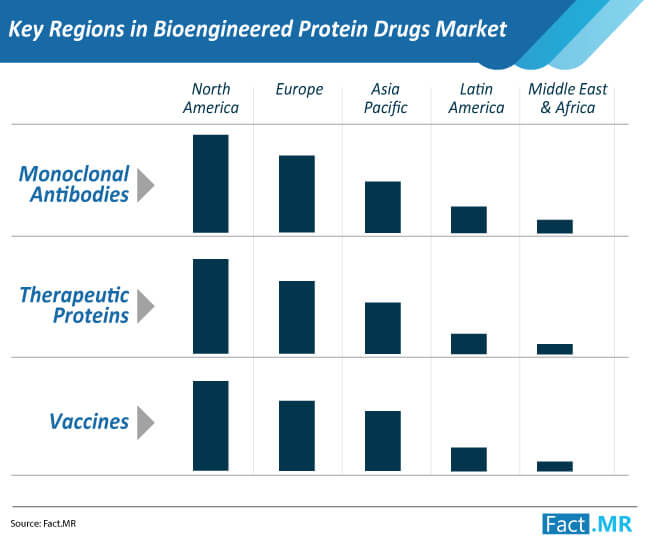
Bioengineered Protein Drugs Market – Assessment of Key Segments
Authors of this comprehensive study have classified the market into key segments for an in-depth study of the bioengineered protein drugs market. Categorisation of the bioengineered protein drugs market is based on drug type, disease, end user, and region. This detailed study also offers information about the incremental opportunity present in the bioengineered protein drugs market during the forecast period. Key segments considered while studying the bioengineered protein drugs market include:
| Drug Type |
Disease |
End User |
Region |
| Therapeutic Proteins |
Cancer |
Pharmaceutical and Biotechnology Companies |
North America |
| Monoclonal Antibodies |
Diabetes |
CROs Research Institutes |
Europe |
| Vaccines |
Autoimmune Disorder |
|
Asia Pacific |
|
Infectious Diseases |
|
Latin America |
|
Haematopoiesis |
|
Middle East & Africa |
|
CVD |
|
|
|
Neurodegenerative Diseases |
|
|
|
Others |
|
|
Revenue of the bioengineered protein drugs market has been evaluated in terms of US$ Mn for the period of 2020 to 2025. In addition to this, compound annual growth rate has been calculated for all key segments for the forecast period of 2020-2025, considering 2019 as the base year.
Authors of this exclusive study on the bioengineered protein drugs market have analysed key players, based on their financials, products, and strategies, in order to provide key detailed information into the competitive landscape. Key players operating in the bioengineered protein drugs market include Abbott Laboratories, Sanofi, Amgen Inc., Reliance Life Sciences Pvt. Ltd., Bayer AG, ProBioGen AG, Bayer AG, Panacea Biotec, Biocon Ltd., Novartis AG, Dr. Reddy’s Laboratories Ltd., Merck & Co., Inc., Eli Lily and Company, Johnson & Johnson (Janssen), F.Hoffmann-La Roche Ltd., GlaxoSmithKline PLC, and Fresenius Kabi.
Get Customization on this Research Report for specific research solutions:
https://www.factmr.com/connectus/sample?flag=RC&rep_id=4440
Prominent Players Rely on Generic Drugs and Strong Distribution Network
F.Hoffmann-La Roche, AbbVie, and Johnson & Johnson are the leading players, collectively accounting for around 60% share in the global bioengineered protein drugs market. The focal point of these players is on the development of branded drugs to treat myriad rare diseases. A substantial revenue of F.Hoffmann-La Roche is attributable to its blockbuster drugs – Avastin, Rituxan, and Herceptin, specifically developed for the treatment of cancer. Another leading player, AbbVie, holds a dominant position in the bioengineered protein drugs market, on account of its flagship product-Humira-which is considered as a breakthrough product to treat a number of conditions and diseases.
In contrast to the focus of leading players on the development of branded drugs, prominent and emerging players strive to ace the market race through generic formulations. Also, they take measured actions towards strengthening their distribution network to increase the accessibility of their products.
About Us:
Market research and consulting agency with a difference! That’s why 80% of Fortune 1,000 companies trust us for making their most critical decisions. While our experienced consultants employ the latest technologies to extract hard-to-find insights, we believe our USP is the trust clients have on our expertise. Spanning a wide range – from automotive & industry 4.0 to healthcare & retail, our coverage is expansive, but we ensure even the most niche categories are analyzed. Our sales offices in United States and Dublin, Ireland. Headquarter based in Dubai, UAE. Reach out to us with your goals, and we’ll be an able research partner.
Contact:
US Sales Office:
11140 Rockville Pike
Suite 400
Rockville, MD 20852
United States
Tel: +1 (628) 251-1583
Corporate Headquarter:
Unit No: AU-01-H Gold Tower (AU),
Plot No: JLT-PH1-I3A,
Jumeirah Lakes Towers,
Dubai, United Arab Emirates
Pharmaceutical and biotechnological companies are the leading end users in the bioengineered protein drugs market, as these companies constantly strive to increase the exclusivity to their portfolios. Collectively, these end users are projected to account for 53% of the market share by 2025. However, a shift from in-house R&D towards outsourced services is augmenting the importance of contract research organisations as end users in the bioengineered protein drugs market.
Increasing reliance on these organisations for drug discovery portends the growing adoption of bioengineered protein drugs to further improve their efficacy. In addition, governments of developed regions have extended financial aid to reduce the mortality rate, which is further likely to strengthen the pathway for the penetration of bioengineered protein drugs. Though the overall market movement looks prodigious, an analytical study published by Fact.MR foresees the advent of generic drugs as an impeder to the growth of the global bioengineered protein drugs market.
For detailed insights on enhancing your product footprint, request for a sample here- https://www.factmr.com/connectus/sample?flag=S&rep_id=4440
A subject matter expert at Fact.MR opines, “The healthcare industry is experiencing a shift from curative care towards preventive care, which is projected to create more sales prospects for bioengineered protein vaccines over therapeutic proteins.”
Key Highlights of Bioengineered Protein Drugs Market
- Patients suffering from cancer continue to remain the target audience of players in the bioengineered protein drugs market. Adoption of bioengineered protein drugs for treatment is projected to increase at a CAGR of around 7% during the forecast period (2020-2025). Also, a spurt in the sales of these drugs is expected, which is likely to be driven by individuals diagnosed with infectious diseases.
- High costs associated with bioengineered protein drugs, in tandem with their short shelf life, causes reluctance among patients towards their adoption. In addition, increasing development of biosimilar products that cost just 20% of branded drugs is expected to deter revenue potential of the bioengineered protein drugs market during the forecast period.
- Preference for oral route of drug administration for any medication is high among patients, on the back of convenience and ease. However, bioengineered protein drugs are difficult to administer in an oral formulation, on account of gastric acid formed in the stomach, which could impede their adoption rate.
Need more information about Report Methodology? Click here-https://www.factmr.com/connectus/sample?flag=RM&rep_id=4440
Bioengineered Protein Drugs Market – Assessment of Key Segments
Authors of this comprehensive study have classified the market into key segments for an in-depth study of the bioengineered protein drugs market. Categorisation of the bioengineered protein drugs market is based on drug type, disease, end user, and region. This detailed study also offers information about the incremental opportunity present in the bioengineered protein drugs market during the forecast period. Key segments considered while studying the bioengineered protein drugs market include:
| Drug Type | Disease | End User | Region |
| Therapeutic Proteins | Cancer | Pharmaceutical and Biotechnology Companies | North America |
| Monoclonal Antibodies | Diabetes | CROs Research Institutes | Europe |
| Vaccines | Autoimmune Disorder | | Asia Pacific |
| Infectious Diseases | | Latin America |
| Haematopoiesis | | Middle East & Africa |
| CVD | | |
| Neurodegenerative Diseases | | |
| Others | | |
Revenue of the bioengineered protein drugs market has been evaluated in terms of US$ Mn for the period of 2020 to 2025. In addition to this, compound annual growth rate has been calculated for all key segments for the forecast period of 2020-2025, considering 2019 as the base year.
Authors of this exclusive study on the bioengineered protein drugs market have analysed key players, based on their financials, products, and strategies, in order to provide key detailed information into the competitive landscape. Key players operating in the bioengineered protein drugs market include Abbott Laboratories, Sanofi, Amgen Inc., Reliance Life Sciences Pvt. Ltd., Bayer AG, ProBioGen AG, Bayer AG, Panacea Biotec, Biocon Ltd., Novartis AG, Dr. Reddy’s Laboratories Ltd., Merck & Co., Inc., Eli Lily and Company, Johnson & Johnson (Janssen), F.Hoffmann-La Roche Ltd., GlaxoSmithKline PLC, and Fresenius Kabi.
Get Customization on this Research Report for specific research solutions:
https://www.factmr.com/connectus/sample?flag=RC&rep_id=4440
Prominent Players Rely on Generic Drugs and Strong Distribution Network
F.Hoffmann-La Roche, AbbVie, and Johnson & Johnson are the leading players, collectively accounting for around 60% share in the global bioengineered protein drugs market. The focal point of these players is on the development of branded drugs to treat myriad rare diseases. A substantial revenue of F.Hoffmann-La Roche is attributable to its blockbuster drugs – Avastin, Rituxan, and Herceptin, specifically developed for the treatment of cancer. Another leading player, AbbVie, holds a dominant position in the bioengineered protein drugs market, on account of its flagship product-Humira-which is considered as a breakthrough product to treat a number of conditions and diseases.
In contrast to the focus of leading players on the development of branded drugs, prominent and emerging players strive to ace the market race through generic formulations. Also, they take measured actions towards strengthening their distribution network to increase the accessibility of their products.
About Us:
Market research and consulting agency with a difference! That’s why 80% of Fortune 1,000 companies trust us for making their most critical decisions. While our experienced consultants employ the latest technologies to extract hard-to-find insights, we believe our USP is the trust clients have on our expertise. Spanning a wide range – from automotive & industry 4.0 to healthcare & retail, our coverage is expansive, but we ensure even the most niche categories are analyzed. Our sales offices in United States and Dublin, Ireland. Headquarter based in Dubai, UAE. Reach out to us with your goals, and we’ll be an able research partner.
Contact:
US Sales Office:
11140 Rockville Pike
Suite 400
Rockville, MD 20852
United States
Tel: +1 (628) 251-1583
Corporate Headquarter:
Unit No: AU-01-H Gold Tower (AU),
Plot No: JLT-PH1-I3A,
Jumeirah Lakes Towers,
Dubai, United Arab Emirates