Headlines
EU Open to Tariff Talks, but Firm on Own Laws, Says Senior Legislator
Published by Global Banking & Finance Review®
Posted on February 14, 2025
2 min readLast updated: January 26, 2026
Add as preferred source on Google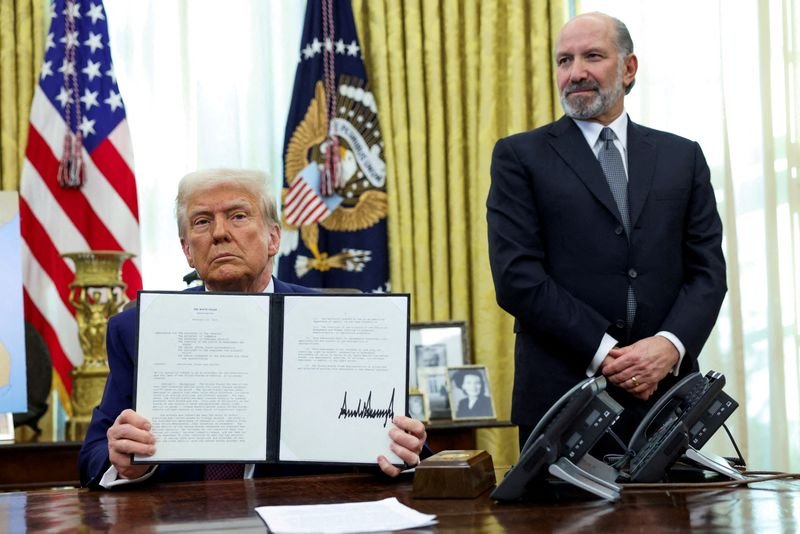
Published by Global Banking & Finance Review®
Posted on February 14, 2025
2 min readLast updated: January 26, 2026
Add as preferred source on GoogleThe EU is open to tariff negotiations with the US but insists on maintaining its regulatory autonomy, especially in taxation and digital platforms.
By Philip Blenkinsop
BRUSSELS (Reuters) - The European Union can negotiate on reciprocal tariffs with the United States but will not give up its right to regulate in areas such as taxation and digital platforms, the chair of the European Parliament's trade committee said on Friday.
U.S. President Donald Trump has tasked his economics team with devising plans for reciprocal tariffs on every country that imposes tariffs on U.S. imports, also targeting value-added taxes or digital services taxes on U.S. companies.
Bernd Lange, a German Social Democrat, said the European Union and the United States could realistically negotiate on import tariff rates.
"On the pure tariffs, we can discuss. And perhaps we can discuss also buying some American products like LNG or whatever," he said.
"But the legislation and the right to legislate inside the European Union in the interest of the consumer and the people is not on the negotiating table," he continued.
Lange said undue U.S. pressure to change EU laws could push the European Union to use its Anti-Coercion Instrument, which has a wide range of countermeasures, including limiting trade in services, in which the United States has a trade surplus.
A White House fact sheet criticised Canada and France for their taxes on digital service operators. U.S. Vice President JD Vance on Tuesday said that "massive" EU regulations on artificial intelligence could strangle the technology. The White House also highlighted the difference between EU tariffs on car imports of 10%, compared with the U.S. rate of 2.5%.
Lange said it was important to view the auto sector as a whole. While the United States has a lower rate for cars, it has a 25% duty for light-duty trucks, including pick-ups, vans and SUVs.
"In the United States, these are the most sold vehicles... We have to put everything on the table," Lange said.
(Reporting by Philip Blenkinsop; Editing by Sharon Singleton)
The article discusses EU's openness to tariff negotiations with the US while maintaining its regulatory rights.
Reciprocal tariffs are duties imposed by one country in response to tariffs imposed by another country.
The EU insists on its right to regulate digital services taxes despite US opposition.
Explore more articles in the Headlines category