
Search
00
GBAF Logo
trophy
Top StoriesInterviewsBusinessFinanceBankingTechnologyInvestingTradingVideosAwardsMagazinesHeadlinesTrends

Subscribe to our newsletter

Get the latest news and updates from our team.

Global Banking & Finance Review®

Global Banking & Finance Review® - Subscribe to our newsletter

Company

    GBAF Logo
    • About Us
    • Advertising and Sponsorship
    • Profile & Readership
    • Contact Us
    • Latest News
    • Privacy & Cookies Policies
    • Terms of Use
    • Advertising Terms
    • Issue 81
    • Issue 80
    • Issue 79
    • Issue 78
    • Issue 77
    • Issue 76
    • Issue 75
    • Issue 74
    • Issue 73
    • Issue 72
    • Issue 71
    • Issue 70
    • View All
    • About the Awards
    • Awards Timetable
    • Awards Winners
    • Submit Nominations
    • Testimonials
    • Media Room
    • FAQ
    • Asset Management Awards
    • Brand of the Year Awards
    • Business Awards
    • Cash Management Banking Awards
    • Banking Technology Awards
    • CEO Awards
    • Customer Service Awards
    • CSR Awards
    • Deal of the Year Awards
    • Corporate Governance Awards
    • Corporate Banking Awards
    • Digital Transformation Awards
    • Fintech Awards
    • Education & Training Awards
    • ESG & Sustainability Awards
    • ESG Awards
    • Forex Banking Awards
    • Innovation Awards
    • Insurance & Takaful Awards
    • Investment Banking Awards
    • Investor Relations Awards
    • Leadership Awards
    • Islamic Banking Awards
    • Real Estate Awards
    • Project Finance Awards
    • Process & Product Awards
    • Telecommunication Awards
    • HR & Recruitment Awards
    • Trade Finance Awards
    • The Next 100 Global Awards
    • Wealth Management Awards
    • Travel Awards
    • Years of Excellence Awards
    • Publishing Principles
    • Ownership & Funding
    • Corrections Policy
    • Editorial Code of Ethics
    • Diversity & Inclusion Policy
    • Fact Checking Policy
    Original content: Global Banking and Finance Review - https://www.globalbankingandfinance.com

    A global financial intelligence and recognition platform delivering authoritative insights, data-driven analysis, and institutional benchmarking across Banking, Capital Markets, Investment, Technology, and Financial Infrastructure.

    Copyright © 2010-2026 - All Rights Reserved. | Sitemap | Tags

    Editorial & Advertiser disclosure

    Global Banking & Finance Review® is an online platform offering news, analysis, and opinion on the latest trends, developments, and innovations in the banking and finance industry worldwide. The platform covers a diverse range of topics, including banking, insurance, investment, wealth management, fintech, and regulatory issues. The website publishes news, press releases, opinion and advertorials on various financial organizations, products and services which are commissioned from various Companies, Organizations, PR agencies, Bloggers etc. These commissioned articles are commercial in nature. This is not to be considered as financial advice and should be considered only for information purposes. It does not reflect the views or opinion of our website and is not to be considered an endorsement or a recommendation. We cannot guarantee the accuracy or applicability of any information provided with respect to your individual or personal circumstances. Please seek Professional advice from a qualified professional before making any financial decisions. We link to various third-party websites, affiliate sales networks, and to our advertising partners websites. When you view or click on certain links available on our articles, our partners may compensate us for displaying the content to you or make a purchase or fill a form. This will not incur any additional charges to you. To make things simpler for you to identity or distinguish advertised or sponsored articles or links, you may consider all articles or links hosted on our site as a commercial article placement. We will not be responsible for any loss you may suffer as a result of any omission or inaccuracy on the website.

    1. Home
    2. >Finance
    3. >Oil shipping rates surge after US sanctions hit availability
    Finance

    Oil Shipping Rates Surge After US Sanctions Hit Availability

    Published by Global Banking & Finance Review®

    Posted on January 14, 2025

    4 min read

    Last updated: January 27, 2026

    Add as preferred source on Google
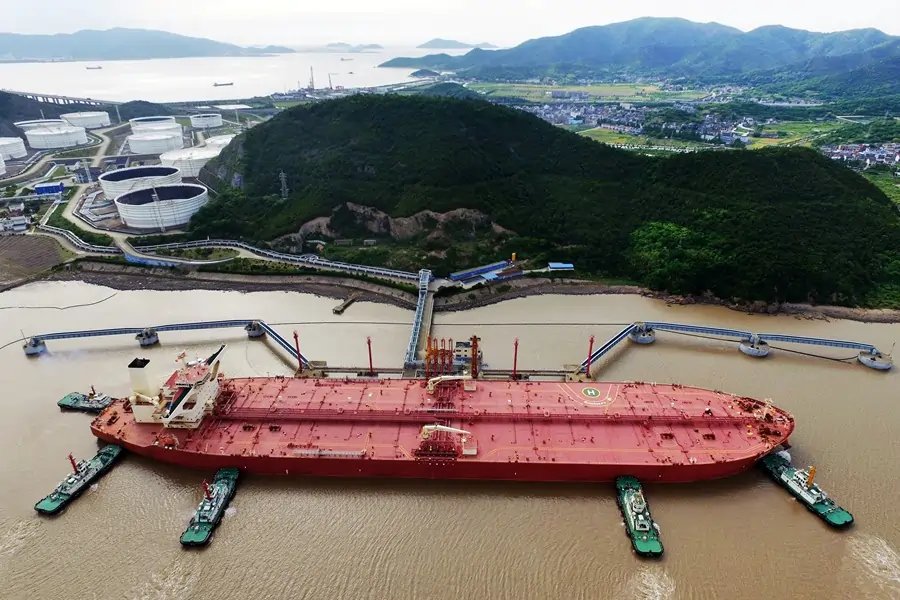
    Image of supertankers navigating the seas, highlighting the surge in oil shipping rates following US sanctions on Russian oil. This illustrates the impact on global oil supply chains as countries like China and India seek alternative sources.
    Supertankers transporting oil amidst rising shipping rates due to US sanctions - Global Banking & Finance Review
    Why waste money on news and opinion when you can access them for free?

    Take advantage of our newsletter subscription and stay informed on the go!

    Subscribe

    Quick Summary

    US sanctions on Russia's oil industry have led to a surge in shipping rates as traders seek alternative routes to China and India.

    Oil Shipping Rates Skyrocket Following US Sanctions

    By Florence Tan and Siyi Liu

    SINGAPORE (Reuters) -Supertanker freight rates jumped after the U.S. expanded sanctions on Russia's oil industry, sending traders rushing to book vessels to ship supply from other countries to China and India, shipbrokers and traders said.

    Chinese and Indian refiners are seeking alternative fuel supplies as they adapt to severe new U.S. sanctions on Russian producers and tankers designed to curb the world No. 2 oil exporter's revenue due to its war in Ukraine.

    Many of the newly-targeted vessels, part of a so-called shadow fleet that seeks to avoid Western restrictions, have been used to ship oil to India and China, which snapped up cheap Russian supply that was banned in Europe following Moscow's invasion of Ukraine. Some of the tankers have also shipped oil from Iran, which is under sanctions as well.

    The latest U.S. action means an estimated 35% of some 669 shadow fleet tankers involved in shipping Russian, Venezuelan and Iranian oil have been hit with sanctions by either the U.S., Britain or European Union, according to analysis by Lloyd’s List Intelligence.

    Freight rates for Very Large Crude Carriers (VLCCs), that can carry 2 million barrels of crude across major routes, jumped after Unipec, the trading arm of Asia's largest refiner Sinopec, chartered several supertankers on Friday, the sources said.

    Unipec also last week snapped up several sweet crude cargoes from Europe and Africa, including 2 million barrels of Norwegian Johan Sverdrup, 1 million barrels of Senegal's Sangomar crude, Ghana's Ten Blend, Angolan Djeno and others, traders said.

    "They must look for alternative crudes. That is the primary driver for the rally (in freight rates)," said Anoop Singh, global head of shipping research at Oil Brokerage.

    Middle East crude benchmarks rallied for a second session on Tuesday, with premiums for Dubai, Oman and Murban rising towards $4 a barrel to Dubai quotes, the highest levels in more than a year, Reuters data showed. [CRU/M]

    Since Friday, Unipec has booked eight tankers to ship oil from the Middle East, tanker booking data showed on Tuesday.

    Other Chinese buyers, Petrochina and Rongsheng, each fixed a tanker to transport Middle East crude, the data showed.

    On a daily basis, a shipbroker said, the rate on the Middle East to China route, known as TD3C, has surged 39% since Friday to $37,800, the highest since October.

    Shipping rates for Russian oil shipments to China have also jumped following the sanctions.

    Freight rates for Aframax-sized tankers to ship ESPO blend crude from Russia's Pacific port of Kozmino to North China more than doubled on Monday to $3.5 million as shipowners requested massive premiums due to limited tonnages available for that route, S&P Global Commodity Insights data showed.

    Adding to tightness, sanctioned tankers are stranded outside China's eastern Shandong province, unable to discharge following a ban imposed by Shandong Port Group before Washington's announcement on Friday.

    Tanker analytics firm Vortexa estimated that more than 85% of Russian crude voyages into Shandong were conducted by the newly-sanctioned tankers.

    Analysts said tanker availability could tighten further as traders look for unsanctioned vessels to ship Russian and Iranian crude.

    "We expect new ships will be pulled into the shadow fleet over the coming months, many of which will be new to this trade, tightening supply in the non-sanctioned freight market," Kpler analysts said in a note.

    The rate for VLCCs from the Middle East to Singapore has gained the most, up worldscale (WS) 11.15 from Friday to WS61.35, another shipbroker said. Worldscale is an industry tool to calculate freight charges.

    On the Middle East to China route, freight jumped to WS59.70, up WS10.40, while the rate for VLCCs carrying West African oil to China rose WS9.55 to WS61.44, the second shipbroker said.

    Shipping crude from the U.S. Gulf to China will now cost $6.82 million per voyage, up $360,000 since last week, he said.

    (Reporting by Florence Tan, Siyi Liu, Chen Aizhu and Jeslyn Lerh in Singapore, Jonathan Saul in London; Additional reporting by Ron Bousso in London; Editing by Sonali Paul, Jan Harvey and Mark Potter)

    Key Takeaways

    • •US sanctions on Russia increase oil shipping rates.
    • •China and India seek alternative oil supplies.
    • •Shadow fleet vessels face new restrictions.
    • •VLCC freight rates rise significantly.
    • •Tanker availability tightens due to sanctions.

    Frequently Asked Questions about Oil shipping rates surge after US sanctions hit availability

    1What is the main topic?

    The article discusses the surge in oil shipping rates following new US sanctions on Russia's oil industry.

    2Why are shipping rates increasing?

    Rates are rising due to US sanctions limiting the availability of vessels for oil transport, especially to China and India.

    3What is the impact of the sanctions?

    Sanctions have reduced the availability of shadow fleet tankers, leading to increased shipping costs and tighter vessel supply.

    More from Finance

    Explore more articles in the Finance category

    Image for Exclusive-At least 40% of Russia's oil export capacity halted, Reuters calculations show
    Exclusive-At Least 40% of Russia's Oil Export Capacity Halted, Reuters Calculations Show
    Image for Hungary's opposition Tisza party widens lead over Orban's Fidesz, poll says
    Hungary's Opposition Tisza Party Widens Lead Over Orban's Fidesz, Poll Says
    Image for Germany's Merz says public finances cannot offset all price rises from Iran war
    Germany's Merz Says Public Finances Cannot Offset All Price Rises From Iran War
    Image for Brazil unveils first supersonic fighter jet assembled in country
    Brazil Unveils First Supersonic Fighter Jet Assembled in Country
    Image for Netanyahu seeks to avoid snap vote as Iran war gives no boost in polls
    Netanyahu Seeks to Avoid Snap Vote as Iran War Gives No Boost in Polls
    Image for Volkswagen's Skoda brand to end China sales this year
    Volkswagen's Skoda Brand to End China Sales This Year
    Image for Climate investors give BP until April 1 to include resolution, threaten court
    Climate Investors Give Bp Until April 1 to Include Resolution, Threaten Court
    Image for Lille to host EU customs authority charged with fixing e-commerce parcel problems
    Lille to Host EU Customs Authority Charged With Fixing E-Commerce Parcel Problems
    Image for Russia evacuates 163 more staff from Iran's Bushehr nuclear plant, 300 remain
    Russia Evacuates 163 More Staff From Iran's Bushehr Nuclear Plant, 300 Remain
    Image for Hungary's Orban faces pivotal battle against ally-turned-foe
    Hungary's Orban Faces Pivotal Battle Against Ally-Turned-Foe
    Image for German finance minister sets out sweeping reform plans to boost growth
    German Finance Minister Sets Out Sweeping Reform Plans to Boost Growth
    Image for ISS urges investors to reject UniCredit pay report over CEO award
    Iss Urges Investors to Reject UniCredit Pay Report Over CEO Award
    View All Finance Posts
    Previous Finance PostLme on Last Lap to Approve Hong Kong as Location for Metal Storage
    Next Finance PostChina Hopes EU Can Be 'trustworthy' Cooperation Partner, Xi Says