Search
00
GBAF Logo
trophy
Top StoriesInterviewsBusinessFinanceBankingTechnologyInvestingTradingVideosAwardsMagazinesHeadlinesTrends

Subscribe to our newsletter

Get the latest news and updates from our team.

Global Banking & Finance Review®

Global Banking & Finance Review® - Subscribe to our newsletter

Company

    GBAF Logo
    • About Us
    • Profile
    • Privacy & Cookie Policy
    • Terms of Use
    • Contact Us
    • Advertising
    • Submit Post
    • Latest News
    • Research Reports
    • Press Release
    • Awards▾
      • About the Awards
      • Awards TimeTable
      • Submit Nominations
      • Testimonials
      • Media Room
      • Award Winners
      • FAQ
    • Magazines▾
      • Global Banking & Finance Review Magazine Issue 79
      • Global Banking & Finance Review Magazine Issue 78
      • Global Banking & Finance Review Magazine Issue 77
      • Global Banking & Finance Review Magazine Issue 76
      • Global Banking & Finance Review Magazine Issue 75
      • Global Banking & Finance Review Magazine Issue 73
      • Global Banking & Finance Review Magazine Issue 71
      • Global Banking & Finance Review Magazine Issue 70
      • Global Banking & Finance Review Magazine Issue 69
      • Global Banking & Finance Review Magazine Issue 66
    Top StoriesInterviewsBusinessFinanceBankingTechnologyInvestingTradingVideosAwardsMagazinesHeadlinesTrends

    Global Banking & Finance Review® is a leading financial portal and online magazine offering News, Analysis, Opinion, Reviews, Interviews & Videos from the world of Banking, Finance, Business, Trading, Technology, Investing, Brokerage, Foreign Exchange, Tax & Legal, Islamic Finance, Asset & Wealth Management.
    Copyright © 2010-2026 GBAF Publications Ltd - All Rights Reserved. | Sitemap | Tags | Developed By eCorpIT

    Editorial & Advertiser disclosure

    Global Banking & Finance Review® is an online platform offering news, analysis, and opinion on the latest trends, developments, and innovations in the banking and finance industry worldwide. The platform covers a diverse range of topics, including banking, insurance, investment, wealth management, fintech, and regulatory issues. The website publishes news, press releases, opinion and advertorials on various financial organizations, products and services which are commissioned from various Companies, Organizations, PR agencies, Bloggers etc. These commissioned articles are commercial in nature. This is not to be considered as financial advice and should be considered only for information purposes. It does not reflect the views or opinion of our website and is not to be considered an endorsement or a recommendation. We cannot guarantee the accuracy or applicability of any information provided with respect to your individual or personal circumstances. Please seek Professional advice from a qualified professional before making any financial decisions. We link to various third-party websites, affiliate sales networks, and to our advertising partners websites. When you view or click on certain links available on our articles, our partners may compensate us for displaying the content to you or make a purchase or fill a form. This will not incur any additional charges to you. To make things simpler for you to identity or distinguish advertised or sponsored articles or links, you may consider all articles or links hosted on our site as a commercial article placement. We will not be responsible for any loss you may suffer as a result of any omission or inaccuracy on the website.

    Home > Headlines > Analysis-Resource-poor Japan was girding for an AI energy surge. DeepSeek raised the stakes
    Headlines

    Analysis-Resource-poor Japan was girding for an AI energy surge. DeepSeek raised the stakes

    Published by Global Banking & Finance Review®

    Posted on January 30, 2025

    4 min read

    Last updated: January 26, 2026

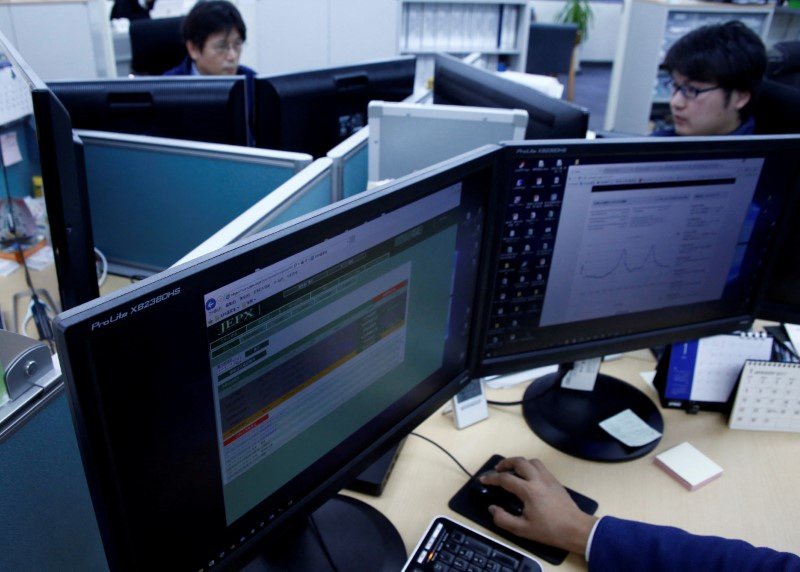
    This image illustrates the rising influence of AI on Japan's energy sector, highlighting DeepSeek's potential to reshape electricity demand, as discussed in the article.
    AI energy surge in Japan analyzed with DeepSeek's impact on electricity demand - Global Banking & Finance Review
    Why waste money on news and opinion when you can access them for free?

    Take advantage of our newsletter subscription and stay informed on the go!

    Subscribe

    Tags:innovationrenewable energytechnologyfinancial markets

    Quick Summary

    Japan's energy plan faces a challenge as DeepSeek's AI models alter power demand forecasts, potentially increasing electricity needs.

    Japan's AI Energy Surge: DeepSeek Raises the Stakes

    By John Geddie and Katya Golubkova

    TOKYO (Reuters) - Weeks after Japan revealed details of a landmark energy plan partly designed to keep up with an expected AI surge, the shock rise of Chinese startup DeepSeek has upended conventional wisdom over the sector's future power demands.

    It was only last year that Tokyo abandoned its long-held forecasts that its future electricity needs would dwindle with its ageing population, and began accounting for higher AI-driven usage from data centres and microchip makers.

    In late December, the government released a draft of its basic energy plan, a major policy document reviewed about every three years, projecting electricity generation would rise between 10-20% by 2040 and citing those factors.

    While Tokyo will not likely hurry to rejig its forecasts, DeepSeek's seemingly leaner models have triggered a broad rethink of AI energy needs that the world's most resource-poor major economy would be remiss to ignore, analysts say.

    "It would be risky (for Japan) not to take this seriously," said Andrew DeWit, professor at Rikkyo University's School of Economic Policy Studies in Tokyo.

    DeepSeek last week launched a free AI assistant that it says uses less data at a fraction of the cost of incumbent services. By Monday, it had overtaken U.S. rival ChatGPT in downloads from Apple's App Store, triggering a global selloff in tech shares.

    Power producers, whose stock prices had outperformed on expectations of ballooning electricity demands needed to scale AI technologies, also took a hit as investors weighed DeepSeek's seemingly more energy-efficient models.

    But as analysts parse DeepSeek's potential impact, an alternative view has emerged: its success may lower the barrier to entry in a sector dominated by Silicon Valley giants and catalyse higher overall electricity demand from new AI entrants.

    This is a potential headache for Japan, which produces just 13% of its energy needs from domestic sources, the second lowest ratio of all 38 OECD countries, besting only Luxembourg.

    "If AI proves to be cheaper to develop than currently expected, that would accelerate its mass introduction rather than slow it. If anything, it would increase power demand in the country," said Yuriy Humber, CEO of K.K. Yuri Group, an energy research and consulting firm based in Tokyo.

    "Japanese officials have taken their time to adjust power demand forecasts even though the AI boom was apparent two years ago. I expect they will monitor the new developments carefully," he said.

    The trade ministry, which oversees the country's long-term energy planning, did not immediately respond to a request for comment.

    A senior official at the ministry, speaking on condition of anonymity, said he had been briefed on DeepSeek in December and concluded that, while impressive, the technology did not advance existing systems. He said he thought markets had over-reacted.

    Tepco, Japan's biggest power company by sales, said it was monitoring DeepSeek's potential impact on power demand closely but has yet to assess its full effects.

    'BITTER LEARNING'

    Japan's grid monitor had for years predicted future electricity demand would decline gradually due to the adoption of energy-efficient equipment and a shrinking population.

    But in 2024, it revised its outlook to reflect an overall increase, largely driven by an expected 5.14 million kWh of new power demand from data centres and chip plants by 2034.

    Senior government officials have also cited AI-related energy needs as a reason to restart nuclear reactors, a sensitive subject in a country that suffered one of the world's worst nuclear disasters when the Fukushima plant was crippled by a massive earthquake and tsunami in 2011.

    Mika Ohbayashi, director at Renewable Energy Institute in Tokyo, said that DeepSeek's emergence was a "clear indication" that AI may become more efficient and demand less power.

    She criticised Japanese officials linking AI energy needs to the promotion of nuclear power, and said the government needs to do more to develop renewable energy instead.

    The jury is out over whether DeepSeek's models could trigger more or less AI energy demands in the future, and analysts say its technology needs to be rigorously stress tested before countries rush to change their plans.

    But Japan has had a bitter experience of getting its energy preparations for technology wrong in the past, said Rikkyo University's DeWit, pointing to the years before its economic bubble burst in the late 1980s.

    "Japan was a chip leader at the time and they figured they were going to become number one and they built out the power system. And of course, as they entered the 90s as the bubble collapsed, that power demand did not eventuate.

    "They've had a bitter learning. So it behoves the policy makers to take this seriously," he said.

    (Reporting by John Geddie and Katya Golubkova; Additional reporting by Tim Kelly and Yuka Obayashi; Editing by Kim Coghill)

    Key Takeaways

    • •Japan's energy plan anticipates a rise in AI-driven power demand.
    • •DeepSeek's AI models challenge conventional energy forecasts.
    • •Tokyo may need to adjust its energy forecasts due to AI.
    • •DeepSeek's success could increase overall electricity demand.
    • •Japan's reliance on domestic energy sources is critically low.

    Frequently Asked Questions about Analysis-Resource-poor Japan was girding for an AI energy surge. DeepSeek raised the stakes

    1What is the main topic?

    The article discusses Japan's energy plan in light of AI-driven power demand, particularly focusing on the impact of DeepSeek's AI models.

    2How does DeepSeek affect Japan's energy forecasts?

    DeepSeek's efficient AI models challenge Japan's energy forecasts, suggesting potential increases in electricity demand.

    3What is Japan's current energy challenge?

    Japan faces a challenge in meeting rising AI-driven power demands with limited domestic energy production.

    More from Headlines

    Explore more articles in the Headlines category

    Image for Treasury's Bessent says further Russian sanctions depend on peace talks
    Treasury's Bessent says further Russian sanctions depend on peace talks
    Image for Norway police open investigation into ex-prime minister Jagland over Epstein files
    Norway police open investigation into ex-prime minister Jagland over Epstein files
    Image for Danone recalls batches of infant formula in Austria, Germany
    Danone recalls batches of infant formula in Austria, Germany
    Image for Italian police to get new arrest powers after Turin riot
    Italian police to get new arrest powers after Turin riot
    Image for US, China opt out of joint declaration on AI use in military
    US, China opt out of joint declaration on AI use in military
    Image for Trump says US retains right to 'militarily secure' Chagos airbase
    Trump says US retains right to 'militarily secure' Chagos airbase
    Image for European corporate outlook improves, but earnings overall expected to fall
    European corporate outlook improves, but earnings overall expected to fall
    Image for Trump endorses Hungary's Orban for re-election ahead of April poll
    Trump endorses Hungary's Orban for re-election ahead of April poll
    Image for Environmental groups sue EU commission over Portugal's lithium mine
    Environmental groups sue EU commission over Portugal's lithium mine
    Image for Slovak prosecutor ends probe over fighter jets, air defence systems donated to Ukraine
    Slovak prosecutor ends probe over fighter jets, air defence systems donated to Ukraine
    Image for Olympics-No credible threats to Milano Cortina Games, U.S. security official says
    Olympics-No credible threats to Milano Cortina Games, U.S. security official says
    Image for Elton John's husband accuses Daily Mail of homophobia in UK privacy trial
    Elton John's husband accuses Daily Mail of homophobia in UK privacy trial
    View All Headlines Posts
    Previous Headlines PostBritain implements delayed third phase of post-Brexit border rules
    Next Headlines PostTrump energy pick Wright to speak to conservative event in London, group says