
Headlines
Syria's New Leaders Turn to Islamic Law in Effort to Rebuild Assad's Police
Published by Global Banking & Finance Review®
Posted on January 23, 2025
9 min readLast updated: January 27, 2026
Add as preferred source on Google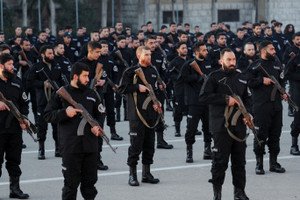
Published by Global Banking & Finance Review®
Posted on January 23, 2025
9 min readLast updated: January 27, 2026
Add as preferred source on GoogleSyria's new leaders use Islamic law to train police, aiming to instill morality and fill a security gap post-Assad. This move raises concerns about societal rifts and international relations.
By Amina Ismail and Khalil Ashawi
DAMASCUS (Reuters) - Syria's new authorities are using Islamic teachings to train a fledgling police force, a move officers say aims to instil a sense of morality as they race to fill a security vacuum after dismantling ousted president Bashar al-Assad's notoriously corrupt and brutal security forces.
Police they brought into Damascus from their former rebel enclave in the northwestern region of Idlib are asking applicants about their beliefs and focusing on Islamic sharia law in the brief training they offer recruits, according to five senior officers and application forms seen by Reuters.
Ensuring stability and winning the trust of people across Syria will be crucial for the Sunni Muslim Islamists to cement their rule. But the move to put religion at the centre of policing risks seeding new rifts in a diverse country awash with guns after 13 years of civil war and alienating foreign governments they have been trying to woo, regional analysts warn.
"There are many Syrians who will find this concerning," said Aron Lund, a fellow at Century International, a Middle East-focused think tank, when asked about Reuters' findings. "Not just minorities - Christians, Alawites, Druze - but also quite a lot of Sunni Muslims in places like Damascus and Aleppo, where you have a fairly large secular, cosmopolitan population that's not interested in religious law."
The religious foundations of the police training are also making Western governments wonder how big a role Islam might play in Syria's constitution, which the former rebel faction now in power plans to revise, said one diplomat, who was not authorized to speak publicly on the matter.
"It's not a good sign, but it also depends on how strictly it will be implemented," the diplomat told Reuters.
Syria's de facto leader, Ahmed al-Sharaa, has sought to reassure Western officials and Middle Eastern governments worried about their own Islamist movements that his faction has renounced its former ties to al Qaeda and will rule with moderation, including protecting minorities.
The group, Hayat Tahrir al-Sham (HTS), has a track record of pragmatism, backing away from enforcing some strict interpretations of Islamic law in areas it controlled during the war.
Syria's Interior Ministry, which oversees police, and Information Ministry did not respond to questions about the focus on religion in police recruitment and training, or whether there are plans to incorporate Islamic law into the legal code.
The senior police officers interviewed by Reuters said the intention was not to impose it on the general population but rather to teach recruits ethical behaviour.
Hamza Abu Abdel Rahman, who helped set up the group's police academy in Idlib before transferring to Damascus, said an understanding of religious matters, "what is permissible and what is not", is crucial for recruits to "act justly".
POLICE DISBANDED
Assad's myriad security forces were widely feared for tyrannical and predatory behaviour, ranging from arrests of dissidents who ended up tortured or killed to demanding bribes to resolve minor infractions.
The extent of public anger against them was evident in the days after Assad was toppled on Dec. 8. Most of the capital's police stations were ransacked by looters, with equipment and records pillaged or destroyed.
Police said half of the roughly 20 stations have since reopened, but they are each staffed by around 10 officers, mostly brought in from Idlib, instead of their previous complement of 100-150 officers.
At three stations visited by Reuters in late December, a handful of exhausted officers was trying to deal with a welter of issues, from complaints of rampant crime to a garbage collector who brought in two bags of hand grenades he found on the street.
When the rebels seized power, they announced they were disbanding Assad's Interior Ministry and security forces, including the police.
More than 200,000 people have registered to join a new police service they are establishing, said Hesham Hilal, who is leading courses for recruits at a police academy in Damascus.
Police who defected to the rebel side before Assad's fall are welcome to apply for the new force, the senior officers told Reuters.
Those who did not have been asked to complete a "reconciliation" process, including signing a document accepting the change of regime and handing in their gun. It is not yet clear whether any will be allowed to join the new force.
Seven officers who manage police stations or are involved in recruitment said they needed more members and welcomed applications from people of any faith.
But the focus on sharia has been a deterrent to some.
A 45-year-old Christian, who worked in Assad's traffic police, said he wouldn't apply for the new force even if he could. Speaking on condition of anonymity for safety reasons, he said he was worried that even people in lowly roles like his would be seen as part of Assad's regime, and that the focus on Islamic law meant there would be discrimination against those of other faiths.
Hundreds of residents took part in a demonstration in the capital, Damascus, in December to call for secular governance and equal rights for women.
"No one is against Islam, but we are certainly against a religious rule based on specific texts and hadiths" - sayings and actions attributed to Islam's Prophet Mohammad - one participant, Ali al-Aqabani, said when asked about using sharia in policing.
Aqabani, 50, is Muslim himself but said Damascus is "diverse in its sects and doctrines."
At the same time, Syria's new authorities need to train police quickly, because Assad's forces "evaporated completely, and stability is a major, major issue," said Lund, of Century International. "Going with what they know and have always done may be the easiest way of doing that."
In Idlib, which HTS has dominated since 2017, the group initially carried out patrols to enforce strict Islamist views on public behaviour, said Aaron Zelin, a senior fellow at the Washington Institute for Near East Policy.
Women were detained for travelling without a male family member or immodest attire, a U.N. commission of inquiry said in a 2021 report.
But morality patrols were later scaled back because residents did not like them, Zelin said.
Sharaa, HTS' leader, has spoken out against a rigid approach to public behaviour, but the coalition he leads includes members regarded as more extreme, adding to the fears of minorities.
THE NEW FORCE
The scale of the crisis confronting the new force was starkly apparent at the police stations Reuters visited in December.
At the Damascus police directorate, and at Marja and Kafr Sousa stations, rooms were strewn with paperwork, broken glass, abandoned uniforms, ammunition and smashed furniture. Officers had cleared a few rooms to work from, but the computers and telephones had been stolen.
Outside Marja and Kafr Sousa, there were green and white police cars with broken windows and flat tires.
At the Damascus directorate, the new police chief, Basel Faoury, and operations head Abu Ahmed al-Sukkar said they had barely slept since arriving from Idlib.
Sukkar had a mattress propped up against a cupboard because he was sleeping in his office. At least 20 people entered with requests, problems or complaints in the two hours Reuters was there.
A businessman wanted approval to hire a private security company to protect his restaurants and shopping malls from thieves. Others wanted permission to organise neighbourhood protection groups. Police said they mostly welcomed this for now but would not allow such groups to bear arms.
All the senior officers Reuters interviewed said they expected staffing levels to improve and more stations to reopen as recruitment and training expand this year.
On Jan. 14, the Damascus academy celebrated the graduation of around 500 police cadets who paraded before their trainers in new black uniforms. When Reuters visited in December, a dozen men were lined up at the academy's gates to interview for the force.
One of them, 19-year-old Zakaria al-Hiji from the eastern city of Deir al-Zor, said he had disliked Assad's rule but liked what he had seen so far of the new authorities. He said his cousins, who already worked for HTS, had told him the police would offer good salaries.
Application forms seen by Reuters contain a section on "beliefs, orientations and opinions" in which recruits are asked to provide their "referential authority," an expression often used for Muslim religious leaders who are considered authoritative by different sects.
Although religion has long been listed on identity documents in Syria, it was not usual under Assad to specify the school of thought.
Three HTS officials, speaking on condition of anonymity because they were not authorised to address media, said the question is intended to help identify applicants who will need closer scrutiny, especially Alawites, who come from the same sect as Assad and may have had ties to his regime.
Houmaida Antara al-Matar, who was interviewing police defectors who want their old jobs back at the Damascus academy, said it was "merely a routine question" and was not intended to discriminate against any faith or sect, including Alawites.
New recruits are receiving just 10 days of instruction, mostly in weapons handling and Islamic law, trainers and recent graduates told Reuters.
When security improves, the aim is to increase the training to nine months, using a system introduced by the rebels in Idlib, said Ahmed Latouf, who headed the police academy in the former rebel enclave before he was appointed police chief in Aleppo.
The religious instruction offered recruits includes principles of Islamic jurisprudence, the biography of Prophet Mohammad and rules of conduct, Latouf said by phone from Aleppo.
The head of Marja police station in Damascus, Ayman Abu Taleb, said he was worried that many Syrians would see HTS as extremists and would not accept their rule. But he said he did not understand why their reliance on Islam would be a concern.
"The religion that respects human rights the most is Islam," he said.
(Amina Ismail and Khalil Ashawi reported from Damascus; Additional reporting by Maya Gebeily in Beirut and Angus McDowall in London; Writing by Angus McDowall; Editing by Alexandra Zavis)
The article discusses Syria's new leaders using Islamic law to train a police force, aiming to instill morality and fill a security gap after Assad's regime.
The focus on Islamic law in policing may create new societal rifts in Syria's diverse population and affect international relations.
Ahmed al-Sharaa seeks to reassure that the new leadership will rule with moderation, protecting minorities and renouncing ties to extremist groups.
Explore more articles in the Headlines category