Headlines
Dancing in Damascus: Syrians Cling to Culture Under Islamists' Rule
Published by Global Banking & Finance Review®
Posted on February 22, 2025
7 min readLast updated: February 27, 2026
Add as preferred source on Google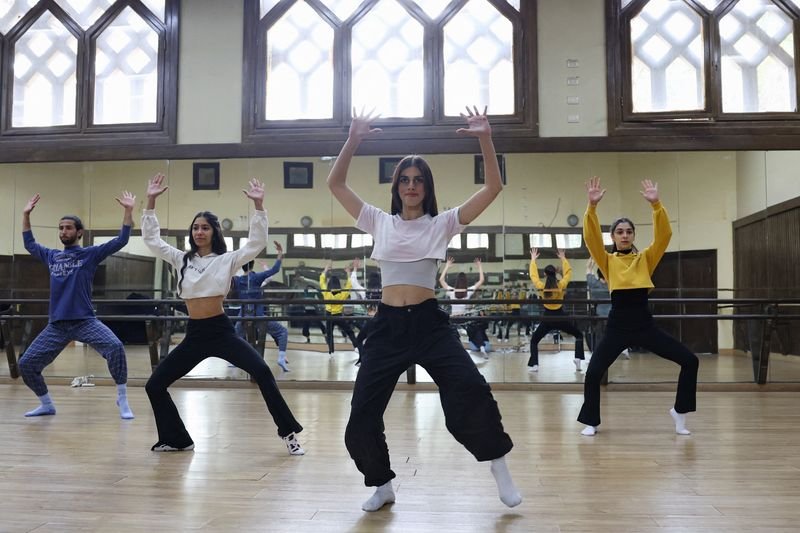
Published by Global Banking & Finance Review®
Posted on February 22, 2025
7 min readLast updated: February 27, 2026
Add as preferred source on GoogleSyrians in Damascus are maintaining cultural activities like concerts and art under new Islamist governance, with authorities showing unexpected support.
By Khalil Ashawi, Kinda Makieh, Yamam Al Shaar and Tom Perry
DAMASCUS (Reuters) - On a wintry night in Damascus, hundreds of people packed into a courtyard in the Old City, dancing and singing during a joyful evening of music - a concert held with the approval of Syria's new, Islamist-led authorities.
It was the kind of scene that the singer, Mahmoud al-Haddad, feared might be in jeopardy as Islamist rebels led by Hayat Tahrir al-Sham (HTS), a group with origins in global jihad, were advancing on the city in December. "Everyone was afraid," Haddad said. "Would we be able to have a concert or not?"
The downfall of President Bashar al-Assad ended more than five decades of iron-fisted rule by his family and their secular Baath Party, making way for HTS, which emerged from a group that was affiliated to al Qaeda until it cut ties in 2016.
Islamists have taken different approaches to artistic expression and cultural heritage in territories they've ruled. The Taliban in Afghanistan have been among the most hardline, stunning the world in 2001 by obliterating the giant Buddhas of Bamiyan. In 2024, the Taliban's morality ministry reported destroying 21,328 musical instruments over the previous year.
But in Syria, following a brief interlude after the fall of Assad, cultural life in Damascus has, for now, flickered back to life – with a nod from the new authorities.
Before resuming his concerts in January at the Beit Jabri restaurant, Haddad first checked with the new authorities: "The answer was surprising to us - 'You can have your concert, and if you want protection, we will send you protection'," he said.
Anas Zeidan, an official in the interim administration responsible for museums and antiquities, told Reuters that the government welcomed "all types and forms of art" and encourages the preservation of cultural heritage.
"The government is not against art. The government encourages art. Art is part of humanity," he said.
Indeed, an exhibition by a prominent artist reopened last month at the National Museum, including a large painting with images of bare skin. At the Higher Institute of Dramatic Arts, students of contemporary dance have resumed rehearsing. Syria's National Symphony Orchestra held its first performance since the fall of Assad, who ran a secular police state but allowed space for art and culture that didn't challenge his rule.
HTS seized power after their fighters burst out of their enclave in Idlib province in northern Syria, where they had governed since 2017, and toppled Assad after more than 13 years of civil war. The group was formally dissolved in January when its leader, Ahmed al-Sharaa, was declared interim president.
The Islamism of Syria's new rulers has surfaced in several ways since they swept southwards and into Damascus in December: recruits to a new police force are being schooled in Islamic law, for example, while proposed changes to school textbooks have emphasized Muslim identity.
More secular-minded Syrians and members of minority communities have been kept on edge by incidents of intolerance - a Christmas tree was torched in the western city of Hama, an attack swiftly condemned by the new ruling authorities.
Attempts to encourage conservative norms - posters have gone up encouraging women to cover up - have also stirred concerns.
IDEOLOGICAL SHIFT
Sharaa, declared Syria's interim head of state in January, has stressed a message of inclusivity as he has tightened his grip and sought recognition from Western and Arab governments, who would be alarmed by any slide towards extremism.
Andrew Hammond, a senior lecturer in Islamic Studies at the Australian National University, said the approach suggests the authorities are ready to challenge the hardline fringe which view the arts as a waste of a believer's time and fuelling unwholesome behaviour, and could become a point of contention.
Such hardliners often have a particular aversion to depictions of the human form as well as music, which they see as in competition with Quranic recitation, he said.
The ruling group's policy also reflect an ideological shift from its roots in transnational jihad towards a more moderate form of political Islam based on Syrian nationalism, in tune with the approach of Islamist groups in other Arab states such as Egypt, Jordan and Tunisia, as well as Turkey, he added.
Hammond said he didn't expect the new administration to adopt radical policies that could alienate Western and regional states, as well as many Syrians themselves, meaning they wouldn't crack down on the arts.
"There might be some who object to it ... but it's not going to be stopped or banned," he said.
In Idlib under HTS, playing loud music in cars once led to a reprimand at checkpoints, water pipe smoking was banned, and mannequin heads in shop windows were often removed or covered, reflecting hardline aversion to depictions of the human form.
HTS relaxed efforts to enforce conservative behaviour in Idlib several years ago, withdrawing morality police from the streets - part of what experts see as part of its gradual shift towards the mainstream.
Syrian artist Sara Shamma said some artists had been worried that creative freedoms could be curbed with the change of government. "They thought that some people might not accept sculptures or figurative work," she told Reuters, referring to art based on real-life objects like humans and animals.
But nothing like that happened, said Shamma, adding she was optimistic about the future.
'A GOOD SIGN - FOR NOW'
Her retrospective exhibition, "Sara Shamma: Echoes of 12 years", opened at the National Museum in November before Assad was toppled. Her first exhibition in Syria since leaving early in 2012 early in the civil war, it comprises works from each of the years she spent outside the country.
The museum closed for a month following Assad's ouster, reopening in January with her 27 works still on display.
Aaron Zelin, an expert on HTS at the Washington Institute for Near East policy, said the group was "trying to avoid making waves with anyone while they're still consolidating control".
In Idlib, HTS had "come to realise they have to work within the reality of society rather than trying to force something upon society in a way that might cause a backlash", he said.
"The question is if and when they feel comfortable enough, whether they might reverse things or cancel certain types of activity they deem outside of the bounds of their world view," Zelin said. "For now, it's a good sign."
Since assuming power, Sharaa has sidestepped media questions about whether sharia law should be applied in Syria, whether women would have to wear the hijab and whether alcohol would be permitted, saying such issues were matters for the new constitution and not for individuals to decide.
He has also dismissed comparisons with Afghanistan, saying Syrian society was very different and its government would fit with its culture and history.
Mustafa Ali, a prominent sculptor, also said artists' initial apprehension about the new government had subsided.
Works on display at his atelier in the Old City include a life size horse sculpted from metal and an imposing bust carved from wood. Ali explained how Islamic art generally tends towards abstract forms such as geometric decoration, but also noted that figurative art had continued throughout key phases of Islamic history, such as the Umayyad Caliphate, which ruled the Islamic empire from Damascus from 661 to 750.
Following Assad's ouster, the Higher Institute of Dramatic Arts closed for several days, with Islamist fighters deployed around the building and the adjacent Damascus Opera House.
Director of dance Nawras Othman said many students had feared the Islamists would ban dance altogether but were calmed by representatives of HTS who came to meet them in December: "They'd been worried, but afterwards they relaxed a lot."
Ghazal al-Badr, a 22-year-old in her fourth year of study, said dancers decided to return to class within a few days to demonstrate the importance of their art to the new authorities and their determination to continue.
"We felt a sense of responsibility – that now it's time for us to step up, to be present," she said.
(Additional reporting by Timour Azhari and Firas Makdesi in Damascus; Writing by Tom Perry; Editing by Pravin Char)
Cultural life in Damascus has flickered back to life following the fall of President Bashar al-Assad, with new authorities allowing concerts and artistic expressions.
The interim administration has welcomed various forms of art and encourages the preservation of cultural heritage, stating that 'art is part of humanity.'
Secular-minded Syrians are on edge due to incidents of intolerance and attempts to enforce conservative norms, such as encouraging women to cover up.
Experts suggest that HTS is trying to avoid alienating society by working within its realities rather than imposing hardline restrictions on cultural activities.
Initially apprehensive, many artists like Sara Shamma expressed optimism as they found that creative freedoms were not curtailed under the new government.
Explore more articles in the Headlines category