Finance
Lagarde's Statement After ECB Policy Meeting
Published by Global Banking & Finance Review®
Posted on January 30, 2025
8 min readLast updated: March 19, 2026
Add as preferred source on Google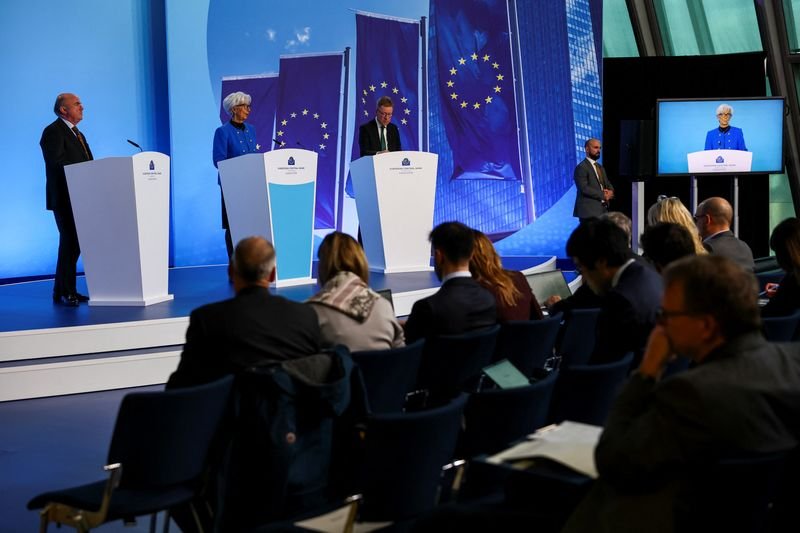
Published by Global Banking & Finance Review®
Posted on January 30, 2025
8 min readLast updated: March 19, 2026
Add as preferred source on GoogleChristine Lagarde announces ECB's rate cut to tackle inflation, aiming for a 2% target. Economic activity is weak, but recovery signs are emerging.
(Reuters) - Following is the text of European Central Bank President Christine Lagarde's statement after the bank's policy meeting on Thursday:
Link to statement on ECB-POLICY-3fdc7763-f2c0-4c30-b494-8614852eaf43>ECB-POLICY-KAZIMIR-00b06d9b-4b99-46ce-a2aa-458d8eb2d993>ECB-POLICY-3fdc7763-f2c0-4c30-b494-8614852eaf43>ECB-POLICY-CENTENO-a52f21b9-8975-4dc5-9a21-8c5e8267aa43>ECB-POLICY-3fdc7763-f2c0-4c30-b494-8614852eaf43>ECB-POLICY-KAZIMIR-00b06d9b-4b99-46ce-a2aa-458d8eb2d993>ECB-POLICY-3fdc7763-f2c0-4c30-b494-8614852eaf43>ECB website:
Good afternoon, the Vice-President and I welcome you to our press conference.
The Governing Council today decided to lower the three key ECB-POLICY-3fdc7763-f2c0-4c30-b494-8614852eaf43>ECB-POLICY-KAZIMIR-00b06d9b-4b99-46ce-a2aa-458d8eb2d993>ECB-POLICY-3fdc7763-f2c0-4c30-b494-8614852eaf43>ECB-POLICY-CENTENO-a52f21b9-8975-4dc5-9a21-8c5e8267aa43>ECB-POLICY-3fdc7763-f2c0-4c30-b494-8614852eaf43>ECB-POLICY-KAZIMIR-00b06d9b-4b99-46ce-a2aa-458d8eb2d993>ECB-POLICY-3fdc7763-f2c0-4c30-b494-8614852eaf43>ECB interest rates by 25 basis points. In particular, the decision to lower the deposit facility rate – the rate through which we steer the monetary policy stance – is based on our updated assessment of the inflation outlook, the dynamics of underlying inflation and the strength of monetary policy transmission.
The disinflation process is well on track. Inflation has continued to develop broadly in line with the staff projections and is set to return to our two per cent medium-term target in the course of this year. Most measures of underlying inflation suggest that inflation will settle at around our target on a sustained basis. Domestic inflation remains high, mostly because wages and prices in certain sectors are still adjusting to the past inflation surge with a substantial delay. But wage growth is moderating as expected, and profits are partially buffering the impact on inflation.
Our recent interest rate cuts are gradually making new borrowing less expensive for firms and households. At the same time, financing conditions continue to be tight, also because our monetary policy remains restrictive and past interest rate hikes are still transmitting to the stock of credit, with some maturing loans being rolled over at higher rates. The economy is still facing headwinds but rising real incomes and the gradually fading effects of restrictive monetary policy should support a pick-up in demand over time.
We are determined to ensure that inflation stabilises sustainably at our two per cent medium-term target. We will follow a data-dependent and meeting-by-meeting approach to determining the appropriate monetary policy stance. In particular, our interest rate decisions will be based on our assessment of the inflation outlook in light of the incoming economic and financial data, the dynamics of underlying inflation and the strength of monetary policy transmission. We are not pre-committing to a particular rate path.
The decisions taken today are set out in a press release available on our website.
I will now outline in more detail how we see the economy and inflation developing and will then explain our assessment of financial and monetary conditions.
Economic activity
The economy stagnated in the fourth quarter, according to Eurostat’s preliminary flash estimate. It is set to remain weak in the near term. Surveys indicate that manufacturing continues to contract while services activity is expanding. Consumer confidence is fragile, and households have not yet drawn sufficient encouragement from rising real incomes to significantly increase their spending.
Nevertheless, the conditions for a recovery remain in place. While the labour market has softened over recent months it continues to be robust, with the unemployment rate staying low, at 6.3 per cent in December. A solid job market and higher incomes should strengthen consumer confidence and allow spending to rise. More affordable credit should also boost consumption and investment over time. Provided trade tensions do not escalate, exports should support the recovery as global demand rises.
Fiscal and structural policies should make the economy more productive, competitive and resilient. We welcome the European Commission’s Competitiveness Compass, which provides a concrete roadmap for action. It is crucial to follow up, with further concrete and ambitious structural policies, on Mario Draghi’s proposals for enhancing European competitiveness and on Enrico Letta’s proposals for empowering the Single Market. Governments should implement their commitments under the EU’s economic governance framework fully and without delay. This will help bring down budget deficits and debt ratios on a sustained basis, while prioritising growth-enhancing reforms and investment.
Inflation
Annual inflation increased to 2.4 per cent in December, up from 2.2 per cent in November. As in the previous two months, the increase was expected and primarily reflected past sharp drops in energy prices falling out of the calculation. Along with a month-on-month increase in December, this led energy prices slightly higher on an annual basis, after four consecutive declines. Food price inflation edged down to 2.6 per cent and goods inflation to 0.5 per cent. Services inflation edged up to 4.0 per cent.
Most underlying inflation indicators have been developing in line with a sustained return of inflation to our medium-term target. Domestic inflation, which closely tracks services inflation, has remained high, as wages and some services prices are still adjusting to the past inflation surge with a substantial delay. At the same time, recent signals point to continued moderation in wage pressures and to the buffering role of profits.
We expect inflation to fluctuate around its current level in the near term. It should then settle sustainably at around the two per cent medium-term target. Easing labour cost pressures and the continuing impact of our past monetary policy tightening on consumer prices should help this process. While market-based indicators of inflation compensation have largely reversed the declines observed in the autumn, most measures of longer-term inflation expectations continue to stand at around 2 per cent.
Risk assessment
The risks to economic growth remain tilted to the downside. Greater friction in global trade could weigh on euro area growth by dampening exports and weakening the global economy. Lower confidence could prevent consumption and investment from recovering as fast as expected. This could be amplified by geopolitical risks, such as Russia’s unjustified war against Ukraine and the tragic conflict in the Middle East, which could disrupt energy supplies and further weigh on global trade. Growth could also be lower if the lagged effects of monetary policy tightening last longer than expected. It could be higher if easier financing conditions and falling inflation allow domestic consumption and investment to rebound faster.
Inflation could turn out higher if wages or profits increase by more than expected. Upside risks to inflation also stem from the heightened geopolitical tensions, which could push energy prices and freight costs higher in the near term and disrupt global trade. Moreover, extreme weather events, and the unfolding climate crisis more broadly, could drive up food prices by more than expected. By contrast, inflation may surprise on the downside if low confidence and concerns about geopolitical events prevent consumption and investment from recovering as fast as expected, if monetary policy dampens demand by more than expected, or if the economic environment in the rest of the world worsens unexpectedly. Greater friction in global trade would make the euro area inflation outlook more uncertain.
Financial and monetary conditions
Market interest rates in the euro area have risen since our December meeting, partly mirroring higher rates in global financial markets. While financing conditions remain tight, our interest rate cuts are gradually making it less expensive for firms and households to borrow.
The average interest rate on new loans to firms declined to 4.5 per cent in November, while the cost of issuing market-based debt remained at 3.6 per cent. The average rate on new mortgages edged down to 3.5 per cent.
Growth in bank lending to firms rose to 1.5 per cent in December, up from 1.0 per cent in November, amid a strong monthly flow. Growth in debt securities issued by firms moderated to 3.2 per cent in annual terms. Mortgage lending continued to rise gradually but remained muted overall, with an annual growth rate of 1.1 per cent.
Credit standards for business loans tightened again in the fourth quarter of 2024, having broadly stabilised over the previous four quarters, as reported in our latest bank lending survey. The renewed tightening mainly reflected banks becoming more concerned about the risks faced by their customers and less willing to take on risks themselves. Demand for loans by firms increased slightly in the fourth quarter but remained weak overall. Credit standards for mortgages were broadly unchanged, after three quarters of easing, while the demand for mortgages again increased strongly, mainly because of more attractive interest rates.
Conclusion
The Governing Council today decided to lower the three key ECB-POLICY-3fdc7763-f2c0-4c30-b494-8614852eaf43>ECB-POLICY-KAZIMIR-00b06d9b-4b99-46ce-a2aa-458d8eb2d993>ECB-POLICY-3fdc7763-f2c0-4c30-b494-8614852eaf43>ECB-POLICY-CENTENO-a52f21b9-8975-4dc5-9a21-8c5e8267aa43>ECB-POLICY-3fdc7763-f2c0-4c30-b494-8614852eaf43>ECB-POLICY-KAZIMIR-00b06d9b-4b99-46ce-a2aa-458d8eb2d993>ECB-POLICY-3fdc7763-f2c0-4c30-b494-8614852eaf43>ECB interest rates by 25 basis points. In particular, the decision to lower the deposit facility rate – the rate through which we steer the monetary policy stance – is based on our updated assessment of the inflation outlook, the dynamics of underlying inflation and the strength of monetary policy transmission. We are determined to ensure that inflation stabilises sustainably at our two per cent medium-term target. We will follow a data-dependent and meeting-by-meeting approach to determining the appropriate monetary policy stance. In particular, our interest rate decisions will be based on our assessment of the inflation outlook in light of the incoming economic and financial data, the dynamics of underlying inflation and the strength of monetary policy transmission. We are not pre-committing to a particular rate path.
In any case, we stand ready to adjust all of our instruments within our mandate to ensure that inflation stabilises sustainably at our medium-term target and to preserve the smooth functioning of monetary policy transmission.
We are now ready to take your questions.
(Compiled by Toby Chopra)
The main topic is the ECB's decision to lower interest rates and its implications for inflation and the Eurozone economy.
The ECB plans to manage inflation by adjusting interest rates based on economic data, aiming for a 2% target.
The Eurozone economy is weak with contracting manufacturing, but a strong labor market and rising incomes may support recovery.
Explore more articles in the Finance category