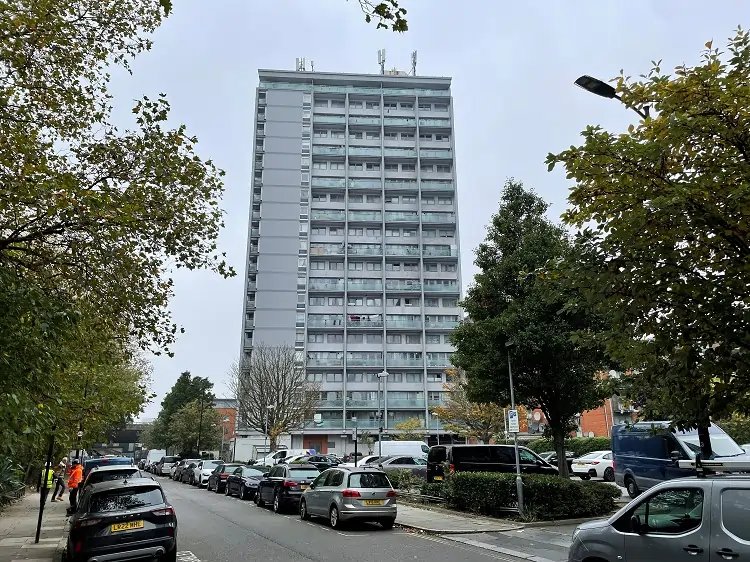
UK Firms Escape Penalties in Grenfell Cladding Scandal
By Tom Bergin
LONDON (Reuters) - When the deadly Grenfell Tower blaze in 2017 led to revelations that high-rise public housing buildings across Britain were wrapped in flammable cladding, the government vowed the building contractors responsible would pay for their negligence.
Seven years on, contractors who fitted cladding panels that didn't meet fire-safety standards in place when installed have largely escaped financial liability, according to a Reuters review of more than 100 buildings.
Cladding is a skin of insulating materials applied to the walls of a new or existing building to improve its thermal performance. The Grenfell Tower blaze, which killed 72 people, raised public awareness that thousands of buildings in the UK were clad in flammable materials.
To quickly tackle the problem, the British government put up much of the money to allow the replacement of flammable cladding on subsidized public housing. Then, to recoup the taxpayer money spent, the housing ministry said it would work with the buildings’ owners to encourage legal claims against contractors who installed defective cladding.
Under UK law, the owner of a property that has been refurbished in a way that doesn't meet building regulations in place at the time, can sue the contractors and designers responsible, and in some cases the manufacturer of the materials used, for the costs of remediation.
The Reuters review identified 103 public housing buildings, owned by 26 local councils and not-for-profit housing associations, which had cladding of a type deemed to be non-compliant by the government, the courts or the public inquiry into the Grenfell fire.
Only five of the 26 owners - responsible for 25 of the 103 buildings - said they had sought some compensation from the companies that installed their flammable cladding. Three were successful in recovering some money while two are still in mediation with contractors in cases that haven't reached court. The total money recovered comprised just 13% of the over 260 million pounds ($325 million) it cost to reclad the 103 buildings, Reuters found.
Four lawyers who have represented both building owners and contractors in post-Grenfell cladding cases told Reuters that the rules of the funds the government created to disburse money for remediation inadvertently created disincentives to sue errant builders. If public housing bodies win litigation against contractors, the proceeds must be given to the government, under the rules, while the legal costs of a losing battle have to be shouldered alone.
The National Housing Federation, which represents social housing bodies across Britain, said the government could have increased the number of claims by covering litigation costs and providing legal guidance.
Reuters found no evidence of a deliberate plan by the government to discourage compensation claims.
Still, the Ministry of Housing, Communities and Local Government said its national recladding scheme prioritised rapid removal of dangerous cladding over the recovery of costs from contractors. It declined to comment on the criticism that its rules disincentivized lawsuits against those responsible or answer questions about the level of claims against construction firms. It also didn't comment on whether it would amend the rules of its cladding schemes to facilitate more claims to help recoup taxpayer funds.
The Reuters analysis is the first broad review of the extent to which contractors have contributed to the recladding of public housing buildings to which they attached non-compliant cladding, and reveals how few cases have been brought against contractors.
Giles Grover, co-lead of the End Our Cladding Scandal campaign, which comprises groups representing tenants affected by the national crisis, said the low number of compensation claims identified by Reuters came as a disappointment.
"It's frustrating that contractors have not paid to fix these blocks, despite all the promises from the government that it would make them pay," he added.
NATIONWIDE SCANDAL
The Grenfell disaster in Kensington killed dozens of residents when the building's plastic-filled exterior panels turned a small fire in one apartment into an inferno that consumed the 24-storey high rise in West London.
The government said in 2017 the panels used did not comply with the regulations in place when installed. The official inquiry, which published its final report in September, agreed and noted that none of the companies responsible even argued that the cladding met the regulatory requirements.
After the fire, inspections by local councils and housing associations, which provide subsidized housing to lower-income families, found that similar panels, and other forms of cladding that didn't meet fire regulations, had been installed on buildings across the country.
Over 700 public housing buildings had their cladding replaced following the Grenfell disaster, while about 1,800 still need to be made safe, the government's spending watchdog said in November. The total cost of remediation will exceed 4 billion pounds, according to government figures.
The watchdog noted that as the public housing owners don't have the cash available, the government may be on the hook for the bill.
The alternative to public money being used to pay for the remediation is for the owners to sue the building contractors, designers or manufacturers responsible for the original cladding, said Chris Leadbetter, a lawyer at Clyde & Co. which has defended building contractors in dozens of cladding cases.
Reuters identified buildings in need of recladding using council statements, media reports, social media posts and other sources. Reuters then established whether the original cladding was compliant when installed using statutory financial accounts, satellite imagery, planning documents, freedom of information requests, minutes of local council meetings and discussions with dozens of lawyers, housing groups and local councils.
Suzannah Nichol, chief executive of Build UK, which represents building companies, said the industry accepted that non-compliant cladding should not have been installed but said contractors did not have the financial strength to cover all the costs of remediation alone. She said others including designers and product manufacturers were partly to blame and so, should share the financial burden.
"I don't think any business is going to step up and pay for something if it's not confident that it's accountable," she added.
Construction firms responsible for the non-compliant cladding identified by Reuters, on the 103 public housing buildings reviewed, included British-based companies Willmott Dixon and Alumet, Paris-listed Bouygues SA and United Living, which is owned by U.S. private equity group Apollo. Willmott Dixon, Bouygues and Apollo declined to comment on cladding contracts while Alumet didn't respond to queries.
'HUGE DISINCENTIVE' TO SUE
Most public housing providers declined to outline their reasons for pursuing or not pursuing cases.
But the rules of the cladding remediation funds the government set up following the Grenfell disaster offer an answer, according to the National Housing Federation and lawyers interviewed.
The government established the first of its funds in 2018 to ensure cash-strapped public housing owners could make their buildings safe as fast as possible. The government said it expected fund recipients to pursue reasonable cases against contractors and repay the government with any compensation received.
The oldest fund, created in 2018, has so far handed out 300 million pounds of taxpayer money to councils and housing associations, official data show. This fund has received less than a million pounds back as a result of compensation claims, according to a Freedom of Information request.
In one case, Sheffield Council decided against suing London-listed Morgan Sindall, which the council said installed non-compliant polyethylene core panels - like the ones used at Grenfell - on its Hanover Tower building.
The council said in a 2020 report that there might be "a public interest" in establishing the facts in court, but that since the government had already covered the costs of recladding, spending money on what would likely be expensive litigation was not in council taxpayers' interests.
Eric Johnstone, legal director at Brodies solicitors in Edinburgh, said the fact the government didn’t fund litigation but wanted to collect the proceeds of any litigation created a "huge disincentive" for social housing providers to sue.
Morgan Sindall told Reuters it didn't believe it had any liability regarding Hanover Tower, without elaborating. Sheffield declined to comment on the case.
Just three of the 26 building owners reviewed by Reuters said they had actually received compensation from contractors in respect of cladding claims. The first, Newport City Homes Housing Association in south Wales, initiated its claim before the government established its first cladding fund. Newport City Homes sought the cost of making three buildings safe from building contractor Wates Group, which had installed polyethylene core panels as part of a 2013 refurbishment. The housing association received a 4-million-pound settlement from Wates without even going to court, its accounts show.
Wates said it did not knowingly install non-compliant products. It declined to answer questions about Newport or any of the 23 other high rise buildings where Reuters found the company installed polyethylene-core cladding panels.
John Cawthorne, a former firefighter who has lived in Hanover Tower in Sheffield for 33 years, told Reuters he was furious that builders who installed non-compliant cladding on blocks like his across the country weren't being held to account. Cawthorne said tenants were haunted by the fact that they could have died as easily as the victims of Grenfell.
"I live on the 15th floor of this building. I'm right on top," the 68-year-old said. "The same thing could have happened here. There's no question about that. We could have all died."
(Reporting by Tom Bergin; Editing by Pravin Char)